
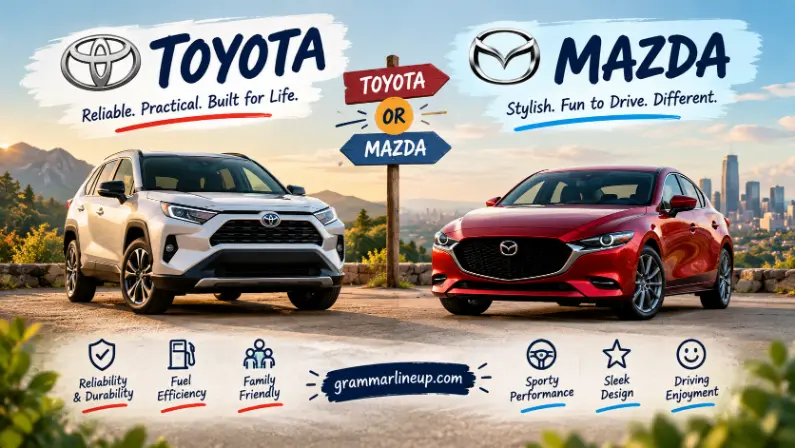
Choosing between Toyota or Mazda can feel like a small decision until you start comparing what really matters. Both brands have built strong reputations, but they approach driving in noticeably different ways.
Toyota is often associated with practicality, efficiency, reliability, and a broad range of everyday vehicles. Mazda, meanwhile, is known for emphasizing driving feel, refined styling, and a more engaging experience behind the wheel.
That does not mean one brand is automatically right for everyone. Your ideal choice can depend on your budget, driving habits, desired features, comfort preferences, fuel economy needs, and how much you value driving enjoyment. Even two vehicles in similar price ranges can feel quite different once you look beyond the badge.
In this guide, we’ll compare Toyota or Mazda in clear, everyday language. We’ll look at their strengths, differences, typical ownership considerations, and the kinds of drivers each brand may suit. By the end, you’ll have a clearer picture of what separates these two popular automakers and what to consider before making your choice.
Toyota and Mazda are both Japanese automakers, but they emphasize different strengths. Toyota has a broader lineup and a particularly strong reputation for reliability and hybrid technology, while Mazda focuses heavily on driving dynamics, interior design, and compact vehicles. The right comparison depends on the specific models, powertrains, budget, and priorities involved.
Toyota or Mazda: Quick Answer
If you are searching “Toyota or Mazda,” you are usually trying to decide which brand makes more sense for your next car.
The important thing is that this is not really a simple brand-versus-brand question. A Toyota Camry and Mazda3, for instance, serve different purposes. A Toyota RAV4 Hybrid and Mazda CX-50 Hybrid are much closer competitors.
Still, there are some useful differences.
Toyota has a large lineup covering compact cars, hybrids, SUVs, trucks, and other vehicle types. Its current U.S. lineup also includes a wide range of hybrid models. Toyota lists the 2026 Camry at up to 52 city/49 highway MPG and the 2026 Corolla Hybrid at an estimated 53 city/46 highway MPG.
Mazda has a smaller lineup, with an emphasis on sedans, hatchbacks, crossovers, SUVs, and the MX-5 Miata sports car. Its 2026 range includes models such as the Mazda3, CX-30, CX-5, CX-50, CX-50 Hybrid, CX-70, CX-90, and MX-5 Miata.
So the better question is:
Which Toyota and Mazda models are you actually comparing, and what matters most to you?
Toyota vs Mazda at a Glance
| Factor | Toyota | Mazda |
|---|---|---|
| Reliability reputation | Very strong | Generally strong, but varies by model |
| Hybrid selection | Broad | More limited |
| Driving character | Comfortable and practical across much of lineup | Often emphasizes engaging handling |
| SUV selection | Very broad | Smaller but varied |
| Sports-car option | GR models | MX-5 Miata |
| Fuel-efficient choices | Extensive hybrid lineup | Gas and hybrid choices |
| Truck selection | Tacoma and Tundra | No traditional pickup equivalent |
| Interior emphasis | Practicality and usability | Design and driver-focused feel |
| Safety | Strong on several models | Strong on several models |
| Best comparison method | Model-to-model | Model-to-model |
This table is intentionally broad. Brand-level generalizations can hide major differences between individual vehicles.
What Is the Main Difference Between Toyota and Mazda?
The biggest difference is product philosophy and lineup breadth.
Toyota is one of the larger mainstream automotive brands in the U.S. Its lineup covers everyday sedans, hybrids, crossovers, SUVs, pickups, and performance-oriented vehicles. Toyota also has substantial hybrid representation, including the Camry, Corolla Hybrid, Prius, Crown, and several hybrid SUVs and trucks.
Mazda takes a somewhat narrower approach.
Its lineup includes compact models such as the Mazda3 and CX-30, larger SUVs such as the CX-70 and CX-90, and the two-seat MX-5 Miata. Mazda also offers hybrid and plug-in hybrid models, although its electrified lineup is smaller than Toyota’s.
That difference matters because shoppers may have very different needs.
Someone looking for a fuel-efficient hybrid sedan has many Toyota options. Someone looking for a small vehicle with a more driver-oriented character might naturally investigate Mazda.
Toyota or Mazda for Reliability?
Reliability is one of the most important reasons people search this comparison.
Current Consumer Reports data gives Toyota a particularly strong position. In its 2026 brand information, Consumer Reports lists Toyota first in new-car reliability and second in used-car reliability among the brands it evaluates.
Mazda’s results are more mixed.
Consumer Reports’ 2026 brand information places Mazda 14th in new-car reliability and third in used-car reliability. It also notes that several Mazda models have historically performed well, while the newer CX-70 and CX-90 have experienced reliability problems in its survey data.
This is an important distinction:
A brand reputation is not the same thing as the reliability of every current model.
For example, Consumer Reports expects the 2026 Mazda3 to be more reliable than the average new car, while its prediction for the redesigned 2026 CX-5 is around average.
Toyota also has individual models with different histories, so a buyer should check the exact year and model rather than relying entirely on the badge.
Toyota or Mazda for Fuel Economy?
Toyota has a clear advantage in breadth of hybrid choices.
For 2026, Toyota lists:
- Camry: 52 city / 49 highway MPG
- Corolla Hybrid: 53 city / 46 highway MPG
- Corolla Cross Hybrid: 46 city / 39 highway MPG
- Grand Highlander Hybrid: 36 city / 32 highway MPG
- Highlander Hybrid: 35 city / 35 highway MPG
These are manufacturer-published EPA estimates and vary by configuration.
Mazda has expanded its hybrid offerings as well.
The 2026 Mazda CX-50 Hybrid is listed at 38 MPG combined, while Mazda also offers plug-in hybrid versions of the CX-70 and CX-90.
So if your priority is having many hybrid choices across different vehicle categories, Toyota gives you more options.
If you want a Mazda specifically, however, the CX-50 Hybrid gives shoppers a current hybrid crossover option.
Toyota or Mazda for Driving Feel?
This is where the comparison becomes less about specifications and more about what you enjoy behind the wheel.
Mazda has long emphasized driving dynamics as part of its brand identity. Its lineup includes vehicles designed around responsive handling, including the Mazda3 and MX-5 Miata.
The MX-5 Miata is particularly different from Toyota’s mainstream lineup because it is a lightweight two-seat sports car. Mazda lists the 2026 MX-5 Miata and MX-5 Miata RF in its current U.S. lineup.
Toyota also has performance-oriented vehicles, including the GR Corolla, along with trucks such as the Tacoma and Tundra.
That means the choice depends heavily on the type of vehicle you want.
For an ordinary commuter, the difference may be less dramatic than it sounds. For someone who genuinely enjoys driving, the exact model, engine, transmission, tires, suspension, and drivetrain matter far more than the logo on the hood.
Toyota or Mazda for SUVs?
Both brands have substantial SUV offerings, but their lineups are structured differently.
Toyota offers models ranging from smaller crossovers to large SUVs and pickup trucks. Its current U.S. lineup includes vehicles such as the Corolla Cross, RAV4, Highlander, Grand Highlander, 4Runner, Sequoia, and others. Toyota also offers several SUV hybrids.
Mazda’s SUV lineup includes the CX-30, CX-5, CX-50, CX-50 Hybrid, CX-70, and CX-90. The CX-90 can seat up to eight, according to Mazda’s current model information.
For example, a shopper comparing compact SUVs might look at the Mazda CX-5 and Toyota RAV4 family.
Consumer Reports currently has a direct comparison covering the 2026 Mazda CX-5 and 2026 Toyota RAV4 Hybrid, including road-test, fuel-economy, reliability, and safety information.
That kind of model-specific comparison is more useful than simply asking whether Toyota or Mazda is better overall.
Toyota or Mazda for Safety?
Both brands have vehicles receiving strong independent safety results, but safety ratings should always be checked for the specific model and model year.
For 2026, IIHS lists the Toyota Prius and Camry among its Top Safety Pick+ vehicles.
Mazda has several 2026 Top Safety Pick+ recipients, including the Mazda3 sedan and hatchback, CX-30, CX-5, CX-50, CX-70, CX-70 PHEV, CX-90, and CX-90 PHEV.
The IIHS also emphasizes that vehicle size matters when considering occupant protection. A safety award does not mean two differently sized vehicles provide identical protection in every crash scenario.
So rather than asking, “Is Toyota safer than Mazda?” check:
- The exact model year
- Crash-test results
- Headlight performance
- Crash-avoidance technology
- Standard versus optional safety equipment
- Vehicle size and weight
That gives you a much more meaningful answer.
Toyota or Mazda for Interior Quality?
Mazda often places noticeable emphasis on cabin design and a more upscale atmosphere.
The appeal is not necessarily about having the most features on a specification sheet. Instead, Mazda frequently focuses on materials, layout, seating position, and the driver’s relationship with the vehicle.
Toyota generally emphasizes practical usability across a very broad lineup.
The exact experience varies significantly by trim level, though. A well-equipped Toyota can have a substantially different cabin from a base model, just as a higher Mazda trim can feel quite different from an entry-level version.
If interior quality matters to you, sit in both vehicles and pay attention to:
- Seat comfort
- Visibility
- Controls
- Infotainment layout
- Rear-seat space
- Cargo access
- Materials
- Road and wind noise
A five-minute showroom inspection can answer questions that a specification chart cannot.
Toyota or Mazda for Hybrid Cars?
Toyota has a much deeper hybrid history and a broader current hybrid lineup.
Its 2026 lineup includes hybrid cars and SUVs, with the company continuing to make hybrid technology a major part of its product range.
Mazda has expanded into hybrids too.
The 2026 CX-50 Hybrid uses an electrified powertrain and Mazda lists it at 38 MPG combined. Mazda also offers plug-in hybrid CX-70 and CX-90 models.
There is an important reliability caveat here.
Consumer Reports’ 2026 findings indicate that hybrid and plug-in-hybrid reliability varies considerably by model. Its survey specifically identified the Mazda CX-50 Hybrid as having below-average predicted reliability, while several Toyota hybrids perform differently depending on model and generation.
That is why “Toyota hybrids are reliable” or “Mazda hybrids are unreliable” would both be overly broad statements.
Look at the individual vehicle.
Toyota or Mazda for Maintenance and Ownership?
Maintenance costs depend on much more than the manufacturer badge.
Factors include:
- Vehicle age
- Mileage
- Engine type
- Hybrid system
- Tire size
- Driving conditions
- Local labor rates
- Insurance
- Repair history
- Parts prices
- Warranty coverage
Consumer Reports currently lists Toyota third among brands for maintenance and repair costs in its 2026 brand information. Mazda is listed ninth.
Those are brand-level measurements, not guarantees for every owner.
A five-year-old Toyota with neglected maintenance can cost more to own than a well-maintained Mazda. Likewise, a complicated newer vehicle can have different ownership costs from a simpler model within the same brand.
Toyota or Mazda for a Used Car?
Used-car shoppers should approach the comparison differently.
Consumer Reports’ current long-term reliability information lists Toyota with a reliability verdict of 73 and Mazda at 58 in its used-car brand data.
But used-car shopping is highly dependent on the individual vehicle.
Before buying a used Toyota or Mazda, check:
- Vehicle history report
- Maintenance records
- Accident history
- Recall status
- Rust or corrosion
- Tire condition
- Brake condition
- Fluid leaks
- Transmission behavior
- Cold-start behavior
- Independent inspection results
A well-maintained Mazda with a documented service history can be a better purchase for a particular buyer than a neglected Toyota.
The reverse can also be true.
The vehicle’s condition matters.
Which Models Should You Compare?
Instead of comparing two entire brands, narrow your search to vehicles serving the same purpose.
| If you’re considering | Look at comparable models |
|---|---|
| Small sedan | Toyota Corolla vs Mazda3 |
| Midsize sedan | Toyota Camry vs Mazda6 — noting Mazda6 is no longer a current U.S. model |
| Small crossover | Toyota Corolla Cross vs Mazda CX-30 |
| Compact SUV | Toyota RAV4 vs Mazda CX-5/CX-50 |
| Hybrid crossover | Toyota RAV4 Hybrid vs Mazda CX-50 Hybrid |
| Larger SUV | Toyota Highlander/Grand Highlander vs Mazda CX-90 |
| Sports car | Toyota GR models vs Mazda MX-5 Miata |
| Pickup truck | Toyota Tacoma/Tundra — Mazda has no direct current equivalent |
The important caveat is that these are not all direct one-to-one competitors.
For instance, the CX-90 is a three-row SUV while the CX-50 is a smaller crossover. Likewise, Toyota has vehicle categories Mazda does not currently cover with a direct equivalent.
Common Misunderstandings About Toyota and Mazda
“Toyota is always more reliable.”
That is too broad.
Current Consumer Reports data gives Toyota a stronger brand-level reliability position, but individual Mazda models can have strong reliability histories. Consumer Reports, for example, expects the 2026 Mazda3 to be more reliable than the average new car.
“Mazda is just a cheaper luxury brand.”
That oversimplifies Mazda’s design philosophy.
Mazda does emphasize interior design and driving dynamics, but its vehicles remain mainstream products with their own engineering priorities and price ranges.
“Every Toyota gets better fuel economy.”
Not necessarily.
Toyota has many highly efficient hybrids, but fuel economy depends on the specific engine, drivetrain, vehicle size, trim, tires, and driving conditions.
“A safety award makes every vehicle equally safe.”
No.
IIHS awards are useful, but vehicles differ in size, weight, crash performance, and equipment. IIHS itself notes that larger and heavier vehicles generally provide more protection than smaller, lighter vehicles.
How to Choose Between Toyota and Mazda
Rather than starting with the brand, start with your priorities.
If fuel economy is your main concern
Compare hybrid models first.
Toyota offers a particularly broad range of hybrids, while Mazda has options such as the CX-50 Hybrid and several plug-in hybrids.
If long-term reliability is your biggest concern
Check current model-specific reliability data, not just reputation.
Toyota currently has a strong brand-level position in Consumer Reports’ reliability data, but individual models still need to be evaluated separately.
If driving enjoyment matters most
Compare the actual vehicles on a test drive.
Mazda has a strong focus on driving dynamics, while Toyota also offers performance-oriented vehicles. The difference can be substantial between individual models.
If you need a pickup
Toyota has a clear product category advantage because it offers the Tacoma and Tundra. Mazda does not currently offer a direct pickup-truck equivalent in its U.S. lineup.
If you want a small sports car
Mazda’s MX-5 Miata is a distinctive option. It is a two-seat sports car, so its practicality is very different from Toyota’s family-oriented vehicles.
FAQs:
Is Toyota or Mazda more reliable?
Current Consumer Reports 2026 brand data places Toyota higher for new-car and used-car reliability than Mazda. However, reliability varies by model and model year, so a direct vehicle-to-vehicle comparison is more useful than relying only on the brand reputation.
Is Toyota or Mazda better on gas?
Toyota offers a broader selection of hybrids, which gives it many highly fuel-efficient choices. Mazda also offers efficient vehicles and hybrid models such as the CX-50 Hybrid. Actual fuel economy depends on the specific vehicle and configuration.
Is Mazda more fun to drive than Toyota?
Mazda places significant emphasis on driving dynamics, but “fun” is subjective. Toyota also makes performance-focused vehicles. The fairest comparison is between specific models with similar purposes.
Which has better SUVs, Toyota or Mazda?
Both have strong SUV lineups, but Toyota offers a broader range of sizes, powertrains, and truck-based vehicles. Mazda’s lineup is smaller and includes models such as the CX-30, CX-5, CX-50, CX-70, and CX-90.
Are Toyota and Mazda both safe?
Many current Toyota and Mazda models have received strong IIHS safety results. For 2026, IIHS lists several Mazda models and Toyota models such as the Prius and Camry among its Top Safety Pick+ vehicles. Always check the exact model and model year.
Should I compare brands or individual cars?
Individual cars. A Toyota sedan, Mazda sports car, Toyota hybrid SUV, and Mazda three-row SUV have very different purposes. Comparing vehicles with similar size, price, powertrain, and intended use produces a much more useful result.
Conclusion:
Toyota or Mazda is not a universal either-or decision.
Toyota currently stands out for its broad lineup, extensive hybrid selection, and strong reliability data. Mazda offers a smaller lineup with a notable focus on driving dynamics and cabin design, alongside an expanding selection of hybrid and plug-in-hybrid vehicles.
The smartest comparison is therefore model against model.
If you’re choosing between two specific vehicles, compare their price, powertrain, fuel economy, reliability history, safety results, cargo space, warranty, maintenance requirements, and how they actually feel to drive.
That turns “Toyota or Mazda?” from a brand debate into a useful car-buying decision.
