
If you have ever looked at a rental agreement and wondered whether sublease or sublet is the correct term, you are not alone. These two words are closely connected and are often used to describe the same basic rental arrangement, but their usage can vary depending on context. That small difference can make choosing the right word feel surprisingly tricky.
In general, both terms relate to a tenant renting all or part of their rented property to another person while the original lease remains in place. The original tenant usually continues to have responsibilities under the main lease, while the new occupant pays rent according to the separate arrangement.
So, is there actually a difference between sublease and sublet? The answer depends partly on how the words are being used. One commonly refers to the arrangement or agreement itself, while the other is often used as the action of renting the space to someone else. Understanding this distinction can help you use the terms naturally and avoid confusion when discussing rental situations.
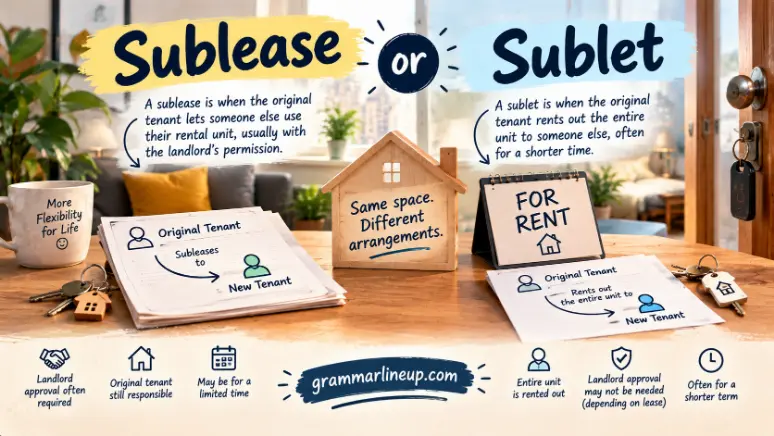
Sublease and sublet usually describe the same basic arrangement: a tenant rents all or part of their rented property to another person, called a subtenant. “Sublease” is often the noun or more formal term, while “sublet” is especially common as a verb. However, legal definitions and permission requirements can vary by lease and jurisdiction, so the original rental agreement should always be checked.
Quick Answer: Sublease vs. Sublet
In ordinary English, sublease and sublet are very closely related and are often interchangeable.
For example:
- “I’m going to sublet my apartment for three months.”
- “I’m going to arrange a sublease for my apartment for three months.”
Both can describe a tenant allowing another person to occupy the rental for part or all of a period while the original lease remains in effect.
The main difference is usually word form and style, rather than a completely different rental arrangement.
| Term | Common use | Basic meaning |
|---|---|---|
| Sublet | Often used as a verb or noun | To rent all or part of a rented property to someone else |
| Sublease | Often used as a noun or formal/legal term | An arrangement or agreement in which a tenant rents the property to another person |
| Subtenant | Noun for the new occupant | A person renting from the original tenant |
| Sublessor | Legal/rental term | The original tenant who creates the sublease |
Cambridge defines sublet as renting all or part of a rented property to someone else and defines sublease as the arrangement by which this happens.
What Does “Sublet” Mean?
Sublet means to rent all or part of a property to someone else when you are already renting that property from another person.
The original tenant becomes the person receiving rent from the new occupant, while the original landlord remains connected to the main lease.
For example, imagine that Maya rents an apartment until December. She plans to spend June through August in another city but intends to return to the apartment afterward.
She might arrange for Jordan to live there during those three months.
Maya is subletting the apartment to Jordan.
Jordan is the subtenant.
Maya remains the original tenant under her lease with the landlord.
Cambridge gives the same basic meaning for residential and commercial property, including renting either an entire building or only part of it.
Natural sentences with “sublet”
- “I’m looking for someone to sublet my apartment this summer.”
- “Can I sublet my room while I’m away?”
- “They decided to sublet their office space.”
- “She sublet the spare bedroom to another student.”
The word is particularly natural when describing the action.
What Does “Sublease” Mean?
A sublease is the rental arrangement created when an existing tenant rents all or part of their leased property to another person.
It can also be used as a verb:
- “We signed a sublease.”
- “The company subleased part of its office.”
- “The tenant wants to sublease the apartment.”
In more formal property or legal language, sublease can sound more precise than sublet.
The Legal Information Institute describes a sublease as a new contract between the original tenant and the sublessee, involving all or part of the tenant’s interest for a shorter term than the original lease.
That definition highlights an important point: a sublease is not normally the same thing as simply handing your lease over permanently to somebody else.
Why Do People Say “Sublet” and “Sublease” Interchangeably?
The overlap exists because the two words describe the same basic concept from slightly different angles.
Sublet commonly focuses on the action:
The tenant sublets the apartment.
Sublease commonly focuses on the arrangement or agreement:
The tenant signs a sublease.
But English does not always keep those roles perfectly separate.
Cambridge’s Business English Dictionary explicitly lists sublease as another term for sublet in property-related usage.
So if someone says:
“I’m looking for a sublet.”
they generally mean they want a property or room that is being rented to them by an existing tenant.
If they say:
“I need to sign a sublease.”
they generally mean they are entering into the rental arrangement itself.
Sublease or Sublet in Real Conversations
Here are natural ways these terms appear in everyday speech.
Looking for temporary housing
Alex: “Are you still living in Chicago this summer?”
Sam: “No. I’m going home for two months.”
Alex: “What are you doing with your apartment?”
Sam: “I’m trying to find someone to sublet it.”
Here, sublet describes the action Sam plans to take.
Talking about the agreement
Jordan: “Is the room available for the whole year?”
Taylor: “No, just through August. It’s a three-month sublease.”
Here, sublease describes the rental arrangement.
Talking about a room
Chris: “Do you know anyone looking for a place?”
Morgan: “Actually, I’m looking for someone to sublet my spare room.”
Again, sublet works naturally as a verb.
Talking about commercial property
Manager: “We have more office space than we need.”
Owner: “Would you consider a sublease?”
In commercial real estate, sublease is common in formal discussions about rented space. Cambridge also documents both terms in business-property contexts.
Subtenant, Tenant, Sublessor, and Landlord
Understanding the people involved makes the terminology much easier.
Suppose Sarah rents an apartment from a landlord. Sarah then rents one bedroom to David.
The relationships look like this:
Landlord → Sarah → David
- The landlord owns or manages the property and rents it to Sarah.
- Sarah is the original tenant.
- Sarah may be the sublessor in the sublease.
- David is the subtenant.
- Sarah and David have their own rental arrangement.
- Sarah generally remains responsible for her obligations under the original lease.
The Legal Information Institute explains that a subtenant rents from the original tenant rather than directly from the property owner, creating a separate agreement between the subtenant and original tenant.
That distinction is one of the most important things to understand when you see the word sublease.
Is a Sublease the Same as an Assignment?
No. A sublease and an assignment can be different legal arrangements.
A sublease generally involves the original tenant retaining an interest in the original lease and renting the property, or part of it, to another person.
An assignment generally involves transferring the tenant’s remaining lease interest to someone else.
For example, suppose your apartment lease ends on December 31.
Sublease
You leave for the summer but plan to return in September.
You arrange for another person to live there temporarily.
You still have obligations under your original lease.
Assignment
You move away permanently and transfer your remaining lease interest to another tenant.
You are no longer planning to return to occupy the apartment.
Nolo describes this distinction as a temporary arrangement versus a permanent transfer of the remaining lease interest, although the precise legal consequences depend on the governing agreement and law.
This is why calling something a “sublease” simply because another person is moving in can sometimes be misleading.
Does a Sublease Need the Landlord’s Permission?
There is no single worldwide answer.
Whether you can sublet depends on the original lease, applicable law, and the location of the property.
Many rental agreements restrict or prohibit subletting without the landlord’s consent. Nolo’s current U.S. guidance recommends checking the lease and obtaining written landlord consent where required before allowing someone to move in.
The Legal Information Institute likewise notes that whether subleasing is allowed depends on the original lease and applicable state law.
So don’t assume:
“I’m the tenant, so I can automatically rent the place to someone else.”
That may not be true under the applicable rules.
Before arranging a sublease, check:
- Your original lease
- Any subletting clause
- Landlord-consent requirements
- Local landlord-tenant laws
- Building or housing-association rules
- Insurance requirements
- Rules concerning rent or occupancy
For legal questions, local law matters more than a general dictionary definition.
Common Misunderstandings About Subleasing
“Sublet” means the tenant has permanently left
Not necessarily.
A sublet can be temporary. In fact, temporary absence is a common reason people sublet a property.
A tenant may leave for an internship, travel, study program, or temporary work assignment and return later.
A subtenant automatically becomes the landlord’s tenant
Not necessarily.
A typical subtenant rents from the original tenant rather than directly from the landlord. The exact legal relationship can vary by jurisdiction and contract.
A sublease cancels the original lease
Usually, no.
A sublease generally creates an additional rental relationship rather than automatically ending the original lease. The original tenant can remain responsible for obligations under the main lease.
Sublease and assignment always mean the same thing
They don’t.
An assignment and a sublease can have different legal consequences, particularly concerning the original tenant’s continuing responsibilities.
You can always sublet a room because you are only renting part of the property
Not necessarily.
Subletting part of a property can still be subject to lease terms and local rules. Cambridge specifically describes subletting as potentially involving only part of a building, such as a room.
When Should You Use “Sublet”?
Use sublet when you’re talking naturally about the act of renting your rented property to someone else.
It works especially well in everyday conversation.
Natural:
- “I’m going to sublet my apartment.”
- “Can I sublet my room?”
- “She wants to sublet while she’s abroad.”
- “They’re subletting their office.”
If your sentence describes what someone is doing, “sublet” is often the most natural choice.
When Should You Use “Sublease”?
Use sublease when referring to the rental arrangement, agreement, or a more formal property context.
Natural:
- “We signed a sublease.”
- “The sublease ends in August.”
- “Please review the sublease agreement.”
- “The company offered the space for sublease.”
It is especially common in formal rental and commercial-property language.
That said, the distinction is not absolute. Dictionaries and legal references recognize significant overlap between sublease and sublet.
Sublease or Sublet: Which One Sounds More Natural?
For everyday American English, both are natural, but they often appear in different grammatical roles.
Use “sublet” for the action:
“I want to sublet my apartment.”
Use “sublease” for the arrangement:
“I signed a sublease.”
You may also hear:
“I’m looking for a sublet.”
Here, sublet functions as a noun referring to the property or room available for temporary rental. Cambridge records this noun usage as well.
So there is no need to treat the two terms as competing vocabulary choices. In many contexts, they are simply different ways of talking about closely related parts of the same arrangement.
A Simple Way to Remember the Difference
Think of it this way:
Sublet = the action
Sublease = the arrangement
Subtenant = the person renting from the tenant
For instance:
“I sublet my apartment, and the subtenant signed a sublease with me.”
This sentence makes the three terms easy to distinguish.
However, remember that real-world legal terminology can be more complicated than this shortcut. Contracts and local laws can define rights and responsibilities differently.
What to Check Before Agreeing to a Sublease
If you’re actually considering subletting a home, room, or office, the vocabulary is only the first part of the issue.
Check the original lease first.
Then confirm whether permission is required and whether that permission must be written.
It is also sensible to put the arrangement with the subtenant in writing. Nolo recommends formalizing subletting arrangements and checking the original rental agreement before allowing a subtenant to move in.
Important details may include:
- Start and end dates
- Monthly rent
- Security deposit
- Utilities
- Furniture
- Maintenance responsibilities
- House rules
- Payment dates
- Damage responsibilities
- Required landlord approval
- What happens if the subtenant leaves early
A written agreement can make the expectations clearer for everyone involved.
Sublease or Sublet: Common Alternatives
Depending on context, you may also encounter:
- Subletting — the practice or process of subletting
- Sublease — the rental arrangement or agreement
- Sublet — the act, or sometimes the property being rented
- Subtenant — the person renting from the original tenant
- Sublessor — the original tenant who subleases the property
- Assignment — a different type of transfer that can have different legal consequences
These terms should not automatically be treated as perfect synonyms.
For example, subtenant identifies a person, while sublease identifies an arrangement. Assignment can describe a different legal transfer altogether.
FAQs:
Is a sublease the same as a sublet?
In many everyday contexts, yes. Sublease and sublet commonly refer to the same basic arrangement in which a tenant rents all or part of a property to another person. The terms can have more specific meanings in particular legal contexts.
Is it better to say “sublet” or “sublease”?
Neither is universally “better.” Use sublet naturally when describing the action, such as “I want to sublet my apartment.” Use sublease when discussing the rental arrangement or agreement, such as “I signed a sublease.”
What is a person who rents a sublet called?
That person is generally called a subtenant or sublessee. They rent from the original tenant rather than directly from the property owner in a typical sublease arrangement.
Does subletting mean you are breaking your lease?
Not automatically. A sublease can be permitted under a lease or applicable law, but many leases restrict or prohibit subletting without permission. Always check the governing lease and local rules.
What’s the difference between a sublease and an assignment?
A sublease generally involves renting the property or part of the lease to another person while the original tenant retains an interest in the lease. An assignment generally transfers the tenant’s remaining lease interest to another person. The exact legal effect depends on the contract and applicable law.
Can you sublet only one room?
Yes, subletting can involve part of a property rather than the entire property. However, whether you are allowed to do so depends on the lease and applicable local rules.
Conclusion:
Sublease and sublet are usually two closely related terms for renting all or part of a property to someone else when you are already the tenant.
The easiest distinction is:
- Sublet often describes the action.
- Sublease often describes the arrangement or agreement.
- Subtenant is the person who rents from the original tenant.
The terms overlap heavily, so the difference is usually about usage and context rather than two completely different concepts. Cambridge treats them as closely related property terms, while legal sources emphasize that the precise rights and responsibilities depend on the lease and applicable law.
If you’re simply choosing the right word in a sentence, “sublet” is usually natural for the action, while “sublease” is useful for the agreement.
If you’re actually planning to sublet a property, however, the wording is the easy part. Check the original lease and applicable local rules before making the arrangement.
