
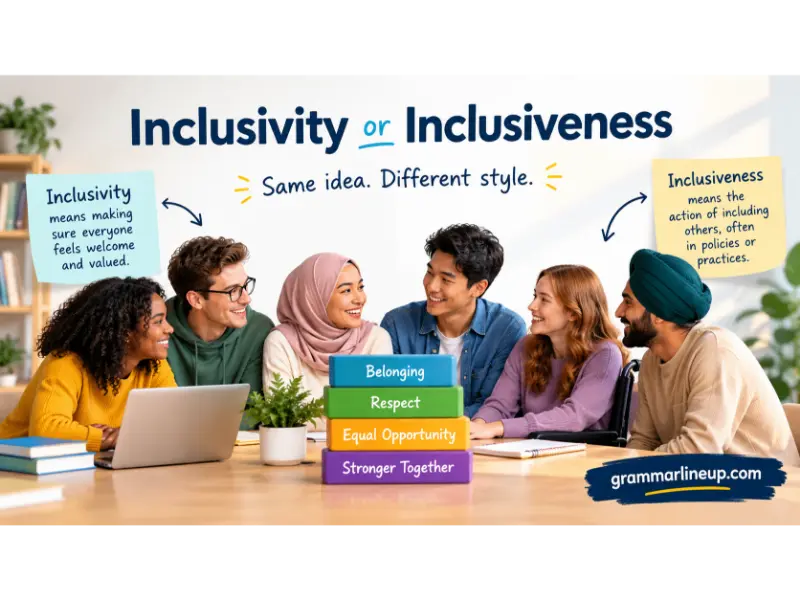
The words inclusivity and inclusiveness are closely related, so it is easy to wonder whether they mean exactly the same thing. Both words are connected to the idea of including people, welcoming different perspectives, and making sure people are not unfairly left out. However, they can carry slightly different shades of meaning depending on the sentence and context.
Inclusivity often refers to the quality, principle, or goal of including people and making spaces accessible and welcoming to different groups. It is commonly used when discussing workplaces, education, communities, policies, and social practices.
Inclusiveness, meanwhile, can describe the general quality or characteristic of being inclusive, especially when focusing on how broadly something embraces different people or ideas.
In everyday English, the two terms can sometimes be used interchangeably, and neither is automatically wrong. The better choice depends on what you are trying to emphasize. Understanding this small distinction can make your writing sound more precise and natural.
In this guide, we will compare inclusivity or inclusiveness, explain how each word is commonly used, look at clear examples, and show you when one may fit better than the other.
Inclusivity and inclusiveness are nouns that describe the quality or practice of including different people, ideas, or groups rather than excluding them. They are closely related and often interchangeable when discussing fairness and participation. Inclusivity can sound more modern or policy-focused, while inclusiveness often emphasizes the quality or characteristic of being inclusive.
Quick Answer
If you’re wondering whether to say “inclusivity” or “inclusiveness,” both words are correct.
They come from the adjective inclusive, and both refer to the quality, condition, or practice of including people, groups, ideas, or perspectives.
For example:
- The company promotes inclusivity in the workplace.
- The company promotes inclusiveness in the workplace.
Both sentences communicate essentially the same idea.
The small difference is usually one of style and emphasis, rather than meaning. Inclusivity is especially common in discussions about organizations, education, workplace culture, accessibility, diversity, and social participation. Inclusiveness can sound slightly more descriptive, focusing on the quality or character of something that includes others.
Cambridge defines inclusivity as the fact of including different types of people, things, or ideas and treating them fairly and equally. It gives a closely related definition for inclusiveness.
What Does Inclusivity Mean?
Inclusivity is a noun meaning the quality or practice of including different kinds of people, ideas, or perspectives and treating them fairly.
In everyday language, it often answers the question:
“Does this environment make room for different people and perspectives?”
For example:
- The school is working to improve inclusivity.
- The organization values cultural inclusivity.
- The website was redesigned with greater accessibility and inclusivity in mind.
- The team discussed ways to encourage inclusivity during meetings.
The word is particularly common when talking about workplaces, schools, communities, organizations, media, accessibility, and social participation.
Importantly, inclusivity is not an abbreviation, slang term, or texting acronym. It is a standard English noun. Its modern use is often associated with discussions about participation, equality, diversity, and reducing barriers to involvement.
Cambridge lists inclusivity as an uncountable noun and defines it around including different types of people, things, or ideas while treating them fairly and equally.
What Does Inclusiveness Mean?
Inclusiveness is also a noun. It describes the quality or state of being inclusive.
For example:
- The inclusiveness of the program helped attract a wider range of participants.
- Her leadership style is known for its inclusiveness.
- The inclusiveness of the discussion allowed different perspectives to be heard.
- The organization wants to create a culture of inclusiveness.
Cambridge similarly defines inclusiveness as the quality of including many different types of people and treating them fairly and equally.
So, if inclusive is the adjective, these are the related nouns:
inclusive → inclusivity / inclusiveness
Both are grammatically valid.
Inclusivity vs. Inclusiveness: What’s the Difference?
There is no major difference in basic meaning.
The distinction is mostly about usage, tone, and emphasis.
| Word | Typical emphasis | Example |
|---|---|---|
| Inclusivity | The concept, goal, or practice of inclusion | “The company is committed to inclusivity.” |
| Inclusiveness | The quality or characteristic of being inclusive | “The inclusiveness of the policy was appreciated.” |
Inclusivity
Inclusivity often appears in modern discussions about:
- workplace culture
- education
- accessibility
- diversity
- representation
- organizational policies
- community participation
- inclusive design
For example:
The university introduced new programs to improve inclusivity.
Here, the word refers to an overall goal or approach.
Inclusiveness
Inclusiveness can place more emphasis on a characteristic or quality:
The inclusiveness of the program made it accessible to a broader audience.
It describes how inclusive something is.
That distinction is not absolute. In many sentences, either noun works naturally.
Is Inclusivity or Inclusiveness More Correct?
Neither is inherently more correct.
Both are established English nouns.
A useful rule is:
Use “inclusivity” when discussing inclusion as a concept, goal, or organizational practice. Use “inclusiveness” when emphasizing the quality or character of being inclusive.
However, this is a usage tendency, not a strict grammar rule.
You should not assume that one word is grammatically correct while the other is wrong.
For instance:
The company promotes inclusivity.
and
The company promotes inclusiveness.
are both grammatical.
The first may sound more natural in contemporary workplace or institutional language, while the second can sound more descriptive.
Origin & Evolution
Both words are built from inclusive.
The deeper root is the Latin verb includere, meaning “to shut in,” “enclose,” or “insert.” The English word include developed from this Latin source.
The history becomes particularly interesting because inclusive has been used in English for centuries.
A 2024 scholarly article by linguist Kathryn Allan notes that inclusive entered English from Latin and is attested in writing from the early 15th century. The article also explains that the nouns inclusiveness and inclusivity developed from inclusive at different periods, with inclusiveness appearing earlier and inclusivity developing later.
The modern social meaning of inclusive also developed over time. Allan notes that the specifically human sense—meaning not excluding people on grounds such as race, gender, religion, age, or disability—has a documented 20th-century history, with an Oxford English Dictionary attestation from 1928 cited in the article.
So the modern meaning is connected to the older idea of including, but the social meaning became more specialized over time.
How to Use Inclusivity in Texts and Chats
Inclusivity is not normally used as casual texting slang.
Still, it can appear naturally in messages, especially when the conversation involves work, school, community activities, or social issues.
Professional message
We should consider inclusivity when planning the event.
Workplace chat
Let’s make sure the new meeting format supports inclusivity.
School discussion
The teacher encouraged inclusivity by giving everyone an opportunity to participate.
Casual conversation
I like the inclusivity of that group. Everyone seems welcome.
In very casual texting, simpler expressions may sound more natural:
Everyone is welcome.
They make everyone feel included.
The group is open to everyone.
This is an important style point: a word can be perfectly correct without being the most natural choice for every conversation.
Real Conversation Examples
Conversation 1: Workplace
Maya: What do you think of the new team policy?
Jordan: I like that it focuses on inclusivity. It gives everyone a chance to contribute.
Here, inclusivity refers to an organizational approach.
Conversation 2: School
Teacher: Why is inclusivity important in the classroom?
Student: Because students should have opportunities to participate regardless of their background or circumstances.
Here, inclusivity refers to creating an environment where different students can participate.
Conversation 3: Community
Alex: Why does the community center offer so many different activities?
Sam: They want to encourage inclusivity and make the center useful to a wider range of people.
Conversation 4: Describing a quality
Nina: What did you like about the event?
Chris: The inclusiveness. People from different backgrounds were able to participate comfortably.
Here, inclusiveness emphasizes the quality of the event.
Meaning by Context
The exact focus of inclusivity can change depending on the context.
Workplace inclusivity
In a workplace, it can refer to practices or environments intended to ensure that employees can participate and contribute.
Example:
The company is reviewing its policies to improve workplace inclusivity.
Educational inclusivity
In education, it can refer to creating learning environments that accommodate and include different students.
Example:
The school is developing programs designed to support greater inclusivity.
Social inclusivity
In social contexts, the term can refer to participation and belonging among different groups.
Example:
The community center promotes social inclusivity through open events.
Accessibility and inclusivity
Accessibility and inclusivity are related but are not identical.
Accessibility often concerns whether people can access or use something, particularly when barriers exist.
Inclusivity is broader and concerns whether different people are included and able to participate.
For example, a website might be technically accessible while still lacking broader forms of inclusive communication or representation.
When to Use It
Use inclusivity or inclusiveness when you are discussing the general quality, practice, or goal of including people or perspectives.
They work particularly well in:
- professional writing
- academic writing
- organizational communication
- education
- policy discussions
- community discussions
- accessibility discussions
- diversity-related conversations
Examples:
The organization is committed to greater inclusivity.
The study examines inclusiveness in higher education.
The design team considered accessibility and inclusivity.
The discussion focused on the inclusiveness of the policy.
When NOT to Use It
You do not need inclusivity simply because you are talking about people being included.
In everyday English, a simpler phrase can sometimes sound more natural.
Instead of:
We need to improve inclusivity at the party.
You might say:
We want everyone to feel welcome at the party.
Instead of:
The manager demonstrated inclusiveness by inviting everyone.
You might say:
The manager made sure everyone could participate.
The choice depends on your audience.
Inclusivity and inclusiveness are useful when the concept itself matters. In casual communication, include, welcome, and make room for may be clearer.
Common Misunderstandings
“Inclusivity” is slang
No. Inclusivity is a standard English noun, not slang.
It may be especially common in contemporary institutional or social discussions, but that does not make it slang.
“Inclusiveness” is incorrect
No. Inclusiveness is also correct.
Cambridge lists it as a noun and provides examples of its use in English.
The two words have completely different meanings
Not usually.
They overlap heavily and can often be substituted for one another without changing the basic meaning.
The difference is more about focus and style than a strict difference in definition.
Inclusivity only refers to people
Not necessarily.
In modern social usage, it frequently refers to people and groups, but the broader concept can also involve ideas, perspectives, categories, or other things being included. Cambridge explicitly includes people, things, and ideas in its definition of inclusivity.
Inclusivity means agreeing with everyone
Not necessarily.
Including someone in a discussion or environment does not automatically mean agreeing with their opinions. Inclusion and agreement are different concepts.
For example:
The meeting encouraged inclusivity by allowing different viewpoints to be heard.
That does not mean every participant had to agree.
Similar Words and Alternatives
Depending on the sentence, you may be able to use:
- inclusion the act or process of including
- openness willingness to consider or welcome something
- acceptance recognition or willingness to accept people or ideas
- belonging the feeling of being accepted as part of a group
- diversity the presence of differences within a group
- accessibility the extent to which something can be accessed or used
- fairness treating people in an impartial or equitable way
- representation the presence or depiction of particular groups or perspectives
These words are related, but they are not perfect synonyms.
For example, diversity describes the presence of differences, while inclusivity focuses more on including and accommodating those differences.
That distinction is useful in sentences such as:
A workplace can have diversity without every employee necessarily experiencing the same level of inclusion.
Inclusivity vs. Inclusion
These words are closely related but grammatically different.
Inclusion generally refers to the act, process, or result of including someone or something.
Inclusivity refers more to the quality, condition, or approach of being inclusive.
Compare:
The inclusion of additional voices improved the discussion.
with:
The inclusivity of the discussion encouraged more people to participate.
Both are useful, but they focus on slightly different aspects.
Inclusivity vs. Diversity
These terms are often used together, but they do not mean exactly the same thing.
Diversity generally concerns the presence of different characteristics, identities, backgrounds, experiences, or perspectives within a group.
Inclusivity concerns whether those different people or perspectives are included and able to participate.
A simple way to remember the distinction is:
Diversity asks who is present. Inclusivity asks who is included and able to participate.
The two concepts are therefore related but not interchangeable. Cambridge describes diversity and inclusion as related concepts involving equal treatment, welcome, and inclusion.
FAQs:
Is inclusivity a real word?
Yes. Inclusivity is an established English noun. Cambridge defines it as the fact of including different types of people, things, or ideas and treating them fairly and equally.
Is inclusiveness the same as inclusivity?
They are very close in meaning. Both refer to the quality or condition of being inclusive. The choice usually depends on sentence structure, emphasis, and style rather than a major difference in meaning.
Which is more common: inclusivity or inclusiveness?
Both are established terms, but inclusivity is particularly common in modern discussions involving organizations, education, diversity, accessibility, and social participation. Inclusiveness remains standard and natural, especially when describing the quality or character of something.
Can I use inclusivity in a formal sentence?
Yes. Inclusivity is appropriate in formal, professional, academic, and everyday contexts when the subject calls for it.
For example:
The organization is committed to improving inclusivity across its programs.
What is the adjective form of inclusivity?
The adjective is inclusive.
For example:
The organization promotes inclusivity.
The organization has an inclusive culture.
What is the opposite of inclusivity?
The most direct conceptual opposite is generally exclusivity or exclusion, depending on the sentence.
For example:
The policy aims to reduce exclusion and encourage inclusion.
However, the exact opposite depends on the context.
Conclusion:
Inclusivity and inclusiveness are both correct English nouns describing the quality or practice of including different people, ideas, or groups.
The practical distinction is simple:
- Inclusivity often sounds natural when discussing a goal, approach, policy, or broader concept.
- Inclusiveness often emphasizes the quality or characteristic of being inclusive.
- Neither word is inherently more grammatically correct.
- Both are standard English, not slang.
- Inclusive is the adjective: an inclusive environment.
- Inclusion refers more directly to the act or process of including.
If you’re choosing between the two for ordinary professional or contemporary writing, either can work. The best choice is the one that fits the sentence naturally and matches the tone of your audience.
