
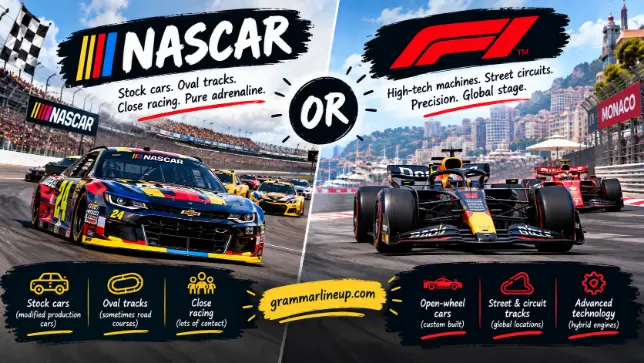
When people compare NASCAR or F1, they are often talking about two very different styles of motorsport. Both feature fast cars, skilled drivers, demanding races, and passionate fans, but the experience of watching each series can feel worlds apart. That is what makes the comparison so interesting.
NASCAR is strongly associated with oval racing, close competition, drafting, and long races where strategy and consistency matter. Formula 1, commonly called F1, is known for technically advanced single-seater cars, road and street circuits, rapid cornering, and a strong focus on engineering and aerodynamics.
So, NASCAR or F1 which one should you watch or learn more about? The answer depends on what you enjoy. Some fans prefer the wheel-to-wheel action and distinctive racing culture of NASCAR, while others enjoy F1’s international calendar, technical development, and variety of circuits.
In this guide, we’ll compare NASCAR and F1 in clear, simple terms, including their cars, tracks, race formats, speeds, strategies, and overall driving styles. By the end, you’ll have a better understanding of what truly separates these two famous forms of racing.
NASCAR and F1 are both major forms of motorsport, but they are built around very different racing philosophies. NASCAR primarily features stock-car-style racing on ovals, road courses, and other circuits, while F1 uses highly specialized open-wheel cars on purpose-built circuits and street tracks. Their cars, rules, race formats, aerodynamics, strategies, and racing environments are substantially different.
Quick Answer:
If you’re wondering whether NASCAR and F1 are basically the same thing, the short answer is no.
Both involve teams, drivers, qualifying, pit stops, tire strategy, engineering, and high-speed competition. But the cars and racing environments are dramatically different.
NASCAR is centered on stock-car racing. The NASCAR Cup Series races across a wide variety of tracks, including oval short tracks, superspeedways, road courses, and street layouts. NASCAR currently lists 35 tracks across the United States and Mexico for its national racing series.
F1, short for Formula 1, is the top level of the FIA’s single-seater formula-racing system. F1 cars are purpose-built open-wheel machines with sophisticated aerodynamics, hybrid power units, and highly specialized components.
So, “NASCAR or F1” is not really a choice between two versions of the same sport. It is a comparison between two distinct racing disciplines.
What Does NASCAR Mean?
NASCAR stands for National Association for Stock Car Auto Racing.
The organization was conceived in December 1947 after Bill France Sr. organized a meeting in Daytona Beach, Florida, to bring greater structure to stock-car racing. NASCAR held its first race in February 1948, and its first “Strictly Stock” race the predecessor of today’s Cup Series took place in June 1949.
The word stock car is important here.
Modern NASCAR cars are highly engineered racing machines rather than ordinary showroom cars, but the discipline developed from stock-car racing and retains that identity.
The NASCAR Cup Series is its premier national series, while NASCAR also oversees other major national series and racing activities.
One of NASCAR’s defining characteristics is variety in track design. Drivers can race on:
- Short ovals
- Intermediate ovals
- Superspeedways
- Road courses
- Street circuits
- Other specialized layouts
That variety means a driver may need a very different approach from one race weekend to the next.
What Does F1 Mean?
F1 means Formula 1.
The “formula” refers to a set of technical and sporting rules that competitors must follow, while the “1” identifies it as the premier formula. Formula 1’s official explanation describes the championship as a team sport involving specialized cars, drivers, circuits, qualifying, Grand Prix races, and different weekend formats.
Unlike NASCAR’s stock-car tradition, F1 uses open-wheel, single-seat race cars specifically designed for Formula 1 competition.
Modern F1 cars use advanced aerodynamics, sophisticated suspension systems, hybrid power units, paddle-shift gearboxes, and highly developed tire systems. F1 explains that its aerodynamic design generates significant downforce, helping the cars produce grip through corners.
F1 also has a strongly international identity, with races taking place across multiple continents and at famous venues such as Monaco, Monza, Silverstone, Spa, and Suzuka.
NASCAR vs F1: The Biggest Differences
The easiest way to understand the difference is to compare the sports category by category.
| Feature | NASCAR | F1 |
|---|---|---|
| Full name | National Association for Stock Car Auto Racing | Formula 1 |
| Main racing style | Stock-car racing | Open-wheel single-seater racing |
| Typical car shape | Enclosed body | Open wheels and open cockpit |
| Track types | Ovals, road courses, street layouts | Purpose-built circuits and street circuits |
| Racing environment | Strongly associated with U.S. racing culture | International championship |
| Aerodynamics | Important, but designed around NASCAR’s rules and racing style | Central to car performance |
| Pit stops | Commonly involve tires and fueling strategy | Often centered on tire changes and race strategy |
| Race format | Varies by NASCAR series and event | Grand Prix format, with qualifying and selected Sprint weekends |
| Championship structure | NASCAR uses its own points and postseason system | F1 awards championship points throughout the season |
| Car development | Controlled by detailed NASCAR rules | Extensive constructor development within F1 regulations |
The table is a broad comparison rather than a claim that every race follows exactly the same pattern.
The Cars Are Built for Different Purposes
One of the most obvious differences between NASCAR and F1 is the design of the cars.
NASCAR cars
NASCAR Cup Series cars have enclosed bodies and are designed for close competition under NASCAR’s technical regulations.
They are built to cope with the physical demands of oval racing as well as road-course competition.
The modern NASCAR Next Gen car introduced major technical changes, including a five-speed sequential transmission, larger brakes, and a single center-lock lug for each wheel.
The design philosophy isn’t simply about making the car as technologically sophisticated as possible. The regulations are also intended to create a particular type of racing.
F1 cars
F1 cars look radically different.
They have:
- Four exposed wheels
- A narrow single-seat cockpit
- Front and rear wings
- Highly optimized aerodynamic surfaces
- Hybrid power units
- Advanced suspension
- Specialized racing tires
F1 describes its cars as machines involving thousands of components, with aerodynamics playing a major role in generating downforce and cornering grip.
This is one reason the two cars can look so different even though both are built to race at extremely high speeds.
NASCAR or F1: Which Has Different Types of Tracks?
Track design is another major distinction.
NASCAR is particularly famous for oval racing, but saying that NASCAR only races on ovals would be inaccurate.
NASCAR’s current track information includes ovals, winding road courses, street layouts, and superspeedways.
Some tracks are enormous, while others are relatively short and technical.
F1, meanwhile, races primarily on dedicated road circuits and temporary street circuits.
That includes legendary venues such as:
- Monaco
- Silverstone
- Monza
- Spa-Francorchamps
- Suzuka
F1’s official 2026 information also identifies Madrid’s new Madring circuit as a new venue on the calendar.
The result is two very different visual experiences.
NASCAR can produce long packs of cars racing closely together around an oval, while F1 often emphasizes braking zones, cornering speed, aerodynamic performance, tire management, and track position.
How Are NASCAR and F1 Races Different?
Race structure is another important difference.
A NASCAR race can involve a large field of cars competing over many laps, with cautions, restarts, pit strategy, tire management, drafting, and track position all playing important roles.
F1 Grands Prix generally feature a much smaller field. F1’s official explanation says only 22 drivers compete in the championship’s current format.
An F1 weekend also has a distinctive qualifying system that determines the starting order for the Grand Prix, while selected weekends use the Sprint format.
For 2026, F1 identifies six Sprint weekends on its calendar.
That means watching an F1 weekend is not simply about watching one race on Sunday. Practice, qualifying, Sprint sessions where applicable, tire choices, penalties, and team strategy can all shape the outcome.
Pit Stops: NASCAR vs F1
Pit stops are important in both sports, but they have different characteristics.
In NASCAR, pit stops can involve changing all four tires and adding fuel. NASCAR’s Next Gen car changed the mechanics of pit stops, including moving to a single center-lock lug and increasing fuel-cell capacity.
F1 pit stops are typically associated with extremely rapid tire changes.
Formula 1 itself highlights that its teams can change all four tires in under two seconds.
But the important point is that a pit stop isn’t simply a mechanical break.
Teams must decide when to stop, which tires to use, whether track position will be gained or lost, and how the strategy interacts with weather, traffic, safety cars, and the remaining race distance.
That’s why a pit stop can be one of the most strategically important moments of a race.
Speed Isn’t the Only Difference
People sometimes search “NASCAR or F1” because they want to know which is faster.
That question sounds simple, but it needs some context.
Straight-line speed is only one measurement.
An F1 car is designed around extreme cornering performance, aerodynamic efficiency, braking, and acceleration. NASCAR cars are designed around a different combination of speed, durability, close racing, aerodynamic behavior, and track-specific requirements.
A car that is faster through a particular corner isn’t necessarily faster in every racing environment.
That’s why saying simply “F1 is faster” or “NASCAR is faster” can hide more than it explains.
A more useful question is:
Faster in what situation straight-line speed, cornering, acceleration, lap time, or top speed?
Those measurements can tell different stories.
NASCAR or F1: Which Requires More Strategy?
Both require substantial strategy, but the strategic problems are different.
NASCAR strategy
NASCAR strategy can involve:
- Tire wear
- Fuel mileage
- Pit timing
- Cautions
- Restarts
- Drafting
- Track position
- Weather
- Traffic
- Adjustments to the car
A caution can completely change the tactical picture.
The wide variety of NASCAR tracks also means teams must adapt their setup and strategy to different racing environments.
F1 strategy
F1 strategy often revolves around:
- Tire compounds
- Tire degradation
- Pit-window timing
- Track position
- Undercuts and overcuts
- Weather
- Safety cars
- Aerodynamic performance
- Traffic
- Qualifying position
Because F1 cars depend heavily on aerodynamic performance, following another car closely can create its own strategic challenges.
So neither sport is simply “more strategic.” They demand different kinds of strategic thinking.
NASCAR or F1: Which Is More International?
Historically, NASCAR has been strongly associated with the United States and American stock-car culture.
That remains an important part of its identity, but NASCAR has expanded internationally.
NASCAR says it now organizes, promotes, and officiates stock-car racing in more than 10 countries across 11 officially sanctioned racing series. The NASCAR Cup Series also held a points-paying race in Mexico City in 2025, marking its first modern-era points-paying Cup race outside the United States.
F1, by contrast, has had an international calendar since its earliest championship era and continues to race across multiple continents. F1’s 2026 calendar includes 24 races in 21 countries.
So the two sports have different historical identities, even though both now reach audiences well beyond their original markets.
Common Misunderstandings About NASCAR and F1
“NASCAR only races on oval tracks.”
Not true.
NASCAR currently includes road courses and street layouts in addition to ovals and superspeedways.
“F1 cars are basically normal cars with racing engines.”
They aren’t.
F1 cars are purpose-built racing machines with specialized aerodynamics, hybrid power units, suspension systems, and other highly engineered components.
“Both sports use the same type of racing strategy.”
Not exactly.
Both involve strategy, but the variables teams manage differ because the cars, tracks, tires, rules, and race formats are different.
“NASCAR is just about going around in circles.”
That description overlooks the technical and tactical complexity of oval racing and ignores NASCAR’s road-course and street-racing events.
“F1 is just about the driver.”
The driver is crucial, but F1 is explicitly a team sport. Teams design and prepare the cars, develop strategy, manage tires, and make rapid decisions throughout a race weekend.
Which One Might You Enjoy More?
Instead of asking which sport is universally better, it makes more sense to ask what kind of racing you enjoy watching.
You may naturally gravitate toward NASCAR if you enjoy:
- Close pack racing
- Oval racing
- Drafting
- Frequent position changes
- Long races
- Restarts
- Strong driver-to-driver battles
- American motorsports culture
- A wide variety of track configurations
You may find F1 more appealing if you enjoy:
- Open-wheel cars
- Technical engineering
- Aerodynamics
- International racing
- Qualifying battles
- Tire strategy
- High-speed cornering
- Street circuits
- Constructor development
These are tendencies, not rules. A motorsports fan can easily enjoy both.
NASCAR or F1: Can You Be a Fan of Both?
Absolutely.
In fact, understanding their differences can make both sports more interesting.
Watching NASCAR can help you appreciate the importance of drafting, restarts, tire management, pit-road timing, and close-quarters racing.
Watching F1 can highlight the importance of aerodynamic efficiency, qualifying performance, tire strategy, engineering development, and precision.
The sports may look very different, but both depend on the interaction of:
driver + car + team + strategy + track + rules.
That common foundation is what makes comparing them useful.
FAQs:
Is NASCAR the same as F1?
No. NASCAR and F1 are different motorsport disciplines. NASCAR is primarily associated with stock-car racing, while F1 uses specialized open-wheel single-seater cars.
Is F1 faster than NASCAR?
It depends on what type of speed you mean. F1 cars are designed for exceptional acceleration, braking, and cornering performance, while NASCAR cars compete under a different technical philosophy and across different types of tracks. A simple overall speed ranking can therefore be misleading.
Do NASCAR and F1 use pit stops?
Yes. Both use pit stops, but their purposes and procedures differ. NASCAR stops can involve tires and fuel, while F1 pit stops are commonly associated with rapid tire changes and race strategy.
Does NASCAR race outside the United States?
Yes. NASCAR oversees sanctioned racing in multiple countries, and the NASCAR Cup Series held a points-paying race in Mexico City in 2025.
Does F1 race on street circuits?
Yes. F1 includes temporary street circuits as well as permanent racing facilities. Monaco, for example, is one of the championship’s historic venues, while newer city-based events have also become part of the calendar.
Which is easier to understand for a new fan, NASCAR or F1?
Neither requires advanced technical knowledge to enjoy. NASCAR may be easier to follow if you immediately enjoy close racing, drafting, and restarts. F1 can be especially appealing if you enjoy qualifying, engineering, tire strategy, and international circuits. Once you understand the basic rules of either sport, the strategic details become easier to appreciate.
Conclusion:
NASCAR or F1 isn’t simply a question of choosing between two racing brands.
NASCAR grew from American stock-car racing and remains strongly connected to oval competition, while also racing on road courses and street layouts. Its modern cars, rules, pit strategy, and championship structure create a distinctive form of motorsport. NASCAR’s history traces back to its formation in 1947 and first race in 1948.
F1 represents a different branch of motorsport, built around highly specialized open-wheel cars, advanced aerodynamics, international circuits, qualifying, tire strategy, and constructor engineering. Its championship dates to the first F1 season in 1950.
The biggest difference is therefore not simply which car goes faster.
It’s the entire racing philosophy.
NASCAR emphasizes stock-car competition, varied track types, close racing, drafting, pit strategy, and the unique demands of its racing formats.
F1 emphasizes open-wheel engineering, aerodynamic performance, precision, qualifying, tire management, and international Grand Prix competition.
If you’re deciding what to watch, the better question is not “Which one is better?” but “What kind of racing do I enjoy most?”
That question makes the NASCAR-versus-F1 comparison much easier to answer for yourself.
