
When a skin rash appears, it can be easy to wonder whether it is ringworm or Lyme disease, especially when the symptoms seem unfamiliar. Although both can cause noticeable skin changes, they are very different conditions with different causes, patterns, and treatments.
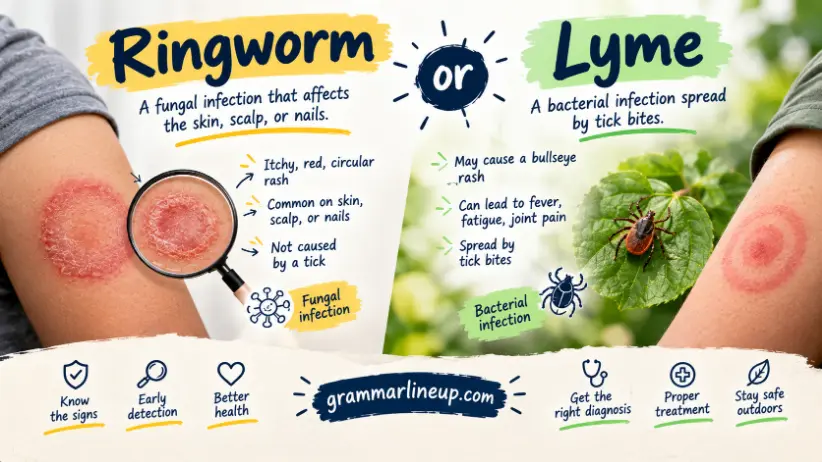
Ringworm is a fungal infection that commonly produces an itchy, ring-shaped rash, while Lyme disease is a bacterial infection transmitted through the bite of an infected tick.
The confusion often comes from the fact that Lyme disease can also cause a distinctive expanding rash, and not every rash looks exactly like the textbook description. Understanding the differences can help you recognize why the two conditions should not be treated as interchangeable.
In this guide, we’ll compare ringworm or Lyme by looking at their causes, typical rash appearance, symptoms, transmission, and treatment. We’ll also explain which clues can help distinguish them and when a healthcare professional should evaluate a rash.
Ringworm and Lyme disease can both cause circular-looking skin rashes, but they are different infections. Ringworm is a fungal infection that commonly causes an itchy, scaly, ring-shaped rash. Lyme disease is a bacterial infection spread by infected blacklegged ticks and may cause an expanding erythema migrans rash, often with fever, fatigue, headache, or muscle and joint aches.
Ringworm or Lyme: Quick Answer
The biggest difference is what causes the condition and how the rash behaves.
Ringworm is a fungal infection. Despite its name, it is not caused by a worm. On the skin, it commonly produces an itchy, scaly, ring-shaped rash with a raised edge.
Lyme disease is a bacterial infection transmitted through the bite of infected blacklegged ticks. One of its characteristic early skin signs is erythema migrans (EM), an expanding rash that can sometimes look like a target or bull’s-eye.
| Feature | Ringworm | Lyme disease |
|---|---|---|
| Cause | Fungus | Bacteria |
| Spread | Skin contact, infected animals, contaminated items or surfaces | Bite from an infected blacklegged tick |
| Typical rash | Often itchy, scaly, ring-shaped | Often an expanding erythema migrans rash |
| Itching | Common | EM is usually not itchy |
| Other symptoms | Usually focused on the skin, hair, or nails | Fever, chills, headache, fatigue, muscle/joint aches and other symptoms can occur |
| Treatment | Antifungal medication | Antibiotics prescribed for Lyme disease |
| Tick exposure relevant? | No | Yes |
These differences are useful clues, but a rash alone cannot always establish the diagnosis. Other skin conditions can resemble either infection, so unexplained or concerning rashes should be assessed by a healthcare professional.
What Does Ringworm Mean?
Ringworm is a common fungal infection affecting the skin, scalp, or nails. The name can be misleading because there is no worm involved.
On the body, ringworm is often called tinea corporis. Its classic appearance is a red or discolored, itchy, scaly ring that may have clearer skin toward the center and a more noticeable edge.
However, ringworm does not always look exactly like a perfect circle.
The CDC notes that the appearance can vary depending on the infected body area. Ringworm may affect the feet, groin, scalp, beard, or nails, with symptoms changing accordingly.
For example:
- Body: Ring-shaped, itchy, scaly patches may appear.
- Feet: Peeling, itchy or swollen skin between the toes can occur.
- Groin: Itchy, scaly patches may develop around the inner thighs.
- Scalp: Scaly areas and hair loss can occur.
- Nails: Nails may become thick, cracked, fragile, or discolored.
Ringworm can spread through contact with infected people or animals and through contaminated personal items or moist surfaces.
What Does Lyme Disease Mean?
Lyme disease is a bacterial infection transmitted to people through the bite of infected blacklegged ticks. In the United States, the main bacteria responsible include Borrelia burgdorferi and, more rarely, Borrelia mayonii.
An important early sign can be erythema migrans, usually called an EM rash.
The rash generally begins at the site of the tick bite and gradually expands. It can become large and may have a target-like appearance, but the familiar bull’s-eye pattern is not required. CDC guidance specifically notes that EM can have several appearances.
Lyme disease can also cause symptoms such as:
- Fever
- Chills
- Headache
- Fatigue
- Muscle aches
- Joint aches
- Swollen lymph nodes
Later untreated infection can involve the joints, nervous system, or heart.
How Ringworm and Lyme Rash Differ
The word “ring” can make these conditions seem more alike than they really are.
A ring-shaped rash does not automatically mean ringworm, and a circular or target-like rash does not automatically mean Lyme disease.
Ringworm tends to be itchy and scaly
A typical ringworm rash is often itchy, scaly, and raised around the edge. The rash may form one or several rings and can gradually spread.
Lyme’s EM rash tends to expand
An EM rash typically expands over several days after beginning near the site of a tick bite. It may look like a target, but it may also lack central clearing. It is usually not itchy or painful.
The timing is different
Ringworm symptoms typically appear 4 to 14 days after exposure to the fungi.
Early Lyme symptoms, including an EM rash, can appear 3 to 30 days after a tick bite.
That timing can provide useful context, but it should not be used by itself to diagnose either condition.
Ringworm or Lyme: Symptoms Compared
When someone searches “ringworm or Lyme,” they are often trying to interpret a rash. Looking beyond the rash can provide additional context.
Symptoms that fit ringworm more closely
Features that can occur with ringworm include:
- Itching
- Scaling
- A raised rash edge
- Circular or overlapping rings
- Localized skin irritation
- Scalp scaling or hair loss
- Thickened or discolored nails
Ringworm generally affects the skin, hair, or nails, although the exact presentation depends on the location.
Symptoms that fit Lyme disease more closely
Lyme disease may cause:
- An expanding EM rash
- Fever
- Chills
- Headache
- Fatigue
- Muscle aches
- Joint aches
- Swollen lymph nodes
Later manifestations can include facial palsy, arthritis, nerve symptoms, heart rhythm problems, and other complications.
A person with Lyme disease does not necessarily have every symptom, and an EM rash does not always have the classic bull’s-eye appearance.
Why the Two Conditions Are Easy to Confuse
The main source of confusion is the shape of the rash.
Ringworm can produce a circular rash. Lyme disease can also produce an expanding circular or target-like rash. The visual similarity can be misleading.
The CDC specifically lists ringworm among skin conditions that can resemble an erythema migrans rash.
There is another important point: not every circular rash is ringworm or Lyme disease.
Other conditions, reactions, and skin disorders can create round, oval, or ring-like marks. That is why the appearance of a rash should be considered together with its timing, symptoms, exposure history, and, when necessary, clinical testing.
How Ringworm Spreads vs Lyme Disease
The infections have very different transmission routes.
Ringworm spreads through fungal exposure
Ringworm can spread through:
- Direct skin contact with an infected person
- Contact with infected animals
- Shared towels or clothing
- Shared bedding or personal items
- Certain moist surfaces, such as locker-room or shower areas
The fungus can also spread from one part of the body to another.
Lyme disease spreads through ticks
Lyme disease is transmitted through the bite of infected blacklegged ticks. It is therefore an exposure-related tick-borne infection, not a contagious fungal skin infection.
This distinction is especially useful when considering the circumstances surrounding a rash.
A person who has had close contact with someone who has ringworm has a possible fungal exposure. Someone who has recently been in an area where Lyme disease occurs and has had a possible tick exposure has a different risk profile.
Can Ringworm Look Like Lyme Disease?
Yes. Ringworm can look similar to an erythema migrans rash in some cases, particularly because both can produce circular or ring-like skin lesions.
But their typical characteristics differ.
Ringworm commonly has scaling and itching, while an EM rash generally expands and is usually not itchy or painful. Lyme’s EM rash can also appear without the classic central “bull’s-eye” clearing.
Because visual appearance can overlap, it is not safe to assume that every circular rash is ringworm.
How Ringworm Is Diagnosed and Treated
A healthcare provider may diagnose ringworm by examining the affected area and, when appropriate, testing a skin scraping or nail sample. This can help distinguish ringworm from other conditions with similar appearances.
Treatment depends on the location and severity of the infection.
Some skin infections can be treated with nonprescription antifungal medicines, while scalp and certain nail infections may require prescription treatment.
One particularly important point from the CDC is to avoid steroid creams when a rash could be ringworm unless a healthcare professional specifically recommends them. Steroids can make ringworm worse and can also alter the appearance of the rash, potentially making diagnosis more difficult.
How Lyme Disease Is Evaluated and Treated
Lyme disease is evaluated using the person’s symptoms, physical findings, and likelihood of exposure to infected ticks. CDC guidance notes that laboratory testing can be helpful when used correctly with FDA-cleared tests.
An EM rash can be an important clinical sign, particularly when it occurs in the appropriate setting after possible tick exposure.
Lyme disease is treated with antibiotics, with treatment depending on factors such as the clinical presentation. Early recognition and treatment can help prevent more serious manifestations.
When to Seek Medical Care for a Circular Rash
A new or unexplained circular rash deserves attention when its cause is unclear, particularly if it is expanding or accompanied by other symptoms.
Seek medical advice promptly if you have a rash along with:
- Fever or chills
- Significant fatigue
- Headache
- Muscle or joint aches
- Facial weakness or drooping
- Significant joint swelling
- Heart-related symptoms
- Neurological symptoms
- A recent possible tick exposure
CDC guidance specifically recommends seeking medical attention when symptoms suggest Lyme disease and there has been a recent tick bite, residence or travel in an area where Lyme disease occurs, or another relevant exposure.
For suspected ringworm, professional evaluation is also useful when the infection involves the scalp or nails, is widespread or severe, or does not improve with appropriate treatment.
Common Misunderstandings About Ringworm or Lyme
“A bull’s-eye rash always means Lyme disease.”
Not necessarily. Although Lyme disease can produce a target-like EM rash, the appearance varies, and other skin conditions can resemble it.
“Ringworm is caused by a worm.”
No. Ringworm is a fungal infection. Its name comes from the ring-shaped appearance it can produce on the skin.
“Lyme disease always causes a rash.”
No. CDC guidance notes that early Lyme disease can produce fever, chills, headache, fatigue, muscle and joint aches, and swollen lymph nodes with or without a rash.
“Every itchy circular rash is ringworm.”
No. Ringworm commonly causes an itchy, scaly ring-shaped rash, but several other skin conditions can look similar. Testing or professional evaluation may be needed for an uncertain rash.
“Every Lyme rash looks like a perfect target.”
No. EM rashes can have different appearances, including expanding lesions without the classic central clearing.
Ringworm or Lyme: A Simple Way to Think About It
If you’re trying to understand the difference, focus on cause + rash pattern + other symptoms + exposure rather than the word “ring.”
Ringworm points toward a fungal skin infection, especially when there is an itchy, scaly, raised-edged rash.
Lyme disease points toward a tick-borne bacterial infection, particularly when an expanding rash occurs alongside possible tick exposure or flu-like symptoms.
Neither description is a substitute for diagnosis. A circular rash can have many causes, and its appearance alone may not provide enough information.
FAQs:
Is ringworm the same as Lyme disease?
No. Ringworm is a fungal infection, while Lyme disease is a bacterial infection transmitted through infected blacklegged tick bites. They can sometimes produce visually similar circular rashes, but they are different diseases requiring different treatments.
Which rash is usually itchier, ringworm or Lyme?
Ringworm is commonly itchy, while an erythema migrans rash associated with Lyme disease is usually not itchy or painful. However, individual rashes can vary, so itching alone cannot establish the diagnosis.
Can ringworm look like a Lyme rash?
Yes. Both can produce circular or ring-like skin lesions. The CDC specifically identifies ringworm as one of the skin conditions that can resemble erythema migrans.
Does Lyme disease always have a bull’s-eye rash?
No. The Lyme-associated EM rash does not always have the classic bull’s-eye appearance. It can appear as an expanding lesion without central clearing or with other patterns.
Can you treat ringworm and Lyme disease with the same medicine?
No. Ringworm requires antifungal treatment, while Lyme disease is treated with antibiotics. Using the wrong treatment can delay appropriate care, so an uncertain rash should be evaluated rather than treated based only on its shape.
When should I get a circular rash checked?
Consider medical evaluation for a new or unexplained rash, especially if it is expanding, accompanied by fever or other systemic symptoms, follows possible tick exposure, affects the scalp or nails, or does not improve with appropriate treatment.
Conclusion:
“Ringworm or Lyme” is a useful comparison because the two conditions can sometimes produce circular-looking rashes, but they are fundamentally different infections.
Ringworm is fungal and commonly causes an itchy, scaly, ring-shaped rash. Lyme disease is bacterial and is spread through infected blacklegged tick bites; its characteristic early rash, erythema migrans, typically expands over time and is usually not itchy or painful.
The safest approach is not to diagnose a rash from its shape alone. Consider the rash’s characteristics, timing, accompanying symptoms, and possible exposure, and seek professional medical advice when the cause is uncertain or concerning.
