
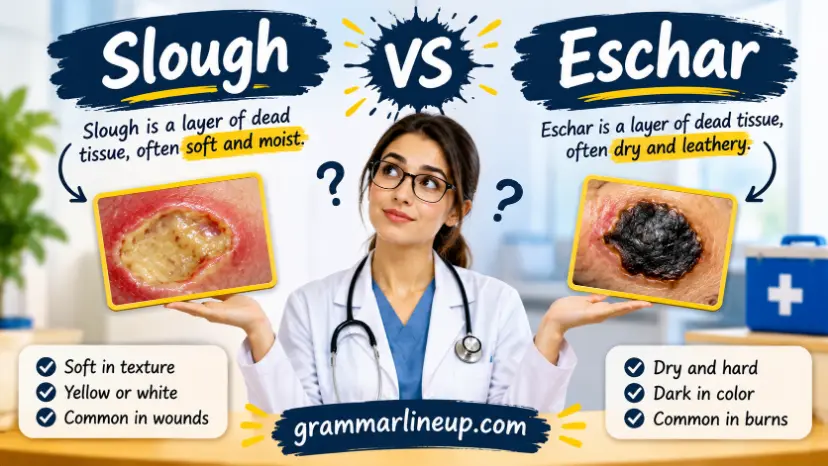
If you’ve come across the terms slough and eschar, you may wonder whether they mean the same thing. Both words describe types of tissue that can appear in a wound, but they are not interchangeable. Understanding the difference can make wound descriptions easier to follow and help you recognize why healthcare professionals use these terms.
Slough is generally soft, moist, and often yellow, white, gray, or tan tissue found in a wound. It may consist of dead cells, fibrin, proteins, and other wound debris. Eschar, by contrast, is typically dry, thick, and firmly attached tissue that can look black, brown, or dark tan. Its appearance and texture are often quite different from slough.
The distinction matters because wound appearance can change as healing progresses, and different types of tissue may require different clinical considerations. However, color alone does not always tell the whole story. Texture, moisture, attachment, wound depth, and the surrounding skin can also provide important clues.
In this guide, we’ll explain slough vs. eschar in simple language, compare their key characteristics, and clarify common questions about how they appear in wounds. The goal is to make these sometimes confusing medical terms easier to understand without relying on complicated jargon.
Slough and eschar are both types of nonviable or dead tissue that can appear in wounds, but they are not the same. Slough is usually soft, moist, and yellow, tan, gray, or greenish, while eschar is typically thicker, drier, and tan, brown, or black. Correct identification matters because wound assessment and treatment depend on the wound’s condition and cause.
Slough or Eschar: What Is the Difference?
The simplest distinction is texture and appearance.
Slough is generally loose, soft, moist, and stringy or adherent tissue found in a wound bed. It can appear yellow, tan, gray, green, or brown.
Eschar is generally thicker, drier, and more firmly attached. It commonly appears tan, brown, or black and may have a leathery appearance. MedlinePlus describes eschar as a layer of dead tissue that commonly forms over a wound or burn.
| Feature | Slough | Eschar |
|---|---|---|
| General appearance | Yellow, tan, gray, green, or brown | Tan, brown, or black |
| Texture | Often soft, moist, stringy, or loosely attached | Often dry, thick, firm, or leathery |
| Location | Often visible within the wound bed | May cover part or all of the wound |
| What it represents | Nonviable tissue and wound debris | Dead tissue, often more firmly attached |
| Can it hide wound depth? | Yes | Yes |
| Should you remove it yourself? | No | No |
These descriptions are useful for understanding terminology, but color alone cannot safely diagnose what is happening in a wound.
The National Pressure Injury Advisory Panel (NPIAP) specifically describes unstageable pressure injuries as wounds whose bases are obscured by slough and/or eschar, making the true depth impossible to determine until the covering is sufficiently removed.
What Does Slough Mean?
Slough refers to nonviable tissue and wound material that can collect in a wound bed.
It often looks like a soft coating or stringy material rather than a dry, solid crust. Depending on the wound, slough may be yellow, tan, gray, green, or brown. NPIAP uses these colors when describing slough in pressure injuries.
Slough can make it difficult to see the healthy tissue underneath. It may also obscure how deep a wound actually is.
That distinction is important because the visible surface does not always reveal the full extent of tissue damage.
Slough in a wound
A wound containing slough may look:
- Moist rather than dry
- Yellow or tan
- Stringy or fibrinous
- Soft or loosely adherent
- Partly covered with drainage
However, these characteristics are descriptive rather than diagnostic. A yellow or green appearance does not automatically mean that a wound has an infection.
The wound needs to be considered as a whole, including drainage, odor, surrounding skin, pain, swelling, and changes over time.
What Does Eschar Mean?
Eschar is a layer of dead or necrotic tissue that commonly develops over a wound or burn. MedlinePlus lists burns, trauma, infections, pressure ulcers, and diabetic foot ulcers among situations in which eschar can form.
Eschar is commonly:
- Dry
- Thick
- Firm or leathery
- Tan, brown, or black
- More firmly attached than typical loose wound debris
It can form a covering over underlying tissue.
That covering can make the wound appear smaller or shallower than it actually is. In pressure injuries, NPIAP notes that when slough or eschar covers the wound base, the true depth cannot be determined from the visible surface.
Slough vs. Eschar: The Key Differences
The most useful way to remember the distinction is to think about soft versus thick and dry.
Slough tends to be softer and wetter.
Eschar tends to be thicker, drier, and more firmly attached.
There is an important limitation, though: real wounds do not always fit neatly into two visual categories.
A wound can contain both slough and eschar. NPIAP explicitly recognizes wounds in which both may be present.
A simple comparison
If a clinician documents slough, they may be describing soft or stringy nonviable material within the wound.
If they document eschar, they are generally describing a thicker layer of dead tissue, often with a dry, leathery appearance.
Neither term simply means “scab.”
A scab is part of the body’s normal healing response to a superficial injury, whereas eschar refers to dead tissue that can occur in wounds and burns. MedlinePlus describes a scab as dried blood that forms over a wound during normal healing.
Is Slough the Same as Eschar?
No.
Both terms relate to nonviable tissue, but they describe different appearances and characteristics.
Slough is generally softer, wetter, and more loosely associated with the wound bed. Eschar is generally thicker, drier, darker, and more firmly attached.
A wound may contain one, the other, or both.
This is why the phrase “slough or eschar” is not simply two different spellings for the same thing. In clinical wound documentation, the distinction can affect how the wound is described and whether its depth can be assessed.
Why Does the Difference Matter?
The distinction matters because dead tissue can hide the wound underneath.
For example, NPIAP’s pressure-injury classification states that an injury whose base is completely obscured by slough or eschar cannot be assigned a definitive depth until enough of that material is removed to reveal the wound base.
This does not mean every piece of eschar should automatically be removed.
In fact, NPIAP specifically states that stable, dry, adherent, intact heel eschar without erythema or fluctuance should not be removed, describing it as a natural biological cover.
That is one reason self-treatment based only on the appearance of a wound can be risky.
Does Slough or Eschar Mean the Wound Is Infected?
Not necessarily.
Slough and eschar indicate nonviable tissue, but their presence by itself does not establish that a wound is infected.
Other findings can be more important when infection is suspected, including increasing redness, swelling, worsening pain, pus or other abnormal drainage, foul odor, or fever. MedlinePlus advises contacting a healthcare provider when wounds develop signs such as increased redness or pain, swelling, pus or bleeding, fever, or worsening drainage.
So it is better to avoid the shortcut:
“Yellow tissue = infection.”
That conclusion is too broad.
The wound’s overall appearance and the person’s symptoms and clinical history matter.
What Is Debridement?
Debridement is the removal of dead or damaged tissue from a wound.
It can be part of wound treatment when clinically appropriate. MedlinePlus describes debridement as removing dead skin and tissue to help a wound heal.
There are different approaches to wound debridement, and the appropriate method depends on the wound and the patient’s circumstances.
The important point for someone searching “slough or eschar” is that you should not attempt to cut, scrape, or peel these tissues away yourself unless a qualified healthcare professional has specifically instructed you to do so.
A wound that contains significant necrotic tissue may require professional assessment to determine its depth, cause, blood supply, infection risk, and appropriate treatment.
Slough or Eschar in Pressure Injuries
The terminology is particularly important when discussing pressure injuries.
NPIAP describes an unstageable pressure injury as full-thickness tissue loss in which the wound base is obscured by slough and/or eschar. Until enough of that material is removed to expose the base, the true depth cannot be determined.
This explains why medical documentation may say something like:
- “Wound bed covered with slough”
- “Eschar obscures the wound base”
- “Slough and eschar present”
- “Depth unable to be determined”
These statements are describing what can and cannot currently be seen.
Is Eschar the Same as a Scab?
No.
This is one of the most common misunderstandings.
A scab forms when blood and wound fluid dry over a superficial injury. It is part of the normal healing process.
Eschar, on the other hand, is dead tissue that can form over wounds or burns.
They can look somewhat similar because both may be dark and attached to the skin, but they are not interchangeable medical terms.
Common Misunderstandings About Slough and Eschar
“Black tissue is always eschar.”
Not necessarily. Color alone is not enough to identify wound tissue reliably.
Eschar is often tan, brown, or black, but the wound needs to be assessed in context.
“Yellow tissue always means infection.”
No. Slough can be yellow, but its presence does not by itself establish infection.
“Eschar should always be removed.”
No. Treatment depends on the wound and clinical situation. NPIAP specifically notes that stable, intact heel eschar without signs such as erythema or fluctuance should not be removed.
“Slough and eschar are the same thing.”
No. They are related terms describing different forms or appearances of nonviable tissue.
“I can remove it at home.”
It is not safe to assume that. Removing tissue can cause bleeding, damage viable tissue, or expose a deeper wound.
When Should a Wound Be Professionally Assessed?
A wound deserves medical attention when it is deep, worsening, not healing, or showing possible signs of infection.
MedlinePlus notes that wounds that do not heal may require specialized wound-care services, particularly when conditions such as diabetes, poor circulation, nerve damage, or infection are involved.
Seek professional advice if a wound has:
- Increasing redness or swelling
- Increasing or persistent pain
- Pus or worsening drainage
- Bad odor
- Fever or chills
- Increasing size or depth
- Black or darkened tissue
- Significant tissue loss
- Difficulty healing
- A suspected pressure injury
- A diabetic foot wound or other chronic wound
A wound that is becoming larger, deeper, darker, or more painful should not be judged by appearance alone.
How to Remember Slough vs. Eschar
A simple memory aid can help:
Slough = soft and moist.
Eschar = thick and dry.
That is only a general description, not a diagnostic test.
If you’re reading a wound-care note, remember that the terms are being used to describe what the clinician sees in or over the wound bed, not necessarily to identify the cause of the wound.
Related Terms You May See
Understanding nearby terminology makes wound-care language easier to follow.
| Term | General meaning |
|---|---|
| Slough | Soft or stringy nonviable tissue in a wound |
| Eschar | Thick, dead tissue that can cover a wound |
| Necrotic tissue | Dead tissue |
| Debridement | Removal of dead or damaged tissue |
| Wound bed | The tissue surface within a wound |
| Scab | Dried blood and wound fluid over a healing superficial injury |
| Pressure injury | Tissue damage associated with pressure and/or shear |
These terms are related, but they are not interchangeable.
FAQs:
Is slough worse than eschar?
Neither term automatically means that one wound is “worse.” Slough and eschar describe different types or appearances of nonviable tissue. The seriousness of a wound depends on factors such as its depth, cause, location, blood supply, infection status, and overall healing conditions.
What color is slough?
Slough may appear yellow, tan, gray, green, or brown. NPIAP uses these colors in its description of slough in pressure injuries.
What color is eschar?
Eschar is commonly described as tan, brown, or black. It may also have a dry, thick, or leathery appearance.
Can a wound have both slough and eschar?
Yes. A wound can contain both. NPIAP’s pressure-injury guidance specifically describes wounds where slough and eschar may both be present.
Does eschar mean a wound is healing?
Not necessarily. Eschar is dead tissue, so its presence should not automatically be interpreted as a sign of healthy healing. The meaning depends on the wound and its clinical circumstances.
Should I remove slough or eschar myself?
Do not cut, scrape, or pull tissue from a wound on your own. Whether nonviable tissue should be removed, and how, depends on professional assessment of the wound.
Cocnlusion:
Slough and eschar are not the same. Slough is generally softer, wetter, and yellow-to-gray or greenish, while eschar is generally thicker, drier, darker, and more firmly attached. Both can obscure the wound beneath them, but their presence does not by itself prove infection or determine the severity of a wound.
The safest way to understand the difference is to treat these as clinical wound-care terms rather than simple color labels. A qualified healthcare professional can determine what the tissue represents and whether any treatment or debridement is appropriate.
