
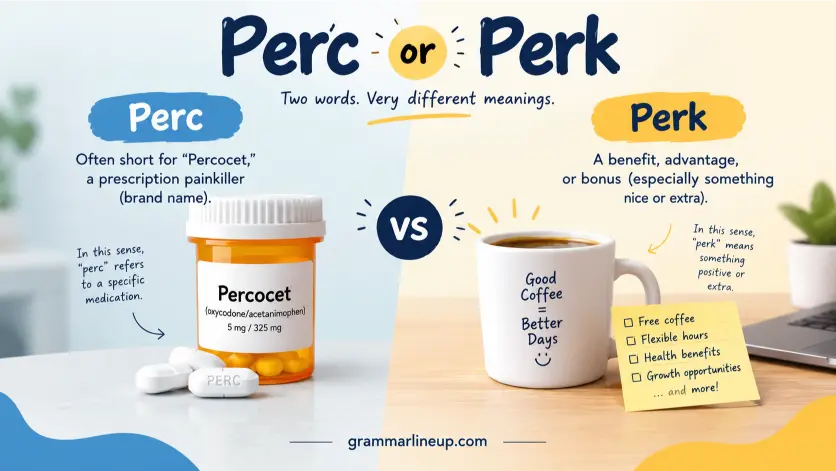
Perc or perk these two words may look and sound surprisingly similar, but they do not mean the same thing. If you have ever paused while writing a sentence and wondered which one is correct, you are certainly not alone.
A small spelling difference can completely change the meaning of a word, especially when one term is a standard English word and the other is mainly used as an abbreviation or informal form.
In everyday English, perk is the word you will encounter far more often. It can refer to a benefit or advantage, such as a workplace perk, and it can also describe something that makes a person feel more cheerful or energetic. Perc, on the other hand, has more specific uses and may appear as a shortened form of another word in particular contexts.
Understanding the difference between perc or perk is useful when you want your writing to sound natural and precise. In this guide, we will look at what each word means, how it is used, and a few simple examples to help you remember the difference without any unnecessary confusion.
Featured Snippet Answer
“Perk” is usually the correct spelling when you mean an extra benefit, advantage, or something that makes a situation better. “Perc” can be an alternative spelling of “perk,” but it also has unrelated meanings, including a dry-cleaning chemical, a percolation test, and slang for Percocet. Context determines which meaning is intended.
What Does “Perk” Mean?
Perk has several established meanings in English, but the most common everyday noun meaning is an extra benefit or advantage.
For example:
- “Free parking is a nice perk of the job.”
- “One perk of working remotely is avoiding the commute.”
- “The hotel offers several perks to returning customers.”
Cambridge Dictionary defines perk as an informal advantage or something extra, such as money or goods, given because of a job. It can also refer more generally to an advantage that comes with a particular situation.
As a verb, perk can mean to become more lively, cheerful, or energetic, usually in the expression perk up.
For example:
“He perked up when he heard the good news.”
It can also be used for coffee, where perk means to percolate.
What Does “Perc” Mean?
Perc has more than one meaning, so it cannot always be treated as a simple misspelling of perk.
One dictionary lists perc as a variation of perk. In that sense, it can mean an informal benefit or perquisite.
However, perc also appears as a shortened form in technical and scientific contexts.
Perchloroethylene
In environmental and dry-cleaning contexts, perc is commonly used as a short form of perchloroethylene, a chemical historically used extensively as a dry-cleaning solvent. Merriam-Webster’s Scrabble dictionary also lists perc as a noun for a chemical used in dry cleaning.
Percolation or a perc test
In land and soil contexts, perc can refer to percolation, especially a soil or septic-system perc test. The meaning is determined by the surrounding words.
For example:
“The property needs a perc test before the septic system can be approved.”
Here, perc has nothing to do with workplace benefits.
Percocet slang
In informal drug-related language, perc or percs can be a shortened form of Percocet. This is a separate slang meaning and should not be confused with the ordinary noun perk.
Perc vs. Perk: The Main Difference
The easiest way to understand the difference is to look at context.
| Word | Common meaning | Example |
|---|---|---|
| perk | An extra benefit or advantage | “Free lunch is a job perk.” |
| perk | Become more energetic | “She perked up after resting.” |
| perk | Percolate, especially coffee | “The coffee is perking.” |
| perc | Alternative form of perk in some usage | “The job has several percs.” |
| perc | Perchloroethylene | “The dry-cleaning process uses perc.” |
| perc | Percolation/perc test | “The land passed its perc test.” |
| perc | Informal shortening of Percocet | “Perc” can occur in drug-related slang. |
So, if you are talking about benefits or advantages, perk is the safest and most widely recognized spelling.
If you are reading perc, don’t automatically assume it means perk. The surrounding sentence may point to an entirely different meaning.
Is “Perc” a Correct Spelling of “Perk”?
Yes, in some contexts—but “perk” is generally the standard spelling for the everyday benefit meaning.
Dictionary.com specifically lists perc as a variation of perk.
However, using perc instead of perk in ordinary writing can create confusion because perc already has several established meanings.
For example:
Clear:
“Free meals are one of the best perks of the job.”
Potentially confusing:
“Free meals are one of the best percs of the job.”
The second sentence can be understood, but perks is the more familiar choice for most readers.
For professional writing, schoolwork, business communication, and general web content, perk/perks is normally the better choice when you mean an extra benefit.
Why Is “Perk” Short for “Perquisite”?
The noun perk meaning an extra benefit comes from perquisite, a word referring to a privilege, benefit, or profit obtained in addition to regular pay or entitlement.
Merriam-Webster explains that perk was formed by shortening and altering perquisite. Its etymology source dates this noun sense to 1869.
This is useful because it explains why a perk is usually something extra.
For example, your salary is normally part of your regular compensation. A company car, free meals, flexible benefits, or other additional advantages may be described as perks.
The word’s history is separate from the older verb perk, which has been used for centuries with meanings involving becoming upright, lively, or jaunty.
How to Use “Perk” in Texts and Chats
In texting and casual conversation, perk is usually straightforward.
Talking about benefits
“The free gym membership is a nice perk.”
😉Talking about advantages
“One perk of living downtown is that everything is close.”
Talking about someone’s mood
“You seem more awake today.”
“Yeah, I finally perked up.”
Using “perks” casually
“What are the perks of the new job?”
“There are some pretty good perks.”
In these situations, perk sounds natural and familiar.
Real Conversation Examples
Workplace conversation
Alex: “Do you like your new job?”
Jordan: “Yeah. The pay is good, and the health benefits are a nice perk.”
Here, perk means an additional benefit.
Talking about a lifestyle advantage
Mia: “Do you like working from home?”
Sam: “Definitely. Not having to commute is a huge perk.”
Here, perk means an advantage.
Talking about energy
Mia: “You look tired.”
Sam: “I am. I just need some coffee to perk me up.”
Here, perk up means to become more energetic or alert.
Talking about a property
Buyer: “Did the land pass the perc test?”
Agent: “Yes, according to the report.”
Here, perc refers to a percolation test, not a job benefit.
Meaning by Context
Because perc has several meanings, context is especially important.
In jobs and employment
Perk usually means an additional benefit.
“Remote work is one of the company’s biggest perks.”
In everyday conversation
Perk can mean an advantage.
“A perk of being early is getting a good seat.”
With “up”
Perk up means to become more lively, cheerful, or energetic.
“He perked up after hearing the news.”
With coffee
Perk can be related to percolating coffee.
“The coffee is perking.”
This is a less common everyday usage than the “benefit” meaning.
In real estate or construction
Perc can refer to a perc test, particularly one assessing soil’s ability to absorb water for certain septic-system considerations.
In dry cleaning and environmental discussions
Perc can refer to perchloroethylene, a chemical associated with dry-cleaning processes.
In drug-related slang
Perc may be used as a shortened form of Percocet. This is a slang meaning and is distinct from perk meaning a benefit.
When to Use “Perk”
Use perk when you mean:
- an extra benefit
- an advantage
- a workplace benefit
- something positive that comes with a situation
- becoming more energetic when used as a verb
- becoming more cheerful in the phrase perk up
Examples:
- “Flexible hours are a major perk.”
- “Free parking is another perk.”
- “The good news really perked her up.”
For most general-audience writing, perk is the clearest choice.
When Not to Use “Perk”
Don’t automatically use perk when the context specifically calls for perc.
For instance, a technical sentence about a perc test should retain perc because it refers to a different term.
Likewise, a sentence discussing perchloroethylene may use perc as its established shortened form.
The same applies to specialized slang. Changing perc to perk can change or obscure the intended meaning.
The key is simple: choose the spelling based on the meaning, not just the sound.
Common Misunderstandings
“Perc” always means “perk”
Not necessarily.
Perc can be an alternative form of perk, but it also has independent meanings.
“Perk” only means a job benefit
No. A perk can be any advantage or extra benefit, not just something offered by an employer. Cambridge gives both job-related and general-advantage uses.
“Perk” and “perky” are unrelated
They are connected historically through the older verb sense of perk, which involves being lively or jaunty. Perky developed from that sense.
“Perc” is always slang
No. Perc appears in ordinary technical vocabulary too, including references to perchloroethylene and percolation.
“Perk” and “perc” sound different
In standard English pronunciation, they are generally pronounced alike. The distinction is primarily spelling and meaning, rather than pronunciation.
Similar Words and Alternatives
Depending on what you mean, several words can replace perk.
When “perk” means a benefit
Useful alternatives include:
- benefit
- advantage
- bonus
- privilege
- extra
- incentive
- added benefit
For example:
“Free parking is a perk.”
can become:
“Free parking is an added benefit.”
When “perk up” means becoming more energetic
Possible alternatives include:
- brighten up
- cheer up
- become livelier
- become more energetic
- regain energy
- become more alert
The best alternative depends on the sentence and tone.
FAQs:
Is “perc” the same as “perk”?
Sometimes. Perc is listed as a variation of perk, including the informal noun sense meaning a benefit or perquisite. However, perc also has other meanings, so the two words are not interchangeable in every context.
Which is correct: “perc” or “perk”?
For an extra benefit or advantage, perk is generally the clearest and most familiar spelling. Perc can appear as a variant, but it also has separate technical and slang meanings.
What does “perk” mean in texting?
In casual messages, perk usually means an advantage, benefit, or extra, especially when someone says something is “a perk.” It can also appear in perk up, meaning to become more energetic or cheerful.
What does “perc” mean in slang?
Depending on context, perc can be slang for a Percocet tablet. It is also used in other contexts, so the surrounding conversation matters.
What does “perk up” mean?
Perk up means to become more lively, cheerful, energetic, or alert. For example, “She perked up when she heard the good news.”
Is “perk” short for “perquisite”?
Yes. The noun perk, meaning an additional benefit or privilege, developed as a shortened form of perquisite. The noun sense is documented from the 19th century.
Final Takeaway:
If you’re talking about an extra benefit or advantage, use perk.
Perk = benefit, advantage, or extra.
Perc can sometimes be an alternative spelling of perk, but it also has distinct meanings involving percolation, perchloroethylene, and Percocet slang. That’s why context matters.
For everyday writing, especially when discussing jobs, benefits, or advantages, “perk” is usually the safest and clearest choice.
