
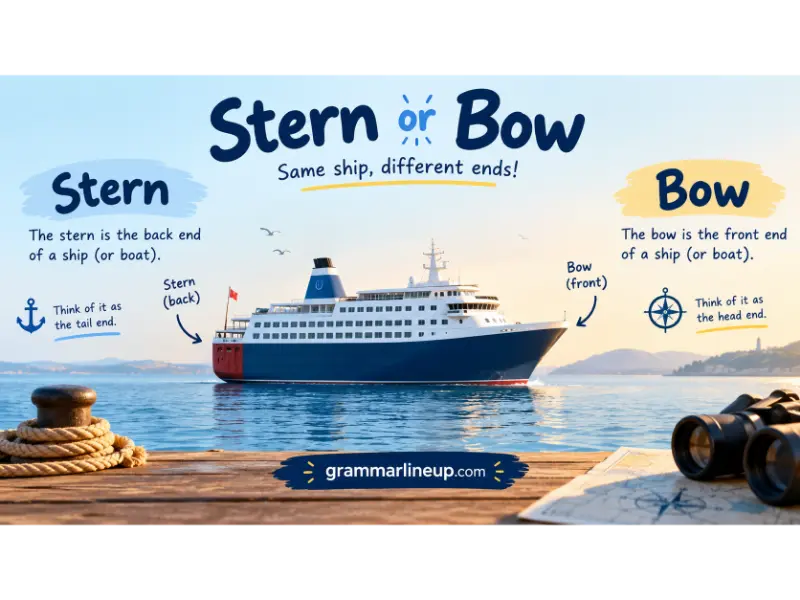
If you have ever looked at a boat and wondered which end is the stern and which is the bow, you are not alone. These two nautical terms are simple once you know what they mean, but they can be easy to mix up at first.
The bow is the front of a boat or ship, while the stern is the back. Unlike everyday words such as front and back, these terms are used consistently in boating, sailing, navigation, and maritime writing.
Knowing the difference between stern and bow can make descriptions of ships much easier to understand. Whether you are reading about a cruise ship, learning basic sailing terminology, or simply trying to follow directions on a boat, knowing which end is which is useful.
In this guide, we will explain stern or bow, how to remember the difference, and how these terms are used in real conversations and nautical contexts.
Featured Snippet Answer
Stern and bow describe opposite ends of a boat or ship. The bow is the front, while the stern is the back or rear. If a vessel is moving forward, it travels toward its bow, with the stern behind it. Aft means toward the stern, while forward means toward the bow.
What Does Stern or Bow Mean?
If you have encountered the phrase “stern or bow” while reading about boats, ships, sailing, or navigation, the basic distinction is simple:
- Bow = front of the vessel
- Stern = back or rear of the vessel
These are standard nautical terms rather than slang or texting abbreviations. Official maritime terminology uses bow for the front and stern for the rear.
For instance, if someone says, “Stand near the bow,” they mean the front part of the boat. If they say, “Move toward the stern,” they mean move toward the back.
The words become especially useful because sailors often need precise directions. Saying “front” or “back” is understandable, but nautical communication commonly uses terms such as bow, stern, forward, and aft.
Quick Answer: Bow vs Stern
| Term | Meaning | Easy way to think about it |
|---|---|---|
| Bow | Front of a boat or ship | Where the vessel heads |
| Stern | Back or rear of a boat or ship | What follows behind |
| Forward | Toward the bow | Toward the front |
| Aft | Toward the stern | Toward the back |
A useful official boating glossary gives the same basic distinction: the bow is the front of a vessel, while the stern is its back or rear.
What Is the Bow of a Boat?
The bow is the most forward part of a boat or ship. In ordinary movement, it is the end pointing in the direction the vessel is traveling.
You may hear expressions such as:
- “The passengers are standing at the bow.”
- “A wave crashed over the bow.”
- “The anchor is near the bow.”
- “Look toward the bow.”
- “The ship’s bow entered the harbor first.”
The word bow can be confusing for English learners because it has other meanings and pronunciations.
In the nautical sense, bow refers to the front of a vessel. The same spelling can also refer to bending forward, a decorative ribbon, or an archery weapon, depending on pronunciation and context.
So when someone says, “The bow of the boat is damaged,” the surrounding words make the nautical meaning clear.
What Is the Stern of a Boat?
The stern is the back or rear end of a boat or ship. Cambridge Dictionary defines the nautical noun as the back end of a ship.
Common phrases include:
- “The engine is located near the stern.”
- “We sat at the stern.”
- “The stern was damaged.”
- “Move toward the stern.”
- “A smaller boat approached the stern.”
Stern also has meanings unrelated to boats. As an adjective, it can describe someone or something that is strict, serious, or firm.
For example:
“The teacher gave him a stern warning.”
Here, stern does not mean the back of a boat. It means strict or serious.
There is also an informal noun use referring to a person’s bottom, but that meaning is quite different from the nautical sense.
Stern or Bow: The Main Difference
The easiest way to understand the two words is to imagine yourself standing inside a boat and looking in the direction the boat normally travels.
In front of you is the bow. Behind you is the stern.
This relationship also explains two important nautical directions:
- Forward = toward the bow
- Aft = toward the stern
The National Oceanic and Atmospheric Administration’s small-boat terminology similarly defines the bow as the most forward part and the stern as the rear portion.
A simple visual idea
STERN ← BACK | BOAT | FRONT → BOW
This is not a statement about which side is left or right. The bow and stern identify the vessel’s ends, not its sides.
How to Remember Stern and Bow
If you regularly mix these words up, a simple directional association can help:
Bow = front
Stern = rear
Then connect the related nautical words:
Forward → bow
Aft → stern
Another useful trick is to remember that a vessel generally moves toward its bow. So if you picture a boat traveling across the water, the end leading the movement is the bow, and the end following behind is the stern.
For a beginner, this four-word pattern is enough:
Bow = front. Stern = back. Forward = bow. Aft = stern.
Stern or Bow in Real Conversations
These terms appear naturally in boating instructions and conversations.
On a tour boat
Guide: “Please remain clear of the bow.”
Passenger: “Is that the front?”
Guide: “Yes, the front of the boat.”
The guide is using bow to identify the front section.
During docking
Captain: “Keep an eye on the stern.”
Crew member: “The rear looks clear.”
Here, stern refers to the rear of the vessel.
Talking about views
“We sat near the bow and watched the waves ahead.”
The sentence works because the bow is the forward end.
Talking about an engine
“The equipment near the stern was making a loud noise.”
Here, stern identifies the rear portion of the vessel.
Stern vs Bow by Context
The meaning is usually straightforward, but context can make these words easier to understand.
| Context | Bow | Stern |
|---|---|---|
| Position | Front | Back |
| Direction | Forward | Aft |
| Movement | Leads the vessel | Follows the vessel |
| Common phrase | At the bow | At the stern |
| Related adjective | Forward | Aft |
| Common association | Front end | Rear end |
One important point: bow and stern are not the same as port and starboard.
Port and starboard describe the vessel’s left and right sides when facing forward. Bow and stern describe its front and back.
Stern, Bow, Aft, and Forward
These four terms are often learned together because they describe position on a vessel.
Bow
The bow is the front end.
“The crew moved toward the bow.”
Stern
The stern is the rear end.
“The boat’s stern was closest to the dock.”
Forward
Forward means in the direction of the bow.
“Move forward.”
Aft
Aft means toward the stern.
“The cabin is located aft.”
This vocabulary appears frequently in boating, maritime safety material, ship descriptions, and navigation.
Common Misunderstandings
Is the stern the front or back?
The stern is the back of a boat or ship. The bow is the front.
Is the bow always the front?
In standard nautical terminology, the bow is the forward end of a vessel.
Are bow and stern the same as left and right?
No.
The bow and stern identify the front and rear. Port and starboard identify the left and right sides when facing forward.
Does “stern” only refer to boats?
No. Stern has other English meanings. As an adjective, it can mean strict or serious. Cambridge also records an informal noun meaning a person’s bottom.
Does “bow” have other meanings?
Yes. Bow is a homograph with several meanings and pronunciations. In a nautical context, it means the front part of a boat or ship.
Common Phrases With Stern and Bow
You may encounter these expressions in books, travel writing, boating guides, and everyday maritime conversation.
At the bow
Means at or near the front of a vessel.
At the stern
Means at or near the rear.
Bow to stern
Means extending from the front to the back.
Stem to stern
An established expression meaning from one end of a vessel to the other. The word stem refers to a structural part at the bow.
Stern-first
Means with the rear end leading or moving first.
Bow-first
Means with the front end leading or moving first.
From bow to stern
Used to describe something covering the vessel from front to rear.
These phrases can also appear figuratively in broader writing, especially when describing something from one end to another.
Why Do Boats Have These Terms?
Ships need precise positional language because “left,” “right,” “front,” and “back” can become less practical when different people face different directions.
Maritime terminology provides a consistent reference system. For example, a person facing toward the bow can identify port and starboard, while bow and stern remain fixed parts of the vessel.
Historical boating literature also treats the distinction as foundational vocabulary: the bow is the front end, the stern is the rear, forward points toward the bow, and aft points toward the stern.
This terminology remains in use today across recreational boating and professional maritime contexts.
How to Use “Stern or Bow” Correctly
If you’re writing a sentence and aren’t sure which word to choose, ask one question:
Am I talking about the front or the back of the vessel?
Use bow for the front:
“The photographer stood at the bow.”
Use stern for the back:
“The passengers gathered at the stern.”
If you mean movement toward the front, use forward. If you mean movement toward the back, use aft.
This approach is more reliable than trying to memorize complicated rules.
When Not to Use Bow or Stern
Don’t automatically use bow or stern when you simply mean the front or back of an ordinary object.
For example, saying:
“The stern of the car”
would sound unusual unless you’re deliberately using nautical terminology metaphorically.
For regular objects, front and back are normally more natural.
Also, don’t confuse stern as a boat term with stern meaning strict:
“The captain stood at the stern.” → rear of the boat
“She gave him a stern look.” → serious or strict
Context determines which meaning applies.
Similar Nautical Terms
Once you understand stern and bow, several related terms become much easier.
- Aft: toward the stern or rear.
- Forward: toward the bow or front.
- Port: left side when facing the bow.
- Starboard: right side when facing the bow.
- Amidships: around the middle of a vessel.
- Beam: the widest part of a vessel.
- Transom: a structure forming the stern of certain boats.
These terms are useful because they allow people on a vessel to communicate location more precisely.
FAQs:
Is the stern the front or back of a boat?
The stern is the back or rear of a boat or ship. The opposite end, the bow, is the front.
Which is the bow on a ship?
The bow is the forward end, or front, of the ship. It is the end toward which the vessel normally travels.
What is the difference between bow and stern?
The bow is the front of a vessel, while the stern is the back. Think of them as the two opposite ends of the boat.
Is aft the same as stern?
Not exactly. Stern is the rear part of the vessel, while aft describes a direction or position toward that rear part.
Is the bow left or right?
Neither. The bow is the front. Left and right are described using terms such as port and starboard when facing forward.
Why is the word “bow” confusing?
Because bow has several meanings and can have different pronunciations in English. In boating, however, it means the front part of a vessel.
Final Takeaway:
Stern = back. Bow = front.
That’s the essential distinction. When you’re talking about a boat or ship, the bow is the forward end, while the stern is the rear end. Forward means toward the bow, and aft means toward the stern.
Once you connect these four terms—bow, stern, forward, and aft—nautical directions become much easier to understand.
The next time you hear “meet me at the stern”, you’ll know they’re sending you to the back of the boat—not the front.
