
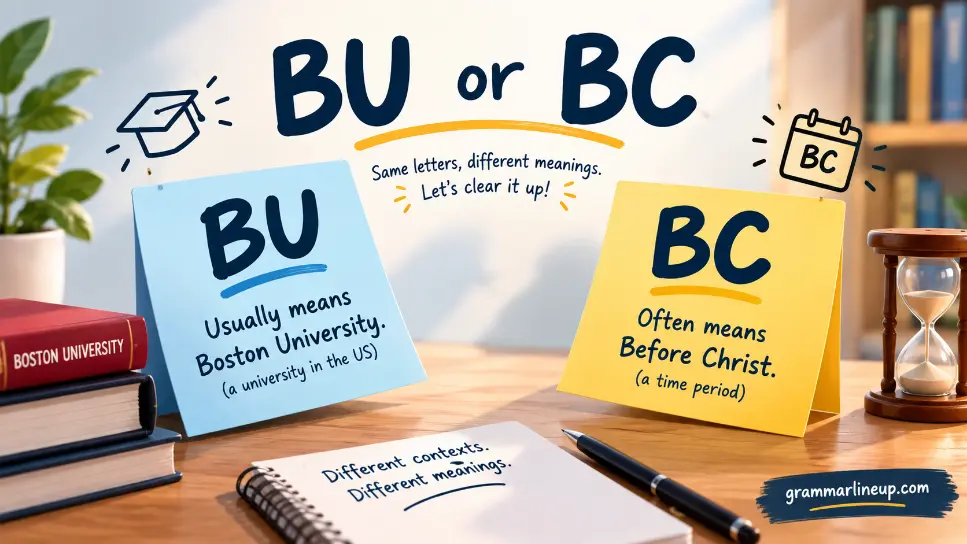
If you have come across “BU” or “BC” and wondered what these short forms mean, you are not alone. Tiny abbreviations can be surprisingly confusing, especially when the meaning changes depending on the conversation, subject, or platform where they appear. One simple letter can sometimes make a bigger difference than expected.
In everyday texting and online communication, BU and BC may appear as quick shorthand, but they do not always mean the same thing. BC is commonly used to mean “because” in casual messages, while BU can have several meanings depending on context. That is why guessing from the letters alone can sometimes lead to confusion.
In this guide, we will explain the common meanings of BU or BC, how they are used, and how to understand them from context. You will also see simple examples that make each meaning easier to recognize.
Whether you spotted these abbreviations in a text, social media post, schoolwork, or an online conversation, this guide will help you understand what the writer likely meant without overthinking two very small letters.
BC usually means “because” in texting and online chats. BU is less standardized and can have several meanings depending on context, including “But You” in some chat-abbreviation references or “backup” in some texting dictionaries. If bu appears where “but” would make sense, it may simply be a typo or informal shortening.
What Does “BU or BC” Mean?
The simplest way to understand bu or bc is to separate the two abbreviations rather than treating them as a matched pair.
| Short form | Common meaning in relevant contexts | Main function |
|---|---|---|
| BC / bc | Because | Gives a reason |
| BU / bu | Context-dependent | May represent “But You,” “backup,” or a typo/other abbreviation |
The important point is that BC has a much clearer texting meaning than BU.
For instance:
“I stayed home bc I was tired.”
Here, bc clearly means because.
By contrast:
“I wanted to go bu it was raining.”
A reader will probably interpret bu as a missing-letter version of but, because but creates the required contrast. Grammar and language tools flag “bu” as a possible typo and suggest words such as by, but, bug, or bus.
That distinction matters when you’re reading a text. You should not automatically expand every BU into one particular word.
BC Meaning in Texting
In texting, BC most commonly means “because.”
It functions as a shortened version of the conjunction because, which introduces a reason or explanation. Cambridge Dictionary recognizes this informal use and gives examples of bc in social media and text messages.
For example:
- “I left early bc I was tired.”
- “I didn’t call bc I was busy.”
- “I’m staying home bc it’s raining.”
- “She smiled bc she got good news.”
The full versions would be:
- “I left early because I was tired.”
- “I didn’t call because I was busy.”
- “I’m staying home because it’s raining.”
- “She smiled because she got good news.”
The meaning stays the same. BC simply makes the message shorter and more casual.
BU Meaning in Texting
Unlike bc, bu does not have one universally established meaning in everyday English texting.
This is where many online explanations become confusing.
Some abbreviation references list BU as “But You” in internet/chat usage. Other texting-reference sources list BU as “backup.” Outside texting, dictionaries also use bu for abbreviations such as bureau or bushel.
So the surrounding sentence is essential.
When “BU” May Mean “But You”
Some chat-abbreviation directories record BU as “But You.”
For example:
“Everyone agreed, bu you didn’t.”
However, this is not the same as saying that “bu” is a standard abbreviation for “but.” If the writer intended the conjunction but, the missing t may simply be a typo or personal shorthand.
When “BU” May Mean “Backup”
Some texting references define BU as “backup.”
For example:
“Can you BU the files?”
In a technology-related conversation, context could make backup a reasonable interpretation.
But because BU has several possible expansions, you should not assume this meaning without context.
BU vs. BC: What Is the Difference?
The biggest difference is certainty and function.
BC usually connects an action or statement to its reason:
“I didn’t go bc I was sick.”
Here, bc answers why?
BU, however, does not have one equivalent function.
If someone writes:
“I wanted to go, bu it was raining.”
the intended word is very likely but, because but introduces a contrast.
The correct standard-English sentence is:
“I wanted to go, but it was raining.”
In other contexts, BU might mean something else entirely.
A Simple Comparison
| Feature | BU | BC |
|---|---|---|
| Most reliable texting meaning | Context-dependent | Because |
| Standard English word? | No, as written | No, as a texting abbreviation |
| Can indicate a reason? | Not normally | Yes |
| Can indicate contrast? | Possibly if intended as “but,” but nonstandard | No |
| Formal writing | Avoid | Avoid |
| Context required | Strongly | Usually less |
How to Tell Whether “BU” Means “But”
If you encounter bu in a sentence, look at what comes before and after it.
Ask whether the writer is contrasting two ideas.
For example:
“I like the restaurant bu it’s expensive.”
The natural interpretation is:
“I like the restaurant, but it’s expensive.”
The contrast is between liking the restaurant and its high price.
Another clue is sentence structure. But commonly joins two ideas that differ, conflict, or qualify one another. The standard conjunction but is used to introduce contrast.
So if bu appears exactly where but should appear, a typo is often more plausible than a special piece of slang.
How to Use BC in Texts and Chats
Using bc is straightforward because its texting meaning is relatively stable.
Casual Texting
“I can’t come bc I have work.”
Group Chat
“Let’s meet later bc everyone is busy.”
Social Media
“I love this song bc the lyrics are so good.”
Quick Reply
“Bc I forgot 😂”
The abbreviation works especially naturally when the conversation is already casual.
You may also encounter:
- b/c
- B/C
- bc
- BC
These forms can represent because, although lowercase bc fits naturally into casual texting.
Real Conversation Examples
Conversation 1: BC as “Because”
Alex: Why didn’t you come?
Sam: I couldn’t bc I was working.
Here, bc = because.
Conversation 2: BC Giving a Reason
Mia: Are you staying home tonight?
Leo: Yeah, bc I’m exhausted.
The abbreviation introduces the reason for staying home.
Conversation 3: “BU” as a Possible Typo for “But”
Alex: Did you like the movie?
Sam: Yeah, bu the ending was weird.
The most natural correction is:
“Yeah, but the ending was weird.”
Conversation 4: BU as a Context-Dependent Abbreviation
Alex: Did you make a backup?
Sam: Not yet. I need to BU the folder.
In a technology-focused conversation, a reader might interpret BU as backup, although the writer could simply write back up or backup for clarity.
Conversation 5: Both in One Message
“I wanted to join, but I couldn’t bc I had work.”
Notice that but and bc perform different jobs:
- but = contrast
- bc = reason
This is the easiest way to remember their grammatical roles.
Meaning by Context
Context can change the interpretation of short forms dramatically.
In Everyday Texting
BC usually means because.
BU needs more interpretation.
In Historical Writing
BC can mean Before Christ, as in:
“The city was founded in 300 BC.”
Cambridge Dictionary distinguishes this historical abbreviation from the informal texting use of bc.
In Canadian Addresses
BC can refer to British Columbia, the Canadian province:
“Vancouver, BC”
Again, the surrounding context tells you that it does not mean because. Cambridge Dictionary lists this geographic abbreviation separately.
In Business or Academic Contexts
BU can represent an organization, institution, business term, or another specialized abbreviation. For example, abbreviation references list Boston University among several possible meanings of BU.
This is why capitalization alone is not enough to determine meaning.
When to Use BC
BC works well when you’re having an informal conversation with people who understand texting shorthand.
Suitable situations include:
- Text messages
- Casual DMs
- Friendly group chats
- Informal social media comments
- Casual gaming chats
- Personal conversations
For example:
“I’ll call you later bc I’m driving.”
The meaning is easy to understand, and the informal style fits the setting.
When Not to Use BU or BC
Avoid relying on these abbreviations when clarity and formality matter.
Use the complete words in:
- Academic essay
- Job applications
- Formal letters
- Professional reports
- Client-facing emails
- Legal documents
- Official applications
Instead of:
“I couldn’t attend bc I was sick.”
write:
“I couldn’t attend because I was sick.”
And instead of:
“I wanted to go bu I was busy.”
write:
“I wanted to go, but I was busy.”
The full words eliminate ambiguity and look more polished.
Common Misunderstandings About BU and BC
“BU always means but.”
Not necessarily.
Some online abbreviation directories list BU as “But You,” but other sources give it different meanings. If bu appears where but naturally belongs, it may simply be a typo or personal shorthand.
“BC always means because.”
Not always.
In casual texting, bc usually means because, but BC can also refer to things such as Before Christ or British Columbia.
“BU and BC are interchangeable.”
They are not.
BC commonly expresses a reason:
“I stayed home bc I was tired.”
But expresses contrast:
“I wanted to go, but I was tired.”
They have different grammatical functions.
“Capital letters determine the meaning.”
Not reliably.
bc and BC can both appear in informal writing for because, while uppercase BC can also have other meanings. Context is more useful than capitalization alone.
Similar Texting Shortcuts and Alternatives
If you mean because, you may also encounter:
- bc
- b/c
- cuz
- coz
- cos
- ’cause
These forms are not identical in style or regional frequency, but they can serve as informal alternatives to because.
If you mean but, the safest choice is simply:
- but
Rather than relying on bu, write the full word when you want your meaning to be immediately clear.
If you mean backup, use:
- backup
- back up
depending on whether you need the noun or verb.
For example:
“Make a backup of the file.”
but:
“Please back up the file.”
This is clearer than using BU without context.
A Quick Memory Trick
Think of the functions rather than the letters:
BC → Because → gives a reason
“I left bc I was tired.”
BUT → contrast
“I wanted to stay, but I had to leave.”
BU → check the context
“BU” does not have one dependable everyday texting expansion.
This simple distinction prevents most confusion around bu or bc.
FAQs:
What does BC mean in texting?
In most casual text messages, BC means “because.” It is an informal abbreviation used to explain a reason. For example, “I stayed home bc I was tired” means “I stayed home because I was tired.”
What does BU mean in a text?
BU has no single universally accepted texting meaning. Some abbreviation references list it as “But You,” while other texting references define it as “backup.” The surrounding conversation is necessary to identify the intended meaning.
Is BU short for “but”?
It can appear that way in informal online writing, but bu is not a standard English abbreviation for “but.” If a sentence such as “I wanted to go bu it rained” clearly requires contrast, the writer probably intended but or made a typing error.
Is BC formal English?
No. When bc means “because,” it is an informal written abbreviation associated with texting and social media. In formal writing, spelling out because is clearer and more appropriate.
Can BC mean something other than “because”?
Yes. Depending on context, BC can mean Before Christ in historical dates or British Columbia in Canadian addresses. Context determines which meaning applies.
How can I tell what BU means?
Read the entire sentence and identify what meaning fits naturally. If bu appears where a contrast is needed, the writer may have intended but. If the conversation concerns files or technology, backup may be possible. If neither interpretation fits, asking the sender is safer than guessing.
Conclusion:
BC is relatively straightforward: in casual texting, it usually means “because.” It gives a reason or explanation.
BU is different. It has several documented abbreviation meanings and is not a standard, universally recognized replacement for but. Some references record “But You,” while others use “backup.”
If you see bu inside an ordinary English sentence, check whether it looks like a typo for but, by, bug, or bus before assigning it a slang meaning.
The easiest rule is:
BC = usually “because.”
BU = context matters.
BUT = use the full word when you mean contrast.
That approach keeps the meaning clear without assuming that every two-letter abbreviation has one fixed definition.
