
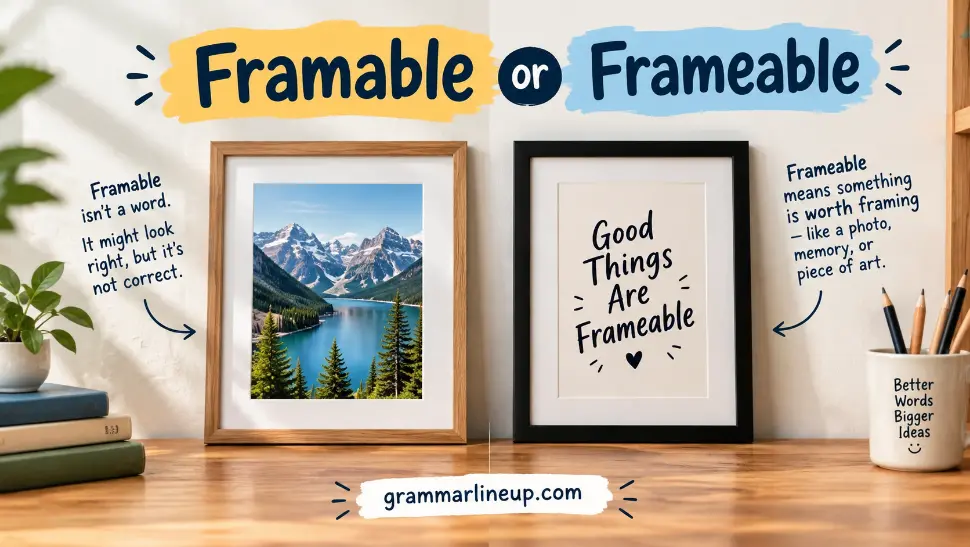
Have you ever paused over the words framable or frameable and wondered which spelling is correct? You are not alone. The two forms look almost identical, and the difference comes down to a small spelling question that can be surprisingly easy to overlook.
If you are writing an email, preparing an article, describing a photograph, or simply trying to use the word correctly, knowing which form to choose can make your writing clearer.
In most standard English usage, frameable is the more widely recognized and established spelling. It describes something that is suitable for putting into a frame, such as a photograph, artwork, certificate, or memorable picture.
Framable may also appear, particularly because English often allows words to be formed by adding -able to a verb, but it is much less common and can look unusual to many readers.
This guide explains the difference between framable and frameable, including their meanings, usage, examples, and pronunciation. You will also see how the words are formed and why frameable is generally the safer choice in everyday writing. By the end, choosing the right spelling should feel much more straightforward.
“Framable” and “frameable” are both valid English spellings meaning capable of being framed or suitable for framing. “Framable” is a recognized alternative form, while “frameable” is also well established in dictionaries and modern usage. The choice often depends on style or dictionary preference rather than a difference in meaning.
What Does “Framable or Frameable” Mean?
If you are wondering whether to write framable or frameable, the good news is that both forms are recognized English words.
They are adjectives formed from the verb frame with the suffix -able. In ordinary usage, both mean something that can be framed or is suitable for being put into a frame.
For example:
- “This photograph is framable.”
- “That painting is frameable.”
- “She found a beautiful, frameable print for the living room.”
There can also be a broader figurative meaning. Something can be frameable if it can be presented, interpreted, or structured in a particular way. Wiktionary, for instance, records this broader sense alongside the literal meaning.
The main issue is therefore not meaning but spelling preference.
Framable vs. Frameable: Quick Answer
| Word | Meaning | Valid? | Typical use |
|---|---|---|---|
| framable | Capable of being framed | Yes | A recognized alternative form |
| frameable | Capable of being framed or suitable for framing | Yes | A well-established spelling |
Collins lists framable or frameable as derived forms of frame.
Wiktionary likewise identifies framable as an alternative form of frameable, meaning that the two forms are not normally treated as different words with different basic meanings.
So if your question is simply “Which one is correct?”, the answer is:
Both are correct.
Is “Framable” a Word?
Yes. Framable is a legitimate English adjective.
It means capable of being framed. Wiktionary lists it as an English adjective and identifies it as an alternative form of frameable.
The form also has a long history. The World English Historical Dictionary records framable/frameable with historical examples going back centuries, including examples from the 1500s and 1600s.
So framable is not simply a modern typo or an invented internet spelling.
For example:
“The photograph is framable.”
This means the photograph is suitable for being placed in a frame.
Is “Frameable” a Word?
Yes. Frameable is also a valid English adjective.
It has the same basic meaning: able or suitable to be framed. Dictionary.com provides contemporary examples of frameable being used for pictures, illustrations, prints, and works of art.
For example:
“That landscape photograph is definitely frameable.”
Here, frameable suggests that the photograph is suitable for display in a physical frame.
The word can also be used more abstractly. Something may be frameable if it can be presented or interpreted within a particular conceptual framework.
Why Are There Two Spellings?
The difference comes from how English handles words ending in -e when adding the suffix -able.
The base word is frame. From it, English has developed both:
- framable
- frameable
Both forms appear in dictionaries and established English sources. Collins specifically gives framable or frameable as derived forms of frame.
There is also evidence of differing editorial preferences. For example, Garner’s Modern English Usage specifically prefers the spelling framable.
That does not make frameable incorrect. Other authoritative dictionary sources recognize and use frameable.
In other words, this is largely a variant-spelling issue, not a difference in meaning.
What Is the Difference Between Framable and Frameable?
In general English, there is no important difference in meaning between the two.
Framable
Framable means capable of being framed or suitable for framing.
“The old map is still framable.”
Frameable
Frameable carries the same basic meaning.
“The old map is still frameable.”
Both sentences communicate essentially the same idea.
The distinction is mainly orthographic and stylistic. Some dictionaries or style references favor one spelling, while others recognize both.
How to Use Framable in a Sentence
Framable works naturally when you are describing something that can be put into a frame.
- “I printed the photo in a framable size.”
- “The certificate is beautifully designed and completely framable.”
- “We found several framable illustrations online.”
- “That old family photograph is still framable.”
- “The artwork looks simple, but it is highly framable.”
It can also appear in less literal contexts when something can be structured or presented in a particular way.
The exact interpretation depends on the surrounding sentence.
How to Use Frameable in a Sentence
Frameable is equally useful in everyday descriptions of pictures, artwork, documents, and other objects.
- “This poster is frameable.”
- “She chose a frameable print for the hallway.”
- “The children’s artwork was surprisingly frameable.”
- “That certificate would look frameable in a wooden border.”
- “We selected several frameable illustrations for the exhibition.”
In contemporary writing, frameable is especially easy for readers to understand because the connection to frame remains visually obvious.
Meaning by Context
The word can take slightly different shades of meaning depending on context.
Photography and Art
Here, framable or frameable usually means suitable for putting into a physical frame.
“That sunset photo is frameable.”
Documents and Certificates
The word can describe something that is appropriate for display.
“The award certificate is frameable.”
Posters and Prints
It can refer to a print or poster that can be displayed in a frame.
“The shop sells affordable frameable art prints.”
Figurative Writing
In more abstract writing, frameable can mean capable of being presented or interpreted in a particular way.
For example:
“The story is frameable as a coming-of-age narrative.”
This figurative use is documented in dictionary material and is broader than simply putting an object inside a physical frame.
Framable or Frameable: Which Should You Use?
If you are writing for a general audience, either spelling can work.
However, consistency matters.
If your dictionary, publication, school, workplace, or style guide prefers framable, use that form consistently. If it uses frameable, that spelling is also supported by established dictionaries and real-world usage.
A practical rule is:
Use the spelling preferred by your chosen style guide or dictionary, and don’t treat the other form as automatically wrong.
For general American English, readers will understand both.
Common Misunderstandings
“Framable” must be a misspelling of “frameable.”
Not necessarily.
Framable is a recognized English word and is listed as an alternative form of frameable.
“Frameable” must have a different meaning.
Usually, it does not.
The two forms share the core meaning capable of being framed.
Only one spelling is grammatically correct.
That is too simplistic.
Major dictionary sources recognize both forms, although individual style references may prefer one.
“Framable” is only used for physical frames.
Not always.
The word can also have a figurative sense involving how an idea, story, or subject can be presented or interpreted.
Similar Words and Alternatives
Depending on the sentence, you may not need either form. Some alternatives are more natural in everyday English.
| Word or phrase | Meaning |
|---|---|
| suitable for framing | Appropriate to put in a frame |
| ready to frame | Prepared to be framed |
| worthy of framing | Good enough or attractive enough to frame |
| display-worthy | Suitable for display |
| suitable for display | Appropriate to display publicly or at home |
| frame-worthy | Informal expression meaning worth framing |
For example, instead of:
“This photograph is framable.”
you could write:
“This photograph is worth framing.”
That version may sound more natural in casual conversation.
When to Use It
Use framable or frameable when you specifically want to communicate the idea that something can be framed or is suitable for framing.
The words are particularly useful when discussing:
- photographs
- artwork
- posters
- prints
- certificates
- maps
- illustrations
- memorabilia
- decorative documents
They can also be useful in formal or analytical writing when discussing how an idea or narrative can be presented within a particular framework.
When Not to Use It
Although both words are valid, they can sound somewhat formal or unusual in casual conversation.
Instead of:
“Your vacation photo is very frameable.”
A natural speaker might simply say:
“Your vacation photo would look great in a frame.”
Similarly, “worthy of framing” can be clearer when you are emphasizing that something is especially attractive or memorable.
The best choice depends on what you want to emphasize: physical possibility, suitability, or desirability.
FAQs:
Is framable or frameable correct?
Both framable and frameable are recognized English forms. They generally mean capable of being framed or suitable for framing.
Is framable a real English word?
Yes. Framable is listed as an English adjective and as an alternative form of frameable.
What does frameable mean?
Frameable means capable of being framed or suitable for framing. It can describe photographs, artwork, prints, certificates, and similar objects. It can also have a figurative meaning related to presenting something within a particular framework.
Is there a difference between framable and frameable?
There is generally no significant difference in meaning. The main difference is spelling preference. Some references favor framable, while others recognize frameable as a standard form.
Which spelling is more common?
Usage varies by source and context, so it is better not to treat one spelling as universally correct and the other as incorrect. Major dictionary sources recognize both forms.
Can framable describe an idea?
Yes. In addition to the literal sense of being suitable for a physical frame, frameable can describe something that can be presented or interpreted in a particular way.
Conclsuion:
Framable and frameable are both legitimate English adjectives. Their core meaning is essentially the same: capable of being framed or suitable for framing. Framable is recognized as an alternative form, while frameable is also well established in dictionaries and contemporary usage.
If you are choosing between them, follow the spelling preferred by your dictionary or style guide and use it consistently. For everyday readers, either form should be understandable.
The key point is simple: “framable” is not automatically a mistake, and “frameable” is not the only acceptable spelling.
