
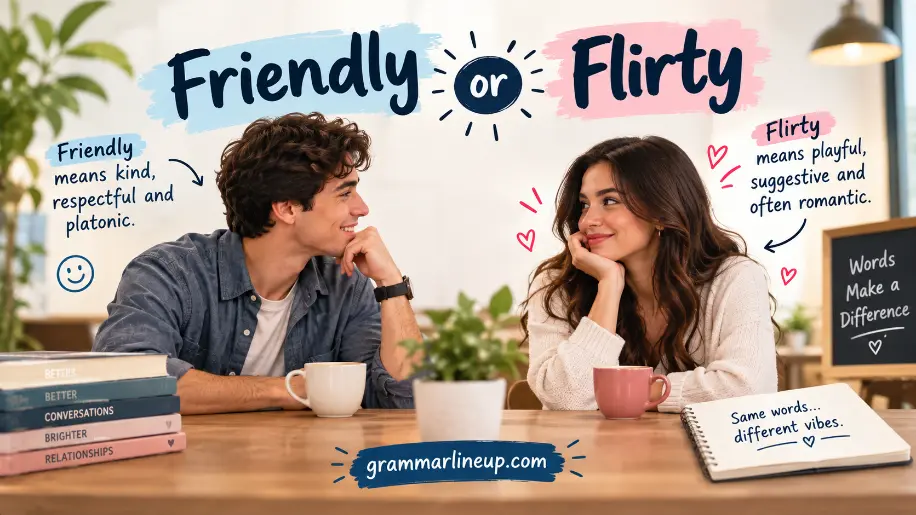
It can be surprisingly hard to tell when someone is simply being friendly and when they are showing a little extra interest. A warm smile, playful joke, quick reply, or thoughtful compliment can mean different things depending on the person and the situation. That is why the difference between friendly or flirty behavior is not always as obvious as it seems.
Friendly behavior usually comes from kindness, comfort, or a genuine desire to connect with someone. Flirting, on the other hand, often includes signals that suggest romantic or personal interest.
The tricky part is that these behaviors can overlap. Someone who is naturally outgoing may seem flirty without intending to be, while a quieter person might show interest in much subtler ways.
Context matters, too. The words someone uses, their tone, body language, consistency, and the setting can all change how a particular interaction feels. A compliment from a close friend may mean something very different from the same compliment coming from someone you have just met.
“Friendly or flirty” asks whether someone’s words or behavior show ordinary warmth and friendship or suggest romantic interest. Friendly communication is usually kind, comfortable, and socially open without a romantic message. Flirting tends to add playful, personal, or romantic signals. However, one text, emoji, compliment, or smile is rarely enough to know someone’s intent. Context and repeated behavior matter more.
What Does “Friendly or Flirty” Mean?
“Friendly or flirty” is usually a question about social intent.
Someone may behave warmly toward you, and you may wonder whether that warmth is simply their personality or whether they are trying to show romantic interest.
For example:
“You’re really fun to talk to.”
That could easily be friendly.
Now consider:
“You’re really fun to talk to. I think I could get addicted to this.”
The second message can carry a stronger romantic or playful undertone, especially if the surrounding conversation supports that interpretation.
The important distinction is that friendly describes a style of social interaction, while flirty describes communication that can signal attraction or romantic interest.
Research on interpersonal communication supports the idea that friendliness and flirtation can be recognized as different social styles, although the signals can overlap. One study of speed-dating conversations examined friendly and flirtatious speech using lexical, conversational, and prosodic features, showing that social intentions can be expressed through several parts of communication rather than one magic phrase.
In everyday life, though, you do not need to analyze someone’s speech with a scientific model. You can start by looking at the bigger pattern.
Friendly vs. Flirty: The Core Difference
The simplest way to understand the difference is this:
Friendly communication creates warmth and connection without necessarily suggesting romance. Flirty communication adds signals that may suggest attraction, romantic curiosity, or playful romantic tension.
| Friendly | Flirty |
|---|---|
| Warm and pleasant | Warm with possible romantic undertones |
| Usually socially comfortable | Often more personally focused |
| Can happen with almost anyone | May single out one person |
| Compliments can be general | Compliments may emphasize attraction |
| Often keeps things casual | May create romantic tension |
| Group interaction is common | One-on-one attention may be emphasized |
| Usually no expectation of romance | May test whether attraction is mutual |
These are tendencies, not rules.
A naturally affectionate person may seem flirty without intending to flirt. Someone who is genuinely interested may also be extremely subtle.
That is why no single behavior should be treated as proof of romantic interest.
Friendly Signs That Can Be Misread as Flirting
Some behaviors look romantic simply because they feel personal or enthusiastic.
They Reply Quickly
Fast replies can feel significant, especially when you like the person.
But some people simply reply quickly to everyone.
Response speed becomes more informative when combined with other patterns, such as consistently initiating conversations, asking personal questions, and creating opportunities to spend time together.
They Give You Compliments
“You’re really good at this.”
“You have a great sense of humor.”
“You look nice today.”
All three can be completely friendly.
A compliment becomes more potentially flirty when the surrounding conversation gives it romantic or attraction-related meaning. Even then, it is better to consider the overall pattern rather than treating the compliment as a declaration of interest.
They Use Lots of Emojis
😊😂❤️😉
Emojis are particularly easy to overinterpret because people have different texting habits.
One person may use a heart emoji with close friends and family. Another may use it mainly when expressing romantic affection.
The emoji itself does not provide enough context.
They Remember Small Details
Someone remembering your favorite coffee, a work deadline, or the name of your pet can feel special.
But remembering details can simply indicate that someone is attentive and cares about the friendship.
They Tease You
Playful teasing can be friendly banter.
It can also be flirting.
The difference often comes from how personal the teasing is, whether it is reciprocal, and what else is happening in the conversation.
Signs a Conversation May Be Flirty
There is no universal checklist that proves someone is flirting. However, certain patterns can make a romantic interpretation more plausible.
The Attention Feels More Personal
Instead of simply talking about a shared activity, the person repeatedly focuses attention on you.
For example:
“You always make conversations more interesting.”
That is more personally directed than:
“That was a fun conversation.”
Personal attention can be one part of flirtation, but it still needs context.
They Use Playful Romantic Teasing
Teasing can move toward flirting when it includes affectionate or attraction-related language.
For instance:
“You’re trouble, you know that?”
On its own, that could still be a joke between friends.
But if the conversation repeatedly contains this kind of playful tension alongside other romantic cues, the interpretation may change.
They Ask About Your Dating Life
Questions such as:
“Are you seeing anyone?”
“What’s your type?”
“Do you usually date people like that?”
can be relevant to romantic interest because they directly explore relationship availability or preferences.
Still, context matters. Friends sometimes discuss dating simply because dating is part of everyday conversation.
They Look for One-on-One Interaction
A group invitation and a personal invitation can carry different social meanings.
“A few of us are going to the movies. Want to come?”
is clearly social.
Compare it with:
“Want to grab coffee with me sometime?”
The second may create more room for romantic interpretation, particularly if it comes with other signs of attraction.
It does not automatically mean the person is flirting, however. Some people simply prefer one-on-one friendships.
The Pattern Continues
This may be the most useful clue.
Flirting is often easier to identify as a pattern than as an isolated action.
Research on flirting has examined different styles of communicating romantic interest, including traditional, physical, sincere, playful, and polite styles. This helps explain why flirting does not always look the same from one person to another.
Someone may flirt through humor.
Someone else may flirt through sincere compliments.
Another person may be more direct.
So there is no universal “flirting sentence.”
Friendly or Flirty Over Text?
Texting makes this question especially difficult because written messages remove many cues that are available in face-to-face conversation.
You cannot hear someone’s voice, see their facial expression, or observe their body language.
That means:
“You’re impossible 😂”
could be friendly teasing between longtime friends.
The exact same sentence could feel flirtatious between two people who recently met and have already shown mutual romantic interest.
A Simple Comparison
| Texting behavior | More likely friendly | May be flirty |
|---|---|---|
| Compliment | “You’re really helpful.” | “You looked amazing today.” |
| Check-in | “How’s your day going?” | “I was wondering when I’d hear from you.” |
| Teasing | “You’re such a goof 😂” | “You’re such a goof, but it’s cute.” |
| Plans | “Want to join everyone?” | “Want to go somewhere just us?” |
| Dating question | General conversation about relationships | Direct curiosity about your availability |
| Conversation | Mostly practical or casual | Repeatedly personal and playful |
| Emojis | Normal everyday use | Used as part of an already suggestive tone |
These examples are illustrative rather than universal rules.
The same words can change meaning depending on the relationship between the people involved.
Real Conversation Examples
Seeing the difference in context can be more useful than memorizing a list of signals.
Conversation A: Clearly Friendly
Person A: “Hey, did you finish that project?”
Person B: “Finally! I thought it would never end 😂”
Person A: “Haha, same. Want me to send you the notes?”
The interaction is warm and comfortable, but there is no obvious romantic direction.
Conversation B: Potentially Flirty
Person A: “You looked really good today.”
Person B: “Oh, really? 👀”
Person A: “Really. I was trying not to stare.”
This conversation contains a more direct attraction-related cue.
Conversation C: Ambiguous
Person A: “You’re cute 😂”
That could be flirting.
It could also be playful language between close friends.
Without knowing the relationship, the person’s usual communication style, and what came before and after the message, there is no reliable way to assign one definite meaning.
Conversation D: Context Changes Everything
Person A: “Wish you were here.”
At a friend’s birthday party, this could simply mean:
“You would have enjoyed this.”
During a private conversation between two people who have been showing romantic interest, it could suggest something more intimate.
The words have not changed.
The context has.
Why “Friendly or Flirty” Is So Easy to Misread
Human communication is rarely a simple code where one signal equals one meaning.
A person may smile because they are happy.
They may smile because they are nervous.
They may smile because they like you.
Or they may simply be a person who smiles a lot.
Research into flirting supports this complexity. A 2021 study investigated facial expressions associated with flirtation and found that some expressions were more readily recognized as flirtatious than others. The researchers also noted differences in how effectively flirtatious expressions were conveyed and recognized.
Another study examining speed-dating conversations found that linguistic and conversational features can help distinguish interpersonal stances such as friendliness and flirtation, but its automated system worked most clearly on particularly strong examples rather than every subtle interaction.
That distinction matters.
Subtle social signals are not guaranteed signals.
The Importance of Context
Before deciding that something is flirty, consider five things.
The Relationship
Are you coworkers, classmates, longtime friends, new acquaintances, or people who met through dating?
The same sentence can carry very different meanings in each relationship.
Their Normal Personality
Does this person compliment everyone?
Do they use heart emojis with all their friends?
Are they naturally playful?
A behavior is more meaningful when it is unusual for that person.
The Conversation Before It
Never isolate one sentence if the surrounding conversation provides important context.
A message can look completely different when you read the five messages before it.
The Pattern Over Time
One compliment is ambiguous.
Repeated personal attention, repeated romantic teasing, questions about availability, and efforts to spend one-on-one time may create a clearer overall pattern.
Cultural and Social Differences
Communication styles differ across cultures, families, communities, and individuals.
A behavior considered romantic in one setting may be ordinary friendliness in another.
This is one reason online “flirting checklists” should be treated as clues rather than universal rules.
When a Compliment Is Friendly or Flirty
Compliments are probably one of the biggest sources of confusion.
Consider:
“You did a great job.”
This is generally straightforward praise.
Now:
“You always make everything look effortless.”
Still potentially friendly.
Now:
“You looked ridiculously good tonight.”
That may have a stronger attraction-related tone.
But even the last sentence is not absolute proof of romantic interest. Some people speak dramatically or affectionately with friends.
A better question is:
Does the compliment fit the person’s normal way of communicating with you and with other people?
That question gives you more useful information than the compliment alone.
When to Use “Friendly” and “Flirty”
If you are describing your own communication, the words have fairly clear uses.
Use friendly when you mean:
- kind
- warm
- approachable
- pleasant
- supportive
- socially open
- non-romantic
Use flirty when you mean:
- playfully suggestive
- romantically interested
- attraction-oriented
- teasing in a romantic way
- intentionally signaling interest
For example:
“She was friendly and easy to talk to.”
This does not necessarily imply attraction.
“He was being flirty during the conversation.”
This suggests some form of romantic or attraction-related signaling.
When Not to Assume Something Is Flirty
It is easy to turn ordinary friendliness into a romantic signal when you already have feelings for someone.
Try not to treat these things as automatic proof:
- fast replies
- liking your posts
- laughing at your jokes
- remembering details
- using emojis
- giving ordinary compliments
- making eye contact
- asking how your day was
- being helpful
- joking with you
- sitting near you
- sending memes
Any of these can occur in ordinary friendship.
Even several of them together do not necessarily establish romantic intent.
The safest interpretation is often “possible, but not certain” until clearer communication appears.
Common Misunderstandings
“They Text Me Every Day, So They Must Like Me.”
Not necessarily.
Daily communication can reflect friendship, shared interests, habit, work, emotional support, or romantic interest.
The frequency matters less than the overall content and context.
“They Used a Heart Emoji, So They’re Flirting.”
Not necessarily.
Emoji habits vary enormously.
Look at the person’s baseline rather than assigning a universal meaning to one symbol.
“They Tease Me, So They’re Interested.”
Teasing is common among friends.
Romantic teasing may have a different tone, but even that is not conclusive by itself.
“They Asked If I’m Single, So They Definitely Like Me.”
That question can indicate romantic curiosity, but it can also arise naturally in conversations about relationships.
Consider what prompted the question and what happens afterward.
“They’re Very Nice to Me, So They Must Be Flirting.”
Kindness is not the same thing as attraction.
Someone can be exceptionally friendly without wanting a romantic relationship.
Friendly or Flirty: A Better Way to Read the Situation
Instead of asking, “What does this one message mean?”, ask:
“What pattern does this person’s behavior create?”
Look for consistency.
Do they repeatedly seek your company?
Do they initiate conversations?
Do they show personal curiosity?
Do they make romantic or attraction-related comments?
Do they treat you noticeably differently from other people?
Do they respond positively when the conversation becomes slightly more personal?
Even then, these are clues rather than certainty.
Research on flirting has found that people can communicate romantic interest in different styles, including playful and sincere approaches.
That means two people can have genuine romantic interest while behaving completely differently.
One might be bold.
Another might be shy.
One might joke.
Another might offer sincere compliments.
There is no universal flirting script.
Similar Terms and Alternatives
If you’re trying to describe the behavior, several related words may fit.
| Term | General meaning |
|---|---|
| Friendly | Warm, pleasant, and socially open |
| Flirty | Suggesting or expressing romantic interest |
| Playful | Lighthearted and fun, not necessarily romantic |
| Affectionate | Showing warmth or fondness |
| Charming | Pleasant and engaging |
| Romantic | Connected more directly with love or attraction |
| Teasing | Playfully making fun of someone |
| Suggestive | Implying something without stating it directly |
These terms overlap, but they are not interchangeable.
Someone can be playful without flirting.
Someone can be affectionate without romantic interest.
Someone can be charming without trying to date you.
FAQs:
Is “friendly or flirty” a slang phrase?
Not exactly. “Friendly or flirty” is better understood as a casual question people use when trying to interpret someone’s social or romantic intent. It is not a fixed slang expression with one official meaning.
How can you tell if someone is friendly or flirty over text?
Look at the overall pattern rather than one message. Consider the conversation’s context, the person’s normal texting style, how personal the attention is, whether romantic topics appear, and whether they repeatedly try to create one-on-one connection.
Does fast texting mean someone is flirting?
No. Fast replies can show enthusiasm or availability, but they do not prove romantic interest. Some people simply respond quickly to most messages.
Is teasing a sign of flirting?
It can be, but teasing is also common between friends. Romantic teasing usually becomes more meaningful when it appears alongside other attraction-related behavior.
Can a compliment be both friendly and flirty?
Yes. A compliment can have either meaning depending on wording, delivery, relationship, and context. “You did a great job” is usually neutral, while a compliment focused on someone’s attractiveness may carry more romantic weight.
What is the biggest difference between friendly and flirty?
The biggest difference is usually romantic intent or signaling. Friendly behavior creates warmth and connection without necessarily suggesting attraction. Flirting adds signals that may communicate romantic or sexual interest. Because intent is internal, however, outsiders cannot always know it from behavior alone.
Conclusion:
The difference between friendly or flirty is rarely hidden inside one magic word, emoji, compliment, or reply time.
Friendly behavior is generally warm, kind, and socially comfortable without necessarily suggesting romance. Flirty behavior can contain those same qualities but adds a possible layer of attraction, playful romantic tension, or intentional interest.
The most reliable approach is to look at the whole pattern:
- What is the relationship?
- How does this person normally communicate?
- Are they treating you differently?
- Is the attention becoming more personal?
- Are romantic topics appearing?
- Does the behavior continue over time?
Most importantly, do not turn an ambiguous signal into certainty.
Communication is messy. People have different personalities, cultures, texting habits, and ways of expressing interest. Even research examining flirting finds that signals can vary and may be subtle or difficult to interpret.
So if you’re wondering whether something was friendly or flirty, context is your best starting point—and clear, respectful communication is usually more reliable than trying to decode every emoji.
