
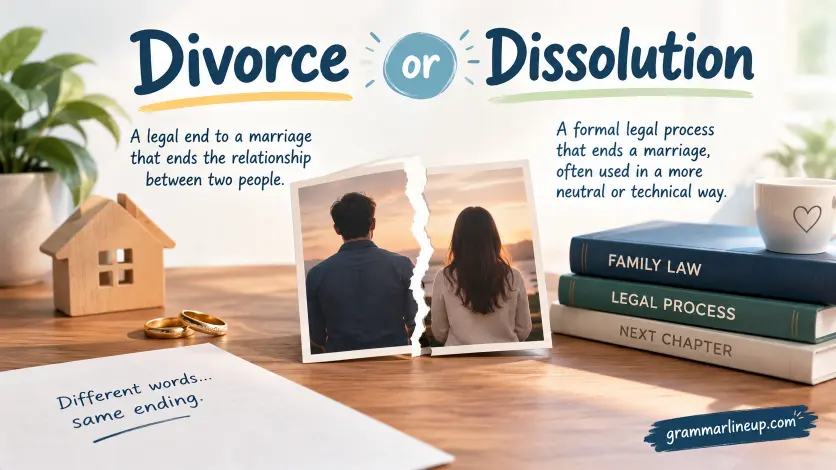
When dealing with relationship or legal terminology, small differences in wording can create surprisingly big questions. One common example is divorce or dissolution. Although the two terms can sometimes appear to describe the same situation, their meanings and usage may differ depending on the legal system, context, and type of relationship involved.
If you have come across both terms while reading a legal document, filling out a form, or simply trying to understand family-law language, it is reasonable to wonder which one is correct. Is “divorce” the everyday word while “dissolution” sounds more formal? Or do they actually refer to different legal processes?
The answer is not always as complicated as the terminology makes it seem. In general conversation, divorce is the familiar term for legally ending a marriage. Dissolution can also refer to the legal ending of a marriage, and in some jurisdictions it is used as the official legal term. However, the precise meaning can vary by location and circumstances
In this guide, we’ll explore divorce or dissolution, explain how the terms are commonly used, and highlight the key differences worth knowing. By the end, you should have a clearer understanding of the language without needing a law dictionary on your desk.
Divorce and dissolution can refer to the legal termination of a marriage. In many U.S. jurisdictions, “dissolution of marriage” is the formal legal term for divorce, while “divorce” is the everyday term. However, terminology and procedures vary by state or country, so the court handling the case is the best source for the exact meaning.
What Does “Divorce or Dissolution” Mean?
The phrase “divorce or dissolution” usually refers to two terms for ending a legally recognized marriage.
Divorce is the familiar everyday word. In legal usage, a divorce formally ends a legal marriage.
Dissolution of marriage describes the legal process or result of terminating the marital relationship. Cornell Law School’s Legal Information Institute defines dissolution of marriage as the legal process that terminates a marriage and notes that “divorce” and “dissolution” are often used interchangeably.
The important point is that these words do not have one universal meaning everywhere.
For example, California courts use dissolution as the legal term for divorce. California’s official self-help materials explain that the legal word for divorce in California is “dissolution.”
So, if someone asks:
“Should I say divorce or dissolution?”
the safest answer is:
Use the terminology used by the relevant court, legal document, or jurisdiction.
Divorce vs. Dissolution: Quick Comparison
| Term | General meaning | Typical context |
|---|---|---|
| Divorce | Legal ending of a marriage | Everyday speech and legal contexts |
| Dissolution | Legal termination of a marriage or other legal relationship | Formal/legal terminology |
| Dissolution of marriage | A legal proceeding that ends a marriage | Court forms and family-law documents |
| Legal separation | Spouses live separately while remaining legally married | Family-law proceedings |
| Annulment/nullity | Legal determination that a marriage was invalid or legally defective | Specific circumstances |
The distinction between divorce and dissolution is often terminological rather than substantive, particularly in jurisdictions such as California. California courts describe dissolution of marriage as divorce and explain that the proceeding can address property, debts, child custody, child support, and spousal support.
Is Divorce the Same as Dissolution?
In many U.S. legal contexts, yes.
For example, California courts explicitly describe dissolution of marriage as divorce. A final judgment of dissolution ends the marriage and can resolve related issues involving property, debts, children, and support.
However, it would be inaccurate to assume that every state or country uses the words in exactly the same way.
Legal terminology is controlled by the jurisdiction’s laws and court procedures. Even when two jurisdictions use different terminology, the practical goal may be similar: legally ending the marriage.
That is why a legal form might say “Petition for Dissolution of Marriage” even though people casually describe the same proceeding as filing for divorce.
Why Do Some Courts Say “Dissolution” Instead of “Divorce”?
The word dissolution emphasizes the formal legal ending of a relationship.
The term is not limited to marriage. In law, dissolution can describe the termination of other legal relationships, including certain partnerships or organizations.
For marriage, dissolution of marriage therefore describes the legal termination of the marital relationship.
California provides a particularly clear example. Cornell’s Legal Information Institute notes that California officially adopted the term dissolution of marriage instead of divorce in 1970, in connection with its no-fault approach to ending marriages.
This does not mean that Californians stopped saying “divorce.” Official court materials continue to explain the relationship between the two terms because divorce remains the common everyday expression.
Origin & Evolution of the Terms
The words have different linguistic histories and legal associations.
Divorce entered English through Anglo-French and ultimately traces to Latin divortium, associated with turning away or separating from a marriage partner. Legal dictionaries continue to use “divorce” for the judicial dissolution or severance of a marriage.
Dissolution is a broader noun meaning the act or process of ending something. In legal terminology, it can refer to the termination of various legal relationships, including marriage.
Over time, legal systems have used both terms to describe the termination of marriage. Modern usage therefore depends heavily on jurisdiction, legal tradition, and context.
One important takeaway is that “dissolution” should not automatically be interpreted as a completely different legal event from “divorce.” In many American court systems, it is simply the formal terminology used for divorce.
How “Divorce” Is Used in Everyday Conversation
Divorce is much more common in ordinary conversation.
People naturally say:
- “They are getting a divorce.”
- “She filed for divorce.”
- “Their divorce was finalized.”
- “He is divorced.”
- “They decided to divorce.”
These sentences are generally understandable without specialized legal knowledge.
The word can also be used as a verb:
“They decided to divorce after years of separation.”
In ordinary English, divorce can also have a figurative meaning. Someone might say that a person needs to “divorce emotion from logic,” meaning to separate two things conceptually.
That figurative use is unrelated to the legal process.
How “Dissolution” Is Used in Legal Documents
Dissolution sounds more formal and is especially common in legal or administrative writing.
You may encounter phrases such as:
- “dissolution of marriage”
- “petition for dissolution”
- “judgment of dissolution”
- “dissolution proceeding”
- “summary dissolution”
- “dissolution of domestic partnership”
For example:
“The parties filed a petition for dissolution of marriage.”
This sounds more formal than:
“The couple filed for divorce.”
Both may describe the same legal proceeding in a jurisdiction that uses dissolution terminology.
California court materials, for instance, use dissolution of marriage as the formal name for the process commonly known as divorce.
Meaning by Context
The best word depends on where you see it.
Everyday Conversation
Use divorce when talking casually about the end of a marriage.
Natural:
“They got divorced last year.”
Less conversational:
“They completed a dissolution of marriage last year.”
The second sentence is understandable, but it sounds much more legal.
Court Documents
Dissolution may be the preferred term if the relevant court uses it.
A document might refer to a:
“Dissolution of Marriage”
rather than simply a “divorce.”
Follow the terminology printed on the court’s forms rather than replacing it with a more familiar word.
Legal Research
Both terms can be useful when searching for information.
Try searches such as:
- “divorce laws”
- “dissolution of marriage”
- “divorce filing requirements”
- “dissolution of marriage forms”
- “divorce vs dissolution”
- “dissolution court process”
Using both terms can help you find information that uses different legal vocabulary.
Domestic Partnerships
The word dissolution can also appear in proceedings involving domestic partnerships. California court resources, for example, distinguish dissolution of marriage and dissolution of domestic partnership.
Divorce, Dissolution, Legal Separation, and Annulment
These terms are easy to confuse, but they can describe different legal outcomes.
Divorce or Dissolution
A divorce or dissolution generally ends the legal marriage.
Once the dissolution is finalized, the parties are no longer married under the law. Depending on the jurisdiction, the proceeding can also address property, debts, child custody, child support, and spousal support.
Legal Separation
A legal separation generally allows spouses to live apart and obtain legal orders concerning issues such as property, support, and children without ending the marriage itself.
Cornell’s Legal Information Institute explains that legally separated spouses remain legally married.
California courts similarly explain that legal separation does not terminate the marriage.
Annulment or Nullity
An annulment, sometimes called nullity, is different from an ordinary divorce.
Rather than simply ending a valid marriage, an annulment proceeding addresses whether the marriage was legally invalid or defective from the beginning under applicable law.
The legal grounds and consequences vary by jurisdiction, so “short marriage” alone should not be assumed to qualify for an annulment. California’s court guidance, for example, specifically distinguishes nullity from dissolution.
Common Misunderstandings
“Dissolution means the couple is only separated.”
Not necessarily.
A dissolution of marriage can mean the marriage has legally ended. Legal separation is the concept in which the parties remain married.
“Divorce and dissolution always have different legal outcomes.”
Not necessarily.
In many jurisdictions, particularly California, the terms refer to the same basic process or result.
“A couple must agree to get divorced.”
That depends on local law and procedure, but agreement between both spouses is not universally required. California court guidance, for example, states that one spouse can pursue a divorce even if the other spouse does not agree.
“Legal separation automatically becomes divorce.”
No.
A legal separation does not itself mean the marriage has ended. A separate dissolution or divorce proceeding may be required to terminate marital status, depending on the jurisdiction.
“Dissolution always means a no-fault divorce.”
Not universally.
Cornell notes that dissolution can be similar to no-fault divorce in some contexts, but divorce laws and grounds vary by jurisdiction.
Similar Terms and Alternatives
Depending on the context, related expressions include:
- divorce
- dissolution of marriage
- marriage dissolution
- dissolution proceeding
- marital dissolution
- legal separation
- annulment
- nullity
- divorce proceeding
- termination of marriage
These are not all exact synonyms.
For example, legal separation is not the same as divorce because the spouses remain legally married. Annulment/nullity is also legally distinct from ordinary dissolution.
When Should You Use “Divorce” Instead of “Dissolution”?
Use divorce when you are writing for a general audience or having a normal conversation.
Examples:
“My sister is going through a divorce.”
“They finalized their divorce last month.”
Use dissolution of marriage when you are discussing official legal terminology, court paperwork, or a jurisdiction that specifically uses the term.
Examples:
“The court issued a judgment of dissolution.”
“The petitioner filed for dissolution of marriage.”
If you are writing legal content for a particular location, use that jurisdiction’s official terminology whenever possible.
When NOT to Treat Them as Interchangeable
Be careful when the context involves:
- legal separation
- annulment or nullity
- domestic partnerships
- international family law
- specific court forms
- residency requirements
- filing procedures
- grounds for ending a marriage
- waiting periods
- property or support rules
These subjects are governed by local law, and terminology can differ.
For example, California’s official guidance says that dissolution is the legal word for divorce, while other jurisdictions may organize their family-law terminology differently.
So if a legal document uses a specific term, do not assume another jurisdiction uses it identically.
Real Conversation Examples
Person A: “Are they separated or divorced?”
Person B: “They are divorced. Their marriage has legally ended.”
Person A: “The form says dissolution of marriage. Is that different from divorce?”
Person B: “Not necessarily. In some jurisdictions, dissolution of marriage is simply the formal legal term for divorce.”
Person A: “Can legal separation end a marriage?”
Person B: “Generally, no. Legal separation allows spouses to remain legally married while living separately.”
Person A: “Why does this court website say dissolution instead of divorce?”
Person B: “That may be the jurisdiction’s official terminology. California, for example, uses dissolution as the legal term for divorce.”
FAQs:
Is dissolution another word for divorce?
Often, yes. In many U.S. legal contexts, dissolution of marriage is the formal term for divorce. However, terminology varies by jurisdiction.
Is dissolution of marriage the same as legal separation?
No. A dissolution generally terminates the marriage, while legal separation generally leaves the spouses legally married.
Is divorce the more common everyday word?
Yes. Divorce is the ordinary term people commonly use when talking about the end of a marriage. Dissolution of marriage tends to sound more formal and legal.
Why does my court form say “dissolution” instead of “divorce”?
Your jurisdiction may officially use dissolution of marriage as the legal name of the proceeding. California is a clear example of this terminology.
Does dissolution mean both spouses agree to end the marriage?
Not necessarily. Whether both spouses must agree depends on the jurisdiction and type of proceeding. California court guidance, for example, states that one spouse can seek a divorce without the other’s agreement.
Is annulment the same as dissolution?
No. An annulment or nullity is legally distinct from dissolution and generally concerns the validity of the marriage itself under specific legal grounds.
Conclusion:
“Divorce” and “dissolution of marriage” often describe the same basic legal outcome: the termination of a marriage. The main difference is frequently one of terminology and context. “Divorce” is the familiar everyday expression, while “dissolution” is often the more formal legal term.
The exact distinction, procedure, filing requirements, and consequences depend on the jurisdiction. If you are reading or completing legal paperwork, use the terminology provided by the relevant court rather than assuming that another state’s or country’s definitions apply.
For general conversation, divorce is usually the clearest choice. For legal documents, dissolution of marriage may be the correct formal term.
Sources used for verification: Cornell Law School’s Legal Information Institute and official California court self-help and family-law resources. These sources support the terminology and distinctions discussed above.
