
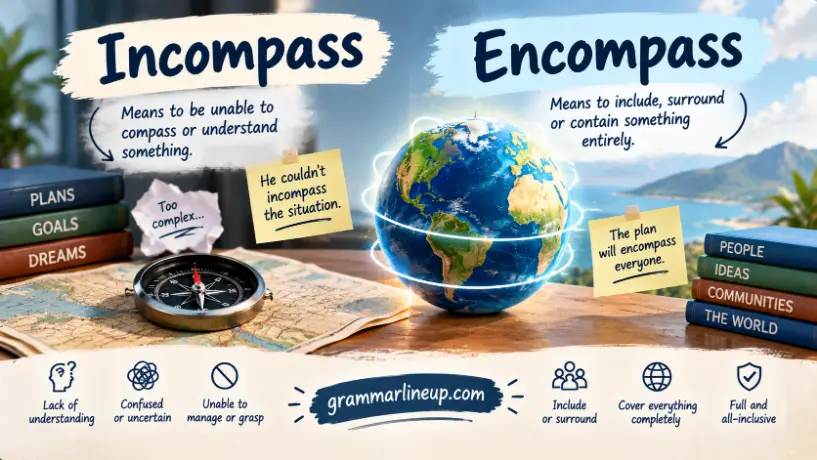
If you’ve ever paused over incompass or encompass, you’re not alone. These two spellings look close enough to cause a quick double take, especially when you’re writing an email, report, essay, or everyday message. But there’s an important difference: encompass is the standard English word, while incompass is generally considered a misspelling in modern standard English.
The confusion makes sense. English has plenty of words that begin with in-, and some people naturally assume that incompass follows the same pattern. However, when you want to express the idea of including something, surrounding it, or covering a particular range, encompass is the word you want.
For example, you might say, “The course encompasses several important topics.” Here, encompasses means that the course includes or covers those topics. The word can also describe something that surrounds another thing, either physically or in a broader sense.
In this guide, we’ll look at incompass vs. encompass, explain which spelling is correct, explore what encompass means, and show you how to use it naturally. By the end, choosing the right spelling should feel much easier.
Encompass is the correct standard spelling in modern English. It means to include a wide range of things or to surround something completely. Incompass is an archaic or historical form that was used in earlier English. For modern writing, use encompass, not incompass.
Quick Answer:
The short answer is encompass.
| Word | Modern status | Meaning |
|---|---|---|
| encompass | Standard modern English | To include, contain, surround, or cover |
| incompass | Archaic/historical form | Older form of encompass |
The important detail is that incompass is not merely a random spelling mistake. Historical dictionaries and references record it as an earlier form. Oxford notes that encompass was formerly also written incompass.
However, that historical status does not make incompass the appropriate spelling for normal modern writing.
If you are choosing between the two today, use encompass.
What Does Encompass Mean?
Encompass is a formal verb with two closely related meanings.
First, it can mean to include a large number or range of things.
For example:
- The course encompasses several areas of science.
- The project encompasses research, design, and testing.
- Her responsibilities encompass customer service and administration.
- The book encompasses many different themes.
In this sense, encompass is similar to include, cover, contain, or embrace.
Second, encompass can mean to surround or completely cover something.
For example:
- Thick fog encompassed the valley.
- Mountains encompass the small town.
- The walls encompassed the courtyard.
The two meanings are connected by the basic idea of something being brought within a larger boundary.
Is Incompass a Correct Word?
The answer depends on what you mean by “correct.”
Incompass is historically attested, but it is not the standard modern spelling.
Oxford’s entry for encompass notes that the word was formerly also written incompass. Other historical dictionary material likewise records incompass as an older form.
That means it would be misleading to say that incompass has never existed.
At the same time, using the historical spelling in ordinary modern English can look like a spelling error. Most modern readers expect encompass.
A useful distinction is:
Historically used: incompass
Standard modern spelling: encompass
So if your goal is clear contemporary English, encompass is the safe choice.
Why Do People Confuse Incompass and Encompass?
The confusion makes sense because the two forms are extremely similar.
The only visible difference is the first vowel:
- incompass
- encompass
There is also a historical reason for the similarity. Oxford traces encompass to Middle English and notes the older incompass form. The word is connected with compass, with the prefix relating to the idea of bringing something within or around a boundary.
Because in- is a common English prefix, writers may naturally assume that incompass is the expected form.
But modern English settled on encompass as the ordinary spelling.
This is one of those cases where a spelling that looks perfectly plausible has a genuine historical connection to the language—but is no longer the normal choice.
Encompass in Modern Sentences
Seeing the word in different contexts makes its meaning easier to remember.
Including a Range of Things
The museum’s collection encompasses works from several centuries.
Here, encompasses means that the collection includes works from those centuries.
Including Different Activities
The job encompasses teaching, planning, and administrative work.
Here, the word means the job covers or includes several responsibilities.
Covering a Large Area
The national park encompasses several valleys and forests.
Here, encompasses can suggest that the park contains or covers those areas.
Surrounding Something
A tall stone wall encompasses the garden.
Here, the meaning is closer to surrounds or encloses.
Covering a Subject
The course encompasses both theory and practical training.
Here, encompasses means includes as part of a larger whole.
Meaning by Context
The meaning of encompass becomes clearer when you look at what comes after it.
| Context | Meaning | Simple replacement |
|---|---|---|
| A course encompasses several subjects | Includes | includes |
| A job encompasses many duties | Covers | covers |
| A book encompasses several themes | Contains/includes | contains |
| Mountains encompass a village | Surround | surround |
| Fog encompasses the valley | Covers/surrounds | covers |
| A project encompasses several stages | Includes | includes |
This flexibility is one reason encompass appears frequently in formal writing.
In everyday conversation, include or cover may sound more natural in many situations. Encompass can have a slightly more formal tone.
👍Encompass vs. Include
Encompass and include are often interchangeable, but they are not always identical in tone.
Include is the more general and common word.
The price includes breakfast.
Encompass often emphasizes the breadth or full range of what is contained within something.
The program encompasses education, training, and community support.
You can think of include as a straightforward way to say that something is part of a whole, while encompass often draws attention to the size, range, or scope of that whole.
For simple everyday writing, include is often enough. For formal descriptions of scope, encompass can be a useful choice.
Encompass vs. Surround
These words overlap when encompass describes physical space.
Surround focuses directly on being around something.
Trees surround the house.
Encompass can also express this idea:
Trees encompass the house.
But encompass has another important use that surround does not normally have: it can describe a collection, subject, activity, or concept that includes many parts.
For example:
The course encompasses history, literature, and philosophy.
You could not naturally replace encompasses with surrounds in that sentence.
Is Encompass Formal or Casual?
Encompass is generally considered a formal or moderately formal word.
Cambridge labels it as formal and defines it in terms of including different types of things. Oxford likewise presents it as a formal verb.
That does not mean you cannot use it in everyday conversation.
For example:
The trip encompasses three cities.
is perfectly understandable.
But in casual speech, many people would simply say:
The trip includes three cities.
In professional, academic, business, or explanatory writing, encompass can sound natural and precise.
Common Mistakes With Encompass
Writing Incompass in Modern Text
A common mistake is to write:
The program incompasses several subjects.
For modern English, write:
The program encompasses several subjects.
Confusing the Verb Forms
The correct forms include:
- encompass
- encompasses
- encompassed
- encompassing
Examples:
The plan encompasses several goals.
The plan encompassed several goals.
The plan is encompassing several areas of work.
Assuming Incompass Is Simply Nonsense
This is another kind of mistake.
Although incompass is not the standard modern spelling, it has historical evidence behind it. Treating it as a completely invented word misses an interesting part of the word’s history.
The practical lesson remains simple: recognize “incompass” as an older form, but use “encompass” in modern writing.
How to Remember the Correct Spelling
A simple memory trick is to connect encompass with the idea of enclosing something.
Both words begin with en-, and both can involve the idea of bringing something within a boundary.
You can also remember this basic pair:
encompass = include or surround
For modern writing:
EN + COMPASS → ENCOMPASS
If you see incompass in an old text, it may be a historical spelling rather than an error in the original source.
Similar Words and Alternatives
Depending on the sentence, you may be able to replace encompass with:
- include
- contain
- cover
- involve
- embrace
- comprise
- surround
- enclose
- encircle
- incorporate
The best alternative depends on the intended meaning.
For example:
The course encompasses five subjects.
could become:
The course includes five subjects.
But:
A wall encompasses the garden.
might be better expressed as:
A wall surrounds the garden.
Choosing a synonym is therefore not just about finding a word with a similar dictionary definition. The surrounding context matters.
When to Use Encompass
Use encompass when you want to communicate that something contains or covers a broad range.
It works particularly well when discussing:
- subjects
- responsibilities
- activities
- ideas
- services
- topics
- areas
- collections
- periods of time
- physical spaces
For example:
The research encompasses several disciplines.
Her role encompasses marketing and customer support.
The historical period encompassed several major changes.
The forest encompasses a large area of the mountain.
The word is especially useful when you want to emphasize scope.
When Not to Use Encompass
You do not need encompass simply because it sounds more sophisticated.
In casual writing, include, cover, or have may be clearer.
Instead of:
My lunch encompasses a sandwich and an apple.
you would normally say:
My lunch includes a sandwich and an apple.
Similarly:
The box encompasses three books.
sounds unusual if you simply mean that the box contains three books.
In that situation, contains is more natural.
Good writing is not about choosing the longest or most formal word. It is about choosing the word that communicates the idea clearly.
FAQs:
Is “incompass” a misspelling of “encompass”?
In modern standard English, incompass should generally be treated as an incorrect spelling for contemporary use. However, it is also an attested archaic form of encompass, so it has a genuine historical background.
What is the correct spelling: incompass or encompass?
Encompass is the correct standard spelling for modern English. Use it in contemporary essays, emails, websites, reports, schoolwork, and professional writing.
What does encompass mean?
Encompass means to include or contain a range of things, and it can also mean to surround or cover something completely.
Is incompass an old word?
Yes. Incompass has been recorded as an older form of encompass. Modern dictionaries and historical references recognize its connection with the word, although it is not the usual modern spelling.
Is encompass the same as include?
They can be very similar. Encompass often emphasizes the range or scope of what is included, while include is the more general everyday word.
Is encompass a formal word?
Yes. Major learner dictionaries describe encompass as formal. It is common in academic, professional, business, and explanatory writing, although it can also appear in ordinary speech.
Conclusion:
When choosing between incompass or encompass, use encompass for modern English.
Encompass means to include, contain, cover, or surround something. It is useful when describing a broad range of subjects, responsibilities, ideas, or physical areas.
Incompass is worth knowing because it is not simply a meaningless typo. It is an archaic or historical form associated with encompass. But unless you are deliberately reproducing historical language, an old text, or a historical spelling, encompass is the form your readers will expect.
