
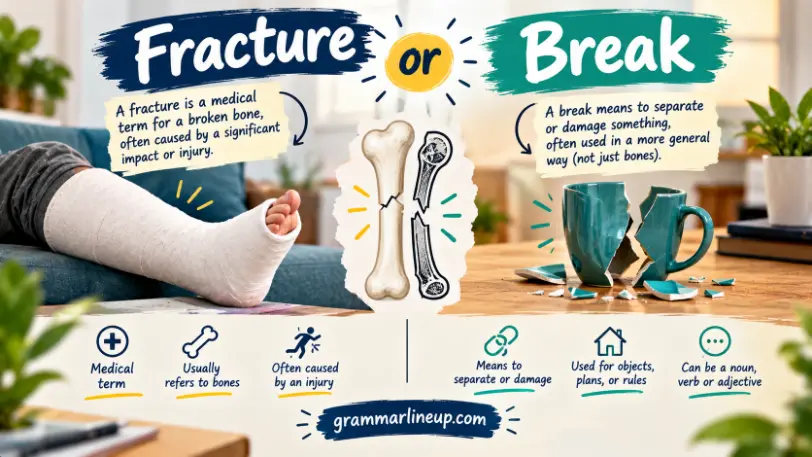
When talking about an injury, it is common to hear people use fracture and break as if they mean exactly the same thing. In many everyday situations, that works perfectly well.
But the two words can carry slightly different tones and levels of formality, especially in medical or written contexts. So, should you say that someone has a fracture or a break?
A fracture is the more formal medical term for a crack or complete break in a bone. Break is the simpler, everyday word people commonly use when describing the same kind of injury. For example, a doctor might write “wrist fracture” in a medical report, while a friend might simply say, “I broke my wrist.”
Understanding this small difference can make your writing and conversations sound more natural. In this guide, we’ll look at how fracture or break is used, when each word fits best, and whether one is actually more correct than the other.
A fracture is a break in a bone, so “fracture” and “break” can refer to the same injury. Fracture is the more formal medical term, while break is common in everyday conversation. A fracture can be partial or complete and may have different patterns, such as stress, spiral, transverse, or compression fractures.
Quick Answer:
Yes, when talking about bones, they generally mean the same thing.
A fracture is medically defined as a break in a bone. MedlinePlus explicitly lists “broken bone” as another name for a fracture. Cleveland Clinic likewise describes a bone fracture as the medical definition of a broken bone.
So these sentences can describe the same injury:
- She fractured her wrist.
- She broke her wrist.
- She has a wrist fracture.
- She has a broken wrist.
The main difference is register and context.
| Word | Typical use | Tone |
|---|---|---|
| Fracture | Medical, formal, technical | More precise/formal |
| Break | Everyday conversation | Natural/informal |
| Broken bone | Everyday descriptions | Clear and familiar |
| Fractured bone | Medical or general writing | Formal but widely understood |
A doctor might document a distal radius fracture in a medical record, while a patient might simply tell a friend, “I broke my wrist.”
What Does “Fracture” Mean?
In medical English, a fracture means a break in a bone. It can describe many different kinds of bone injuries, including partial and complete breaks.
The word is useful because it allows healthcare professionals to describe the injury more specifically.
For instance, a healthcare provider might describe a fracture according to:
- its location,
- its shape or pattern,
- whether it is partial or complete,
- whether the bone has moved out of alignment,
- whether the skin has been broken,
- or what caused the injury.
That is why fracture is more than simply a fancy way to say break in a medical setting. It can be part of a much more detailed description.
For example:
The X-ray showed a transverse fracture of the radius.
This gives considerably more information than:
The X-ray showed a break.
The second sentence is understandable, but it is less specific.
What Does “Break” Mean?
Break is a much broader everyday word.
When talking about bones, to break a bone means to damage it so that it fractures. The noun break can also refer to the injury itself.
For example:
- I broke my ankle.
- He broke his collarbone.
- She has a broken finger.
- The doctor said it was a clean break.
These are all natural expressions in everyday English.
However, break is not limited to bones. Something can break in many different ways:
- break a glass
- break a phone
- break a promise
- break a rule
- break a habit
- break a record
- break a window
So fracture is narrower in ordinary usage, while break has many meanings.
Fracture vs. Break in Medical English
The important distinction is not usually the injury itself. It is how specifically you are describing it.
Consider this conversation:
Patient: “I think I broke my arm.”
Doctor: “You have a fracture of the radius.”
There is no contradiction here. The patient is using an ordinary expression, while the doctor is using medical terminology.
A useful way to remember it is:
A fracture is a break; a break is not always a fracture.
The second half matters because break has many meanings unrelated to bones.
For example:
- I broke my glasses. → The glasses were damaged.
- I broke my arm. → The bone was fractured.
- I need a break. → I need rest.
- The machine broke. → The machine stopped working.
Only the bone-related meaning corresponds directly to fracture.
Different Types of Bone Fractures
One reason medical professionals use fracture is that bone breaks can have different characteristics.
Stress Fracture
A stress fracture is a small crack or break that commonly develops because of repeated or prolonged force on a bone. Repetitive activities can contribute to this type of injury.
For example:
The runner developed a stress fracture in her foot.
You would normally use fracture here because stress fracture is an established medical term.
Open Fracture
An open fracture occurs when the broken bone is exposed through a wound in the skin. It may also be called a compound fracture.
Example:
The accident resulted in an open fracture.
In ordinary conversation, someone might simply say:
He broke his leg badly.
Closed Fracture
A closed fracture is a fracture in which the broken bone does not break through the skin.
The word closed adds medical detail that the simple word break does not communicate.
Stress, Compression, and Other Patterns
Fractures can also be described by their pattern or cause. Examples include spiral, transverse, oblique, comminuted, compression, buckle, and avulsion fractures.
This is another reason fracture is particularly useful in medical writing: it works as part of a precise classification system.
When Should You Use “Fracture”?
Use fracture when you want to sound:
- medically precise,
- formal,
- technical,
- professional,
- or specific about the type of bone injury.
For example:
The scan confirmed a fracture.
She was diagnosed with a stress fracture.
The patient has a displaced fracture.
The report describes a compression fracture.
In medical documents, healthcare discussions, research, and formal writing, fracture is usually the more appropriate term.
When Should You Use “Break”?
Use break when speaking naturally in everyday conversation.
For example:
I broke my wrist playing basketball.
Did you break your leg?
He thinks he may have broken a finger.
She broke her ankle last winter.
These sentences sound completely natural to most English speakers.
In casual conversation, saying “I fractured my wrist” is also correct, but it can sound somewhat more clinical.
Fracture or Break: Which Sounds More Natural?
It depends on the sentence.
| Sentence | Naturalness | Context |
|---|---|---|
| I broke my arm. | Very natural | Everyday speech |
| I fractured my arm. | Correct | More formal/medical |
| I have a broken arm. | Very natural | Everyday speech |
| I have an arm fracture. | Correct | Medical/formal |
| The X-ray showed a fracture. | Very natural | Medical |
| The X-ray showed a break. | Understandable | Less technical |
There is no general rule that one word is “correct” and the other is “wrong.”
Instead, ask yourself:
Am I talking casually about a broken bone, or am I describing the injury medically?
That usually tells you which word fits better.
Common Misunderstandings About Fractures
“A fracture must mean a completely broken bone.”
Not necessarily.
Fractures can be partial or complete. A stress fracture, for example, can be a small crack in a bone, while other fractures can involve more extensive breaks.
So fracture does not automatically mean the bone has separated into two completely detached pieces.
“A small fracture is not really a break.”
Medically, it is still a fracture. The severity and pattern can vary, but a fracture is still a break in the bone.
“If I can move the body part, it cannot be fractured.”
That is not a reliable way to determine whether a bone is broken. Symptoms can vary, and diagnosis may require a healthcare assessment and imaging. Cleveland Clinic notes that X-rays, CT scans, MRI, or other imaging may be used depending on the situation.
“Fracture sounds worse than break.”
The word itself does not determine how serious the injury is.
A fracture can range from a relatively small crack to a more complicated injury. Healthcare providers classify fractures according to factors such as their pattern, location, alignment, and whether the skin is involved.
Fracture or Break in Everyday Sentences
Here are some natural ways to use both words.
Casual conversation
I think I broke my toe.
Did you break your wrist?
He broke his leg during the game.
Medical conversation
The X-ray showed a fracture.
She was diagnosed with a wrist fracture.
The doctor identified a stress fracture.
Formal writing
The patient sustained a fracture during the accident.
Imaging confirmed a fracture of the left radius.
The difference is mainly one of register, precision, and context, not a fundamental difference between two kinds of bone injuries.
Similar Words and Alternatives
Depending on the context, you may encounter several related expressions.
Broken bone — the most straightforward everyday expression.
Fracture — the standard medical term for a broken bone.
Broken — an adjective commonly used in everyday speech.
Crack — can describe a small fracture, although it does not replace fracture in every context.
Stress fracture — a specific type of bone fracture caused by repeated or prolonged stress.
Break — the everyday noun or verb used when referring to a bone injury.
Be careful with sprain and dislocation, however. They are not simply alternative words for fracture. A sprain involves a ligament, while a dislocation involves a joint becoming displaced. These conditions can occur alongside fractures but are not synonymous with them.
What Should You Say: “I Fractured My Arm” or “I Broke My Arm”?
Both are grammatically correct.
“I broke my arm” is usually the more natural choice in casual conversation.
“I fractured my arm” is also correct and sounds more formal or clinical.
Compare:
I broke my arm yesterday.
This sounds like something you might tell a friend.
I fractured my arm yesterday.
This sounds somewhat more medical or formal.
Neither sentence changes the underlying fact that the bone has been fractured.
FAQs:
Is a fracture the same as a break?
Yes. When referring to a bone, a fracture is a break in the bone. Broken bone is another common name for a fracture.
Is “broken bone” or “fracture” more correct?
Both are correct. Fracture is the more formal medical term, while broken bone is more common in everyday language.
Can a fracture be only a small crack?
Yes. Some fractures are small cracks or incomplete breaks. Stress fractures, for example, can develop from repeated force on a bone.
Which is better in medical writing, “break” or “fracture”?
Fracture is generally more appropriate for medical writing because it is the standard medical term and can be combined with descriptions of the fracture’s type, location, pattern, and severity.
Is “I fractured my leg” grammatically correct?
Yes. Fracture can be used as a verb, so “I fractured my leg” is grammatically correct. “I broke my leg” is also correct and is more conversational.
Does every fracture require surgery?
No. Treatment depends on the type and severity of the fracture and other factors. Some fractures can be treated with immobilization such as a splint or cast, while more serious fractures may require procedures or surgery.
Conclusion:
Fracture and break can mean the same thing when you’re talking about a bone.
The easiest distinction is:
- Fracture = the medical/formal term
- Break = the everyday term
- Broken bone = the familiar everyday expression
So, if you are chatting with a friend, “I broke my arm” sounds perfectly natural. If you are writing a medical report, “arm fracture” is the more precise choice.
One important point: if you actually suspect that you have broken a bone, the terminology matters less than getting appropriate medical evaluation. A suspected fracture can require examination and imaging, and some fractures need prompt treatment.

2 thoughts on “Fracture Or Break The Trustworthy Guide To Understanding Both”