
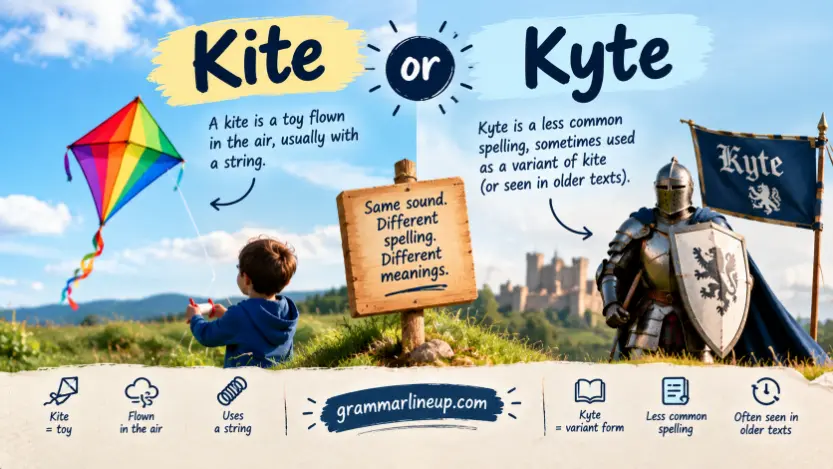
If you have ever wondered whether “kite” or “kyte” is the correct spelling, you are not alone. The two words look almost identical, but they do not always have the same meaning or usage. In most everyday English, kite is the familiar and standard spelling. It can refer to the lightweight object that flies on a string, as well as several other meanings depending on the context.
Kyte, on the other hand, is much less common in standard English. It may appear as a surname, a name, a brand, or in specific specialized uses. That can make the spelling confusing when you come across it online or in written communication.
So, which one should you use? The answer depends on what you are trying to say. If you mean the colorful object flown in the wind, kite is the spelling you want. If you have seen kyte somewhere, its context matters before deciding whether it is simply a proper name or a different term.
In this guide, we will look at kite vs. kyte, explain their meanings, show how each is used, and give you simple examples so you can choose the right spelling with confidence.
Kite is the standard spelling for the flying toy and other common meanings, while kyte is a regional Scots and northern-English word meaning “belly” or “stomach.” Although the two spellings are related in dictionary usage, they are not interchangeable in ordinary modern English. For a flying object, animal, or common expression, choose kite.
Quick Answer: Kite or Kyte?
For modern everyday English, kite is the normal spelling.
| Word | Main meaning | Typical use |
|---|---|---|
| kite | A flying toy on a string | “We flew a kite at the beach.” |
| kite | A bird of prey | “A kite circled above the field.” |
| kite | Several specialized or figurative meanings | Finance, slang, expressions |
| kyte | Belly, stomach, or paunch | Scots and northern English |
So if your sentence is about flying a kite, there is no spelling dilemma:
We bought a new kite.
Not:
We bought a new kyte.
But if you encounter kyte in Scottish literature or regional English, do not automatically assume it is a typo. It can be a legitimate regional word.
What Does Kite Mean?
The most familiar meaning of kite is a lightweight frame covered with paper, fabric, plastic, or another material that is flown in the wind on a string.
For example:
The children ran across the field with their kite.
The word kite also names certain birds of prey in the hawk family. These birds are known for their ability to soar and glide.
The connection between the bird and the flying toy is reflected in the history of the word. The bird sense is much older, while the toy sense appeared later and was associated with the toy’s bird-like movement through the air.
Kite has also developed specialized meanings. In financial language, kiting can refer to using checks or other financial instruments improperly to obtain money or create a misleading balance. The verb kite has also been used for this activity.
Another familiar expression is go fly a kite, which can be used as a dismissive way of telling someone to leave or go away. Depending on tone and context, it can sound playful rather than seriously hostile.
What Does Kyte Mean?
Kyte has a different everyday meaning.
In Scots and northern English, kyte can mean the belly, stomach, or paunch. Dictionary sources identify it as a regional word and give it a history separate from the ordinary modern use of kite.
You are much more likely to encounter kyte in:
- Scots writing
- Northern English dialect
- Older literature
- Historical texts
- Regional expressions
- Dictionaries discussing dialect words
For instance, a historical or dialect sentence might use kyte when referring to someone’s stomach.
This is why replacing every occurrence of kyte with kite can change the meaning of a passage.
If you encounter the word while reading older Scottish material, look at the surrounding sentence before deciding that the spelling is an error.
Kite vs. Kyte: The Main Difference
The easiest way to remember the distinction is:
Kite = the familiar modern word.
Kyte = a regional word for the belly or stomach.
Consider these two sentences:
The kite rose high above the trees.
Here, kite refers to the flying object.
Now consider:
He had a full kyte.
In a Scots or northern-English context, kyte can refer to the belly.
The spelling difference is small, but the meanings can be quite different.
Where Does the Word Kite Come From?
The history of kite is more interesting than its simple appearance suggests.
The bird sense goes back to Old English cyta. Etymological sources connect the word with the name of the bird and suggest that the original form may have been influenced by the bird’s cry. The word was later applied to people who preyed on others, creating an older figurative sense.
The flying-toy meaning came later. The toy was called a kite because its ability to hover and glide in the air resembled the movement of the bird. Etymological sources date this sense to the seventeenth century.
The word therefore has a long history in English, with its meanings expanding over time.
The history of kyte is different. Dictionary.com records kyte as a Scots and northern-English noun meaning the belly or stomach and gives an etymology that may involve Scandinavian influence. The source also notes an Icelandic comparison.
Because the words have overlapping historical spelling traditions, seeing kyte in older material does not necessarily mean the writer made a spelling mistake.
How to Use Kite in a Sentence
For ordinary modern English, kite is the spelling to use in sentences about the flying toy.
Talking about a toy
We flew a kite in the park.
My daughter made a colorful kite for school.
The kite disappeared behind the trees.
Talking about the bird
A kite was circling above the valley.
We watched the kite glide over the fields.
Using the word figuratively
The company was accused of kiting checks.
Here, kite is being used in a specialized financial sense rather than referring to a toy.
Using a common expression
He told me to go fly a kite.
This expression can be humorous or dismissive depending on the situation.
How to Understand Kyte in a Sentence
Because kyte is regional, the context matters much more than it does with kite.
If you see kyte in a Scots text, especially alongside other dialect vocabulary, it may mean belly or stomach.
For example:
His kyte was full after the meal.
In a regional context, a reader could understand kyte as referring to the stomach or belly.
The word may feel unfamiliar to speakers of standard modern English, but unfamiliar does not mean incorrect. Dialects preserve many words that are uncommon in general English.
Why Do People Confuse Kite and Kyte?
There are several reasons these words are easy to mix up.
They sound alike in some contexts
Both spellings can represent similar pronunciations depending on the particular regional usage.
They look like spelling variants
The difference between i and y is visually small, making kyte look like an old-fashioned spelling of kite.
Older English used different spellings
Historical English spelling was less standardized than modern English. Older texts can contain forms that look unusual today.
Kyte is genuinely a dictionary word
This is the important point. Kyte is not simply a made-up alternative spelling. It has a documented regional meaning.
At the same time, that does not mean you should freely substitute kyte for kite in modern writing.
When Should You Use Kite?
Use kite when you are writing ordinary modern English and mean:
- A flying toy
- A kite bird
- A related figurative expression
- A financial or business meaning involving “kiting”
- A common phrase such as “go fly a kite”
For example:
We took the kite to the beach.
The kite flew higher as the wind increased.
A kite was visible in the distance.
For general audiences, kite is the clear and natural choice.
When Should You Use Kyte?
Use kyte when you specifically need the regional or historical word meaning belly, stomach, or paunch, particularly when reproducing or discussing Scots or northern-English language.
It may also appear in quotations from older works.
For example:
The old Scottish text uses kyte to mean “belly.”
In this situation, changing kyte to kite would remove an important feature of the original language.
If you are simply trying to say “stomach” in ordinary modern English, however, stomach, belly, or another standard term will usually be clearer than kyte.
Common Misunderstandings
“Kyte is just a wrong spelling of kite.”
Not necessarily.
Kyte is a documented regional English word meaning the belly or stomach. It is especially associated with Scots and northern English usage.
“Kite and kyte always mean the same thing.”
No.
Although dictionaries connect the spellings in some entries, their common meanings are different. Kite has several widespread meanings, while kyte has a regional sense referring to the belly or stomach.
“I can use kyte instead of kite because it looks more traditional.”
That would not normally be appropriate in standard modern writing.
If you mean the flying toy, kite is the standard choice.
“Every occurrence of kyte in an old text is a spelling mistake.”
No.
Historical and regional English contain vocabulary that is unfamiliar to modern readers. Context is essential when interpreting older texts.
Kite or Kyte in Modern English
If your goal is clear communication with a general English-speaking audience, kite is overwhelmingly the practical choice for the familiar word.
Imagine writing:
I bought a new kyte for my son.
Most readers would probably interpret this as an unusual spelling of kite, not as a deliberate use of the Scots word for “belly.”
That is why spelling should follow meaning and audience.
If you are writing an ordinary email, article, school assignment, message, or social post about the flying toy, use kite.
If you are analyzing Scots vocabulary or quoting a historical source, kyte may be exactly the word you need.
Similar Words and Related Terms
Depending on the intended meaning, several words may be more useful than either kite or kyte.
For the flying object:
- flying toy
- paper kite
- box kite
- stunt kite
- toy kite
For the regional meaning of kyte:
- belly
- stomach
- paunch
- abdomen
For the bird:
- bird of prey
- hawk
- raptor
The best replacement depends entirely on the sentence. A synonym should preserve the intended meaning rather than simply resemble the original spelling.
FAQs:
Is kite the correct spelling?
Yes, kite is the standard spelling when you mean the familiar flying toy or the other common modern meanings of the word.
Is kyte a real word?
Yes. Kyte is a documented Scots and northern-English word meaning the belly, stomach, or paunch. It can also appear as a variant spelling in dictionary records.
Does kyte mean the same thing as kite?
Not in ordinary usage. Kite has several common meanings, including the flying toy and a bird of prey. Kyte is especially associated with the regional meaning “belly” or “stomach.”
Is kyte used in Scotland?
Yes. Kyte is recorded as a Scots and northern-English regional word. It is more likely to appear in dialect or historical writing than in standard contemporary English.
Which should I use in a school assignment?
If you mean the flying toy, use kite. If you are discussing a Scots word or quoting a historical text, kyte may be appropriate when the context calls for it.
Why are kite and kyte so similar?
English has a long history of spelling variation, and these forms are recorded in related dictionary traditions. However, the modern meanings you encounter most often are different: kite is the familiar standard word, while kyte has a regional meaning connected with the belly or stomach.
Conclusion:
Kite is the correct everyday spelling when you mean the flying toy, the bird, or most other modern meanings of the word.
Kyte is a legitimate but much more specialized regional word, particularly in Scots and northern English, where it can mean belly, stomach, or paunch.
So the simplest rule is:
Flying object → kite
Regional Scots/northern-English “belly” → kyte
When in doubt, choose kite for standard modern English unless your context specifically calls for the regional word kyte.
