
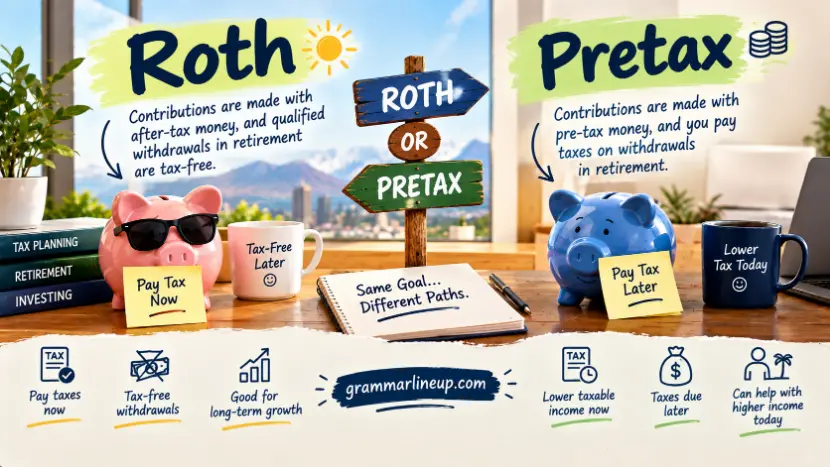
When planning for retirement, you may come across two terms again and again: Roth and pretax. Both can help you save for the future, but they handle taxes at different points in the process. That small difference can have a meaningful effect on how your retirement savings grow and how much you may owe later.
With a pretax contribution, money generally goes into a qualifying retirement account before income taxes are applied to it. You may receive a tax benefit today, while withdrawals in retirement are generally subject to income tax. A Roth contribution works differently. You typically contribute money after taxes have already been paid, but qualified withdrawals can generally be tax-free.
So, which approach makes more sense? There is no single answer for everyone. Your income, current tax situation, expected future tax rate, retirement timeline, and employer plan can all play a role.
The good news is that the basic distinction is easier to understand than it first appears. Once you know when you pay taxes with each option, the Roth vs. pretax comparison becomes much clearer. This guide breaks down the differences, advantages, limitations, and key factors to consider before choosing between them.
Roth and pretax are two ways to contribute to a retirement plan. Pretax contributions generally reduce your taxable income now, with taxes due when taxable withdrawals are made later. Roth contributions are taxed before they enter the account, but qualified Roth withdrawals can generally be tax-free. The better fit depends on your circumstances and tax expectations.
What Does “Roth or Pretax” Mean?
“Roth or pretax” usually refers to the contribution choice available in an employer-sponsored retirement plan such as a 401(k), 403(b), or governmental 457(b).
The two choices differ mainly in when you pay federal income tax.
A traditional or pretax contribution is generally excluded from your taxable income for federal income tax purposes when you make the contribution. Taxes generally come later when money is distributed.
A designated Roth contribution works differently. The contribution is included in your gross income when it is made, meaning you pay the applicable income taxes up front. Qualified distributions from the Roth account can generally be tax-free, including investment earnings.
In simple terms:
| Feature | Pretax | Roth |
|---|---|---|
| Tax treatment of contribution | Generally not included in current federal taxable income | Included in current income |
| Main tax benefit | Potential tax savings now | Potential tax-free qualified withdrawals later |
| Investment growth | Generally tax-deferred | Generally tax-free when part of a qualified distribution |
| Taxes when withdrawn | Generally taxable | Generally tax-free for qualified distributions |
| Basic idea | Pay taxes later | Pay taxes now |
These descriptions apply specifically to retirement-plan contribution types and should not be confused with every type of “after-tax” contribution.
Roth vs Pretax: The Basic Difference
The easiest way to understand the choice is to imagine the tax bill moving from one point in time to another.
Pretax
Suppose you earn money and direct part of your salary into a traditional pretax 401(k).
That contribution generally isn’t included in your federal taxable income for the year. However, the money generally becomes taxable when you eventually take taxable distributions from the account.
The benefit is immediate: your taxable income can be lower than it otherwise would have been.
Roth
With a Roth 401(k) contribution, the contribution is included in your income for tax purposes when you make it.
The trade-off comes later. If the distribution meets the rules for a qualified Roth distribution, the withdrawal can generally be tax-free, including earnings.
So the central question becomes:
Would you rather receive the tax benefit now or potentially receive the tax benefit later?
That is the heart of the Roth-or-pretax decision.
How Roth and Pretax Affect Your Paycheck
The choice can also affect how much money you take home from each paycheck.
Because pretax contributions generally reduce the amount of compensation subject to federal income tax, they can reduce your current federal income-taxable wages.
Roth contributions don’t receive that same current federal income-tax exclusion. The IRS states that designated Roth contributions are included in gross income when they would otherwise have been paid as cash.
For that reason, putting the same dollar amount into Roth instead of pretax can result in a different take-home paycheck.
There is an important detail, though: pretax and Roth employee contributions are generally still subject to Social Security and Medicare taxes. The IRS specifically distinguishes federal income-tax treatment from FICA treatment.
Which One Is Better for You?
There is no universal answer because the two choices make different tax assumptions.
A useful way to think about the decision is to compare your tax rate today with what you expect your tax situation to look like when you withdraw the money.
Pretax may be worth considering when
A pretax contribution may be attractive if you place significant value on reducing your taxable income today.
For instance, someone currently earning a relatively high income may prefer receiving the tax benefit during their working years and paying taxes on withdrawals later.
This is not a prediction about future tax rates. Your actual retirement tax situation can depend on income, deductions, account balances, withdrawals, tax laws, and other factors.
Roth may be worth considering when
A Roth contribution may appeal to someone who prefers paying the income tax now in exchange for the possibility of tax-free qualified withdrawals later.
This can be particularly relevant if you expect your future taxable income or tax rate to be higher, although nobody can know future tax laws or personal circumstances with certainty.
The IRS confirms that qualified distributions from designated Roth accounts are generally not included in gross income.
Can You Choose Both Roth and Pretax?
In many employer retirement plans, yes.
The IRS states that participants can contribute to both a designated Roth account and a traditional pretax account in the same year, subject to the applicable plan and contribution rules.
That means the decision does not always have to be an all-or-nothing choice.
For example, someone might divide contributions between Roth and pretax accounts rather than putting every contribution into one category.
This approach can provide different types of tax treatment within the same overall retirement strategy.
However, the exact options depend on the retirement plan. Your employer’s plan documents determine which contribution types are available.
Roth 401(k) vs Traditional 401(k)
The terms can sound intimidating, but the distinction is fairly straightforward.
A traditional 401(k) generally refers to contributions made on a pretax basis.
A Roth 401(k) uses designated Roth contributions, which are made with after-tax dollars. The investment earnings and qualified withdrawals can generally receive tax-free treatment.
The investment choices themselves do not necessarily become different simply because you choose Roth rather than pretax. The major difference is the tax treatment of the money.
For many workplace plans, the two choices can sit side by side.
Roth 401(k) vs Roth IRA
Another common source of confusion is the difference between a Roth 401(k) and a Roth IRA.
They share the Roth tax concept, but they are not the same account.
A Roth 401(k) is part of an employer-sponsored retirement plan. A Roth IRA is an individual retirement account that you generally open through a financial institution.
Investor.gov describes Roth IRAs as accounts funded with after-tax dollars, with qualified withdrawals generally being tax-free.
A Roth 401(k), meanwhile, is offered through an eligible employer plan and follows the rules applicable to designated Roth accounts.
Because the rules differ, it is important not to assume that a Roth 401(k) and Roth IRA are interchangeable.
What About Employer Matching Contributions?
Employer matching contributions deserve separate attention.
A company match is generally based on the employee’s eligible contribution under the plan’s matching formula. The existence and details of a match depend on the specific employer plan.
For designated Roth accounts, the IRS explains that employer matching and profit-sharing contributions cannot be deposited directly into the designated Roth account. Instead, matching contributions must be contributed to another account within the plan.
The practical lesson is simple:
Read your plan’s matching rules instead of assuming that Roth and pretax contributions are treated identically in every detail.
If your employer offers a match, understand the requirements before making decisions about how you contribute.
Does Roth or Pretax Change Your Investments?
Usually, the Roth-versus-pretax choice is primarily about tax treatment, not about whether your money can be invested.
A 401(k) generally gives participants a selection of investment options, such as mutual funds or other plan-approved investments.
Your plan may allow both Roth and pretax contributions to be invested through the same menu of choices.
For example, you might contribute part of your salary as Roth and part as pretax while investing both portions according to the same investment strategy.
The account type determines how the contributions are taxed; the investment selections determine how the invested money may perform.
Those are separate decisions.
Common Misunderstandings About Roth and Pretax
Roth does not mean “no taxes”
Roth contributions are generally taxed before they enter the account.
The potential tax advantage comes later, because qualified Roth distributions can generally be tax-free.
Pretax does not mean “tax-free”
Pretax contributions generally receive favorable tax treatment when contributed, but taxes are generally due when taxable distributions are taken.
The tax is deferred rather than permanently eliminated.
Roth and after-tax are not always identical terms
This is an especially important distinction.
The IRS separately describes designated Roth contributions and other after-tax contributions. They can have different tax treatment and rules.
So if your retirement plan uses the phrase “after-tax,” don’t automatically assume it means “Roth.”
Roth does not automatically produce a larger retirement balance
Roth and pretax contributions can have different tax consequences, but the investment return itself depends on the investments and market performance.
The tax treatment should be considered separately from investment performance.
Roth or Pretax: A Simple Decision Framework
Instead of asking which option is universally better, consider these questions:
1. How important is a tax benefit today?
Pretax contributions can generally reduce current federal taxable income.
If lowering current taxable income is a major consideration, pretax may deserve attention.
2. How do you view your future tax situation?
Roth contributions shift the tax payment toward the present, while pretax contributions generally shift taxation toward future taxable withdrawals.
Nobody can know exactly what future tax laws or personal circumstances will look like.
3. Do you value future tax-free qualified withdrawals?
Roth accounts can provide tax-free qualified distributions, which may offer useful tax flexibility during retirement.
4. Does your employer plan allow both?
Some plans offer both choices, while the exact features vary by plan.
Check your benefits documentation or ask your plan administrator.
5. Are you comparing the right accounts?
Make sure you’re comparing Roth 401(k) with pretax 401(k), rather than accidentally comparing a Roth IRA with a traditional IRA or another retirement account.
The rules are not identical across account types.
Real World Scenarios
Consider three simplified situations.
A worker focused on current taxes
Someone who wants to reduce current federal taxable income may look closely at pretax contributions because qualifying contributions generally aren’t included in current federal taxable income.
A worker focused on future tax-free income
Someone who prefers paying taxes now and potentially taking qualified retirement distributions tax-free may look closely at Roth contributions.
A worker who wants tax diversification
Someone may choose to use both Roth and pretax contributions.
This can create retirement savings with different tax characteristics rather than relying entirely on one type of account.
The appropriate mix depends on individual circumstances, and this article does not determine which mix is right for a particular person.
When to Get Professional Advice
Retirement tax decisions can become complicated when you have multiple income sources, substantial retirement savings, business income, complex investments, or significant tax-planning concerns.
Tax laws can also change.
For a personalized decision, consider speaking with a qualified tax professional or financial adviser who can review your actual income, tax situation, retirement accounts, and plan rules.
The IRS and Investor.gov provide general educational information, but neither replaces individualized professional advice. Investor.gov specifically recommends consulting a tax professional regarding tax consequences of retirement accounts.
FAQs:
Is Roth or pretax better?
Neither is universally better. Pretax contributions generally provide a current federal income-tax benefit, while Roth contributions are taxed now and can provide tax-free qualified withdrawals later. The appropriate choice depends on your circumstances and tax expectations.
Is Roth or pretax better for a 401(k)?
Both can be useful. A pretax 401(k) generally defers income taxes until taxable withdrawals, while a Roth 401(k) generally taxes contributions now and allows qualified distributions to be tax-free.
Can I contribute to Roth and pretax at the same time?
Yes, if your employer plan offers both options. IRS guidance says participants can contribute to both designated Roth and traditional pretax accounts in the same year, subject to applicable rules and limits.
Does Roth reduce my taxable income?
Generally, no. Designated Roth contributions are included in gross income when contributed, unlike qualifying pretax elective deferrals.
Do you pay taxes on Roth 401(k) withdrawals?
Qualified Roth 401(k) distributions are generally tax-free, including earnings. However, specific requirements apply, so not every withdrawal should automatically be assumed to be tax-free.
Are Roth and after-tax contributions the same?
No. The IRS treats designated Roth contributions and other after-tax contributions as different contribution types, with different rules.
Conclusion:
Roth or pretax is mainly a question of when you want to receive the tax benefit.
Pretax contributions generally provide the tax benefit now and defer income taxes until taxable withdrawals. Roth contributions generally require you to pay income tax now, while qualified withdrawals can generally be tax-free.
If your retirement plan offers both, you may be able to use both rather than choosing only one.
The most useful starting point is to understand your current tax situation, consider what you reasonably expect in retirement, and review the exact rules of your employer’s plan before making a decision.
