
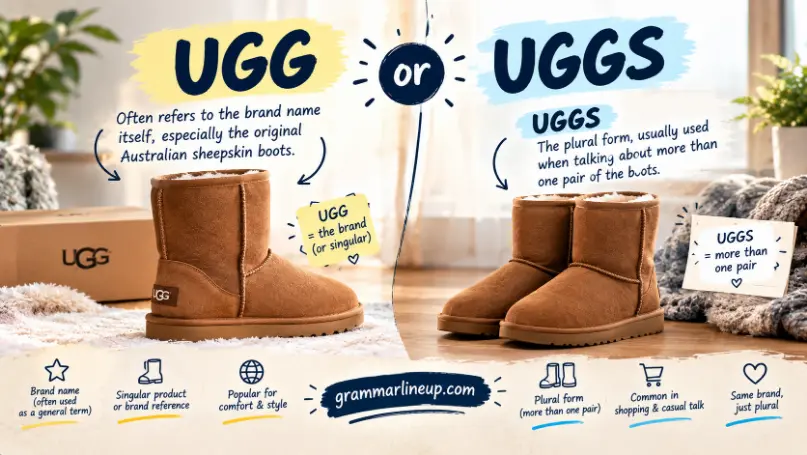
If you have ever searched for the right way to talk about those famous sheepskin boots, you may have wondered whether to say UGG or Uggs. Both forms are common, but they do not always work in exactly the same way. One can refer to the brand, while the other is often used casually to describe the boots themselves.
This small difference can be surprisingly confusing, especially when you are writing a sentence, shopping online, or talking about footwear with friends. You might hear someone say, “I bought a new pair of Uggs,” while a product page or brand name uses “UGG.” So, are they both correct, or is one technically the proper choice?
The answer depends largely on how the word is being used. “UGG” is the official brand name, while “Uggs” is widely used as a plural or informal term for a pair or pairs of the boots. Context matters, too, because the words can appear differently in casual conversation, advertising, and formal writing.
In this guide, we’ll explain UGG vs. Uggs in simple terms, show how each is commonly used, and provide clear examples so you can choose the right form without second-guessing your sentence.
Featured Snippet Answer:
UGG is the brand name, while UGGs is commonly used in everyday English to refer to UGG boots or similar footwear. For example, “I bought UGG boots” names the brand and product, while “I bought a new pair of UGGs” uses the informal plural noun. The exact usage can depend on context and trademark conventions.
Quick Answer: UGG vs. UGGs
| Form | Typical use | What it refers to |
|---|---|---|
| UGG | Brand name or adjective-like brand reference | The UGG brand or a UGG product |
| UGGs | Informal plural noun | UGG boots or footwear, usually a pair |
| UGG boots | Clear, brand-specific wording | Boots made by the UGG brand |
| uggs | Generic/informal usage in some contexts | Sheepskin or fleece boots, depending on region |
For example:
- “I bought UGG boots.” — identifies the brand.
- “I bought a new pair of UGGs.” — refers to the footwear informally.
- “UGG makes more than boots.” — refers to the company/brand.
- “Her UGGs got wet.” — treats the footwear as a plural noun.
This is why UGG and UGGs aren’t really competing spellings of the same grammatical form. They often perform different jobs in a sentence.
What Does UGG Mean?
UGG is the name of a global footwear and lifestyle brand best known for its sheepskin and comfort footwear.
The company’s official history says Brian Smith founded the UGG brand in 1978 after moving from Australia to Southern California. His idea was inspired by sheepskin boots worn by Australian surfers to keep their feet warm after cold surf sessions.
Today, UGG is much broader than a single type of boot. Deckers describes UGG as a global lifestyle brand offering footwear, apparel, accessories, and home products.
So when UGG appears with its trademark styling, it normally refers to the brand, not simply to the generic idea of a boot.
For example:
“She bought UGG boots for winter.”
Here, UGG identifies the brand.
What Does UGGs Mean?
UGGs is a common informal plural form used in everyday speech and writing for UGG footwear.
For instance:
“I wore my UGGs to class.”
Here, the speaker isn’t usually talking about the company itself. They’re talking about the boots or other UGG footwear they’re wearing.
The form works much like other brand names that become everyday nouns in casual conversation.
You might hear:
- “Where are my UGGs?”
- “I need to clean my UGGs.”
- “She bought new UGGs.”
- “Those UGGs look comfortable.”
In these sentences, UGGs means the footwear rather than the brand as a business.
There is an important trademark distinction, though. UGG’s official branding uses UGG® as the brand name, while informal writers may use “UGGs” as a noun for the products.
Why Do People Say “UGGs” If the Brand Is “UGG”?
This is where ordinary English and formal brand usage can differ.
A brand name can be used in two ways:
- As a proper brand name
- As an informal noun referring to the product
In formal brand language, UGG identifies the company or brand.
In casual conversation, someone may turn the name into a plural noun:
“I love my UGGs.”
The speaker is essentially using UGGs to mean “my UGG shoes/boots.”
This doesn’t mean the official brand name has changed to UGGs. It reflects how people naturally use brand names in everyday language.
It’s similar to how people sometimes say:
“I need new Nikes.”
The company or brand is Nike, but Nikes can function as an informal noun for the shoes.
The same conversational pattern explains much of the difference between UGG and UGGs.
UGG vs. UGGs in a Sentence
The easiest way to understand the distinction is to see the words doing different jobs.
Talking About the Brand
“UGG launched a new footwear collection.”
Here, UGG is the brand.
Naming a Product
“She bought UGG boots.”
Again, UGG identifies the brand that makes the boots.
Talking About the Shoes Informally
“She wore her UGGs all day.”
Here, UGGs functions as a plural noun for the footwear.
Talking About More Than One Pair
“The store had several pairs of UGGs.”
The informal noun form works naturally here.
Talking About a Single Product
Instead of:
“I bought an UGG.”
you would normally make the product clear:
“I bought an UGG boot.”
or:
“I bought a pair of UGGs.”
The second version is especially natural when talking about a pair of boots.
Is “UGG” Singular and “UGGs” Plural?
Informally, yes, but there’s a small complication.
In everyday conversation, UGGs behaves like a plural noun referring to UGG footwear.
For example:
“My UGGs are muddy.”
The plural verb are makes sense because the sentence treats the footwear as plural.
But UGG itself is primarily a brand name, rather than simply the singular form of the everyday noun “UGGs.”
That’s an important distinction.
You wouldn’t normally think of the brand name as working exactly like a standard count noun:
- UGG = one shoe
- UGGs = two shoes
Instead:
- UGG = brand
- UGG boots = branded boots
- UGGs = informal reference to the footwear
That distinction prevents a lot of awkward wording.
Is “UGGs” the Correct Spelling?
If you’re writing casually, UGGs is a widely understood way to refer to the footwear.
However, if you’re writing officially for the brand, product listings, editorial content, or business communications, it’s better to distinguish the brand name from the product description.
For example, a more precise sentence is:
“UGG Classic Boots are made for everyday comfort.”
rather than treating the brand name itself as a generic category.
The UGG brand officially uses UGG®, and Deckers identifies UGG as one of its brands.
For casual conversation, however, “my UGGs” is immediately understandable.
Does UGG Mean “Ugly”?
One common question is whether UGG is simply short for “ugly.”
There isn’t a solid basis for treating that as the established official meaning of the brand name.
Dictionary.com notes that the history of the term is disputed and specifically rejects the idea that UGG is simply an abbreviation of the interjection “ugh.” It also describes competing explanations for the word’s earlier history.
UGG’s own official history instead focuses on Brian Smith’s creation of the brand in Southern California in the late 1970s.
So it’s better not to present “UGG = ugly” as a proven fact.
Where Did UGG Come From?
The history of UGG is more complicated than the modern brand name might suggest.
UGG’s official account says Brian Smith, an Australian surfer, came to Southern California in the late 1970s and introduced sheepskin boots to the local surf community.
UGG’s support material dates the brand’s beginning to 1978, while Deckers likewise describes UGG as founded in 1978 by an Australian surfer in California.
Deckers later acquired the UGG brand in 1995 and developed it into a broader global lifestyle business.
There is a separate linguistic history surrounding the generic term ugg/uggs, particularly in Australia and New Zealand. Dictionary.com notes that the history and trademark status of the term have been disputed across markets.
That means it is wise to separate:
- the history of UGG as a brand
- the history of ugg/uggs as a footwear term
They are related, but they’re not necessarily identical questions.
UGG or UGGs: Which One Should You Use?
Use the form that matches what you’re talking about.
Use “UGG” When:
- referring to the brand
- describing a branded product
- discussing the company
- writing formal brand-focused content
Example:
“UGG released a new collection.”
Use “UGGs” When:
- talking casually about the footwear
- referring to a pair of UGG boots
- discussing several pairs
- writing conversationally
Example:
“I left my UGGs by the door.”
Use “UGG boots” When:
- you want maximum clarity
- you’re writing formally
- you’re explaining the product to someone unfamiliar with the term
Example:
“She bought a pair of UGG boots for winter.”
Common Misunderstandings About UGG and UGGs
“UGG” Always Means One Boot
Not necessarily.
UGG is primarily the brand name. If you mean one physical boot, say “an UGG boot” or specify the product.
“UGGs” Is the Official Brand Name
Not quite.
UGG is the brand styling. UGGs is a common informal way of referring to UGG footwear.
UGG Always Means Sheepskin Boots
Not anymore.
UGG has expanded beyond its original iconic boot into other footwear and lifestyle categories. Deckers currently describes the brand as offering footwear, apparel, accessories, and homewares.
UGG Means “Ugh”
That’s not an established explanation for the brand name. Dictionary.com specifically distinguishes the footwear term from the interjection “ugh.”
Every “ugg” Boot Is an Official UGG Product
That’s also too broad.
A person may use ugg/uggs informally for a style of sheepskin or fleece footwear, while UGG® identifies the particular brand.
UGGs in Texts, Chats, and Social Media
In texting and social media, UGGs is usually the most natural form when someone means the footwear.
You might see:
“My UGGs finally arrived 😍”
“These UGGs are so comfy.”
“I need new UGGs for winter.”
“Where did you get those UGGs?”
In these sentences, the speaker is treating UGGs as an everyday noun.
For a casual audience, there’s usually no need to explain the distinction unless the conversation is specifically about the brand.
Similar Terms and Related Expressions
If you’re writing about UGG footwear, several expressions may appear in the same conversation.
| Term | Typical meaning |
|---|---|
| UGG | The footwear/lifestyle brand |
| UGGs | Informal reference to UGG footwear |
| UGG boots | Boots associated with the UGG brand |
| sheepskin boots | A broader footwear category |
| fleece-lined boots | A broader description based on construction |
| ugg-style boots | Informal description of a similar-looking style |
The important point is that these terms aren’t interchangeable in every context.
UGG identifies a brand, while descriptions such as sheepskin boots describe a type of footwear more generally.
When to Use UGG vs. UGGs in Formal Writing
For formal or professional writing, precision is useful.
Instead of:
“UGGs are a major footwear brand.”
write:
“UGG is a footwear and lifestyle brand.”
If you’re discussing the actual products:
“UGG boots are popular winter footwear.”
If you’re writing a casual lifestyle article:
“Her UGGs were by the door.”
All three can be natural because they perform different grammatical and semantic roles.
The safest approach is simple: use UGG for the brand and UGGs when casually referring to the footwear.
FAQs:
Is UGG singular or plural?
UGG is primarily a brand name. UGGs is commonly used as an informal plural noun for UGG footwear.
Why are UGG boots called UGGs?
In everyday English, people often shorten “UGG boots” or other UGG footwear to UGGs. The exact historical development of the generic term “ugg” is more complicated and disputed.
Is UGG the same as UGGs?
They are closely related but aren’t normally used in exactly the same way. UGG refers to the brand, while UGGs commonly refers informally to the footwear.
Is UGG short for ugly?
That is not an established official meaning. The history of the word is disputed, and sources give different explanations for its development.
Should I write “UGG” or “UGGs”?
Use UGG when you’re talking about the brand. Use UGGs when you’re casually talking about the shoes or boots.
Is “UGG boots” grammatically correct?
Yes. UGG boots is a clear way to identify boots associated with the UGG brand. It is often more precise than using “UGG” by itself.
Conclusion:
UGG and UGGs are both common, but they usually have different roles.
UGG is the brand name. UGGs is an informal noun people commonly use for UGG footwear, especially boots.
So:
“UGG is a footwear brand.”
and
“I wore my UGGs today.”
are both natural sentences.
If you’re writing professionally, UGG or a specific product name is usually the clearer choice. In everyday conversation, UGGs is perfectly understandable when you’re talking about the footwear.
The key is not to treat the two forms as simple singular-versus-plural spellings. The real distinction is brand name versus informal product reference.
