
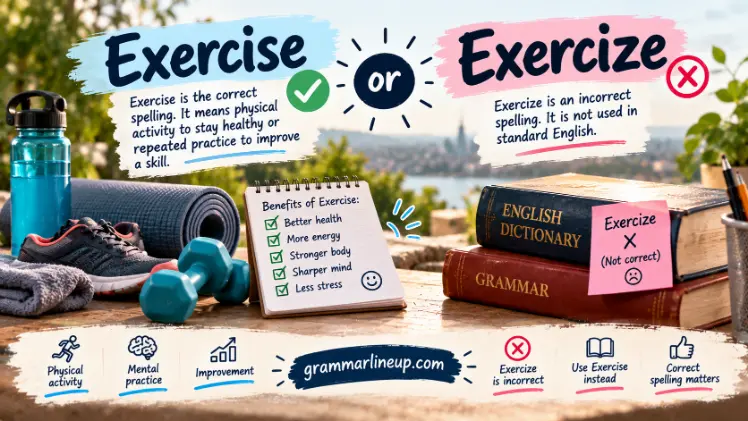
Have you ever typed “exercize” and then wondered whether something looked slightly off? You’re not alone. The words “exercise” and “exercize” can easily cause confusion because they sound almost identical when spoken. The difference becomes much clearer when you see them written down.
The correct spelling in standard English is exercise. The form exercize is generally considered a misspelling, even though the ending may seem logical because English has many words where -ize appears. This small spelling mix-up is especially easy to make when writing quickly, using autocorrect, or relying on pronunciation.
In this guide, we’ll look at exercise or exercize, explain which spelling is correct, and show how to use exercise naturally in everyday sentences. We’ll also explore why exercize appears in writing and how you can remember the correct form without overthinking it.
Whether you’re writing a school assignment, a work email, a fitness article, or simply trying to improve your spelling, knowing the difference can help your writing look more polished and confident. By the end, you’ll have a simple way to remember which version belongs in standard English.
Exercise is the correct standard spelling in modern English. Exercize is not the standard modern form, although it has appeared historically as an obsolete variant. Exercise can be a noun meaning physical activity, practice, or a learning task, and a verb meaning to engage in physical activity or use something such as a right or option.
Exercise or Exercize: Which Spelling Is Correct?
The standard spelling is exercise.
| Spelling | Modern standard English? | Use it? |
|---|---|---|
| exercise | Yes | Yes |
| exercize | No, not as the standard modern form | No |
| exersise | No | No |
| excercise | No | No |
| exersize | No | No |
So if you are writing an email, school assignment, article, report, résumé, website, or social media post, use exercise.
Correct
I try to exercise every morning.
Incorrect in standard modern English
I try to exercize every morning.
The confusion is understandable because exercise is pronounced with a z sound in the middle. Cambridge gives the US pronunciation as /ˈek.sɚ.saɪz/ and the UK pronunciation as /ˈek.sə.saɪz/.
In other words, the sound does not give you a reliable clue that the spelling should contain z.
What Does Exercise Mean?
Exercise has several related meanings, so context matters.
The most familiar meaning is physical activity performed to improve or maintain health, fitness, strength, or physical condition. Cambridge defines the noun in this sense as physical activity done to make the body strong and healthy.
For example:
- Walking is good exercise.
- She gets plenty of exercise by cycling.
- Swimming is my favorite form of exercise.
- Regular exercise is part of his routine.
But exercise is not limited to physical fitness.
It can also mean a task or activity intended for practice or improvement:
The students completed a grammar exercise.
It can describe an organized activity designed to practice something:
The company conducted a training exercise.
And in formal contexts, exercise can mean the use of something, especially a right, authority, control, restraint, or option:
She exercised her right to appeal.
Cambridge lists these noun and verb senses separately, including physical activity, practice, use, and the verb sense of using a right or option.
Exercise as a Noun
As a noun, exercise can refer to an activity or task.
Physical activity
Daily exercise can be as simple as walking.
Learning practice
The teacher assigned three exercises for homework.
Practice or training
The emergency exercise helped the team prepare for a real situation.
Formal use or application
The exercise of restraint prevented the disagreement from escalating.
This variety is one reason the word appears in many different types of writing.
You might see it in a fitness article, a school textbook, a business report, a legal document, or a news story.
Exercise as a Verb
Exercise is also a verb.
In the physical sense, it means to engage in physical activity:
I exercise three times a week.
It can also mean to make something physically active or keep it fit:
The trainer exercised the horse every morning.
But the verb has broader formal uses too.
For example:
You should exercise caution.
Here, exercise does not mean “work out.” It means use or apply caution.
Similarly:
He exercised his legal right to remain silent.
Here, exercise means use a right.
Other common expressions include:
- exercise control
- exercise authority
- exercise judgment
- exercise restraint
- exercise an option
- exercise a right
These uses are recognized in standard dictionary definitions.
Why Is It Exercise Instead of Exercize?
This is where English spelling becomes less intuitive.
You might expect exercize because the word’s middle s is pronounced like the sound represented by z in words such as zero or zebra.
But English spelling does not always represent pronunciation in a one-to-one way.
The word exercise comes through Old French exercice from Latin exercitium. Etymonline traces the modern word to these earlier forms and dates its English use to the Middle English period.
The spelling therefore has a historical background rather than simply being a phonetic representation of the modern pronunciation.
This is also why you should be careful with the idea that every English word pronounced with a /z/ sound must be spelled with z.
It does not work that way.
For exercise, the established modern spelling is -cise, not -cize.
The History of Exercize
There is an important nuance here.
Calling exercize merely a random spelling mistake would leave out part of the story.
Historical English has used exercize as an alternative spelling. Wiktionary currently lists exercize under exercise as an obsolete alternative form.
That means you may encounter the spelling in older texts or historical material.
However, historical existence does not make it the normal spelling today.
Compare these two statements:
Exercize has existed as a historical spelling.
and:
Exercize is the standard spelling in modern English.
The first can be true while the second is false.
For contemporary writing, exercise is the form to choose.
How to Use Exercise in a Sentence
Here are examples showing the word in several common contexts.
Physical fitness
I need to get more exercise during the week.
Walking is an easy way to add exercise to your routine.
She exercises before work every morning.
Education
Please complete the exercise on page 42.
This grammar exercise focuses on verb tenses.
Training and preparation
The firefighters participated in a safety exercise.
The team held a practice exercise before the event.
Formal use
The manager exercised caution before making the decision.
The customer exercised her right to cancel the agreement.
Notice that the meaning changes with the surrounding words. The spelling does not.
Exercise in Different Contexts
Understanding the context can help you recognize the word quickly.
| Context | Meaning | Example |
|---|---|---|
| Fitness | Physical activity | Walking is excellent exercise. |
| Education | Practice task | Complete the exercise below. |
| Training | Practice or preparation | The team conducted an emergency exercise. |
| Formal writing | Use or application | Exercise caution when entering. |
| Law/business | Use of a right or option | They exercised their contractual right. |
| Mental activity | Practice for the mind | The puzzle was a useful mental exercise. |
This broader meaning is worth remembering because exercise does not automatically mean “going to the gym.”
Cambridge likewise distinguishes physical activity from practice, written work, and formal “use” senses.
Exercise vs Exercize: The Easy Way to Remember
If you repeatedly hesitate between exercise and exercize, focus on the spelling rather than the sound.
Remember:
EXERCISE
Break it visually into:
EXER + CISE
The important middle sequence is RCIS, followed by E.
You can also connect it with familiar words that use -cise, such as precise and concise. The comparison is not a universal spelling rule, but it can help you visually remember the established form.
Another useful reminder is:
The sound is /z/, but the spelling uses S.
That is the key point.
Common Misspellings of Exercise
Exercize is only one spelling people may produce when the word is heard rather than seen.
Other incorrect forms include:
- exersise
- excersise
- excercise
- exersize
- exercize
The first two can happen because the pronunciation makes the spelling feel less obvious.
The versions beginning with exc- are a different visual error: the letters are rearranged or duplicated compared with exercise.
The standard form remains:
E-X-E-R-C-I-S-E
Exercise or Exorcise?
One spelling distinction deserves special attention: exercise and exorcise.
They look similar, but they have completely different meanings.
Exercise relates to physical activity, practice, use, or training.
Exorcise means to drive out an evil spirit or demon, or, figuratively, to get rid of something troubling.
Compare:
She exercises every morning.
with:
The story describes a priest trying to exorcise a demon.
The difference is only a few letters, but the meanings are nowhere near the same.
This is a useful reminder that spelling matters even when two words sound somewhat similar.
Is Exercize Ever Correct?
In modern standard English, you should use exercise, not exercize.
There is, however, a historical qualification: exercize has been recorded as an obsolete alternative form.
So if you encounter exercize in an old document, historical text, or specialized discussion of spelling history, that does not necessarily mean the writer simply invented the form.
For contemporary communication, though, the practical rule is simple:
Write exercise.
When to Use Exercise
Use exercise when you mean:
- physical activity
- a workout or fitness activity
- a practice task
- a learning activity
- training or preparation
- mental practice
- the formal use of a right, authority, option, or control
Examples:
Exercise is important to my daily routine.
We completed a vocabulary exercise.
The company organized a safety exercise.
She exercised her right to appeal.
When Not to Use Exercize
Avoid exercize in standard modern writing.
This is especially important in:
- academic work
- professional emails
- business documents
- resumes
- websites
- published articles
- formal reports
- school assignments
Even if readers understand what you mean, using a nonstandard spelling can make your writing look careless.
If you are editing someone else’s historical text, however, do not automatically “correct” every occurrence of exercize. The historical context may matter.
Is Exercise Pronounced With an S or Z Sound?
The spelling contains s, but the relevant sound is /z/.
Cambridge gives the US pronunciation as /ˈek.sɚ.saɪz/ and the UK pronunciation as /ˈek.sə.saɪz/.
That explains much of the spelling confusion.
The pronunciation can make exercize look logical even though it is not the standard modern spelling.
This is a good example of why English spelling cannot always be reconstructed directly from pronunciation.
Common Misunderstandings
“If it sounds like Z, shouldn’t it be spelled with Z?”
Not necessarily.
English contains many cases where spelling and pronunciation do not line up perfectly. In exercise, the established spelling uses s, despite the /z/ sound.
“Is exercize an American spelling?”
No. It should not be treated as the standard American equivalent of British exercise.
Unlike some words where British and American spelling conventions differ, exercise is the standard spelling in both varieties.
“Does exercise only mean physical activity?”
No.
It can refer to physical activity, a learning task, practice or training, and formal use of something such as a right or option.
“Is exercise only a noun?”
No.
It is both a noun and a verb.
Noun: Exercise is important.
Verb: I exercise regularly.
Similar Words and Alternatives
Depending on the context, several words can be related to exercise, but they are not always interchangeable.
| Word | Typical meaning |
|---|---|
| exercise | Physical activity or practice |
| workout | A session of physical exercise |
| training | Practice designed to improve ability or performance |
| practice | Repeated activity to develop a skill |
| drill | Repeated practice, often structured |
| activity | A broad term for something someone does |
| fitness | The state or quality of being physically fit |
For example, workout usually refers to a particular session:
I had a long workout today.
Exercise can refer to physical activity more generally:
Regular exercise is important.
Training often suggests a structured program aimed at a particular goal:
She is training for a marathon.
These distinctions become useful when choosing the most natural word rather than simply looking for a synonym.
FAQs:
Is exercise or exercize correct?
Exercise is the correct standard spelling in modern English. Exercize is recorded as an obsolete historical alternative, but it is not the standard form for contemporary writing.
Why is exercise spelled with an S if it sounds like Z?
The spelling reflects the word’s historical development rather than simply copying its modern pronunciation. Exercise came into English through Old French from Latin, and its established spelling uses s.
How do you spell exercise?
Spell it:
E-X-E-R-C-I-S-E
The letter sequence after R is C-I-S, not Z.
Does exercize have a meaning?
Exercize is not the standard modern spelling of the word, but it has existed historically as an obsolete alternative form of exercise.
Is exercise a noun or a verb?
It can be both.
As a noun:
Exercise is good for you.
As a verb:
I exercise every morning.
It also has several non-fitness meanings.
What is the difference between exercise and workout?
Exercise is the broader term for physical activity or training, while a workout usually refers to a particular session of physical exercise. The exact distinction depends on context.
Conclusion:
When choosing between exercise and exercize, use exercise for modern standard English.
The spelling may feel surprising because the s is pronounced with a z sound, but pronunciation does not change the established spelling. Exercise can mean physical activity, a learning task, training, practice, or the formal use of something such as a right or option.
And while exercize has a genuine historical record as an obsolete spelling, that does not make it the appropriate choice for contemporary writing.
Quick memory trick:
Exercise = E-X-E-R-C-I-S-E.
Use the S, even though you hear a Z sound.
