
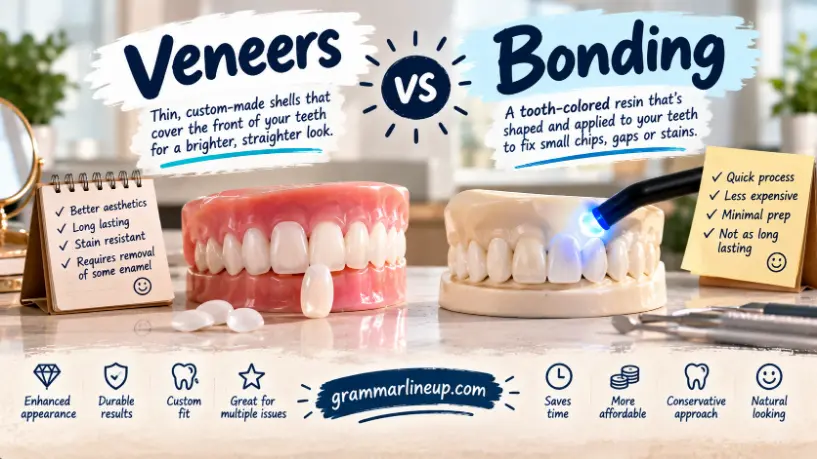
Choosing between veneers or bonding can feel like a small decision until you start wondering what each option actually does for your smile. Both cosmetic dental treatments can improve the appearance of teeth, but they work in different ways and may suit different needs.
Dental bonding generally uses a tooth-colored resin that is shaped directly onto the tooth and hardened to improve its appearance. It can be useful for addressing small chips, gaps, discoloration, or minor changes in tooth shape. Veneers, on the other hand, are thin coverings placed over the front surface of teeth. They are often considered when someone wants a more noticeable or comprehensive cosmetic change.
The choice is not simply about which option looks better. Factors such as the condition of your teeth, the amount of tooth alteration involved, durability, maintenance, cost, and your desired result can all matter. A treatment that works well for one person may not be the right fit for another.
In this guide, we’ll compare veneers and bonding in clear, everyday language, explain their main differences, and look at the situations where each option may make sense. By the end, you’ll have a clearer idea of what to discuss with your dentist.
Veneers and bonding both improve the appearance of teeth, but they work differently. Bonding uses tooth-colored composite resin shaped directly on the tooth and is usually less invasive and reversible. Veneers are thin shells placed over the front of teeth and generally require more preparation. Bonding can be suitable for smaller cosmetic changes, while veneers may be considered when broader or more substantial changes are desired.
Quick Answer
The simplest distinction is this:
| Feature | Dental Bonding | Veneers |
|---|---|---|
| Material | Tooth-colored composite resin | Usually porcelain or another veneer material |
| Application | Sculpted directly on the tooth | Custom-made covering placed on the tooth |
| Tooth preparation | Often minimal | May require removal of some enamel |
| Reversible? | Generally yes when enamel hasn’t been removed | Porcelain veneers generally aren’t reversible |
| Treatment time | Often one visit | Often requires more than one appointment |
| Best suited to | Smaller cosmetic changes and repairs | Broader cosmetic changes |
| Stain resistance | More susceptible to staining than porcelain | Porcelain is generally more stain-resistant |
| Maintenance | May need touch-ups | May eventually need replacement |
These are general comparisons, not guarantees. Different veneer materials and bonding techniques can change the details.
The American Dental Association describes direct composite materials as tooth-colored materials used in applications including veneers, while indirect restorations are generally fabricated outside the mouth before placement.
What Is Dental Bonding?
Dental bonding, also called composite bonding or teeth bonding, uses a tooth-colored composite resin.
The dentist selects a suitable shade, prepares the tooth surface, applies the resin, shapes it to the desired form, hardens it with a curing light, and then polishes it.
Bonding can be used to:
- Repair small chips
- Close certain small gaps
- Alter the shape of a tooth
- Make a tooth appear longer
- Conceal some discoloration
- Improve minor cosmetic irregularities
One of the biggest practical differences is that bonding is usually performed directly on the tooth. Cleveland Clinic notes that dental bonding can often be completed during a single office visit and generally does not require major enamel removal.
Bonding is also considered reversible in situations where significant tooth structure has not been removed.
That makes it particularly relevant when someone wants a relatively conservative cosmetic change.
What Are Dental Veneers?
A dental veneer is a thin covering placed over the visible front surface of a tooth.
Porcelain veneers are among the best-known types. Veneers can be used to change the apparent color, shape, size, or overall appearance of teeth.
Depending on the type of veneer and the treatment plan, the dentist may need to remove some enamel so the veneer can fit properly.
The NHS describes veneers as thin layers of porcelain or natural-colored material fitted over the front of a tooth. It also notes that some veneers involve removing a small amount of tooth structure, while not all types require the same degree of preparation.
Because preparation varies, the phrase “veneers always require extensive drilling” is too broad. Your dentist needs to determine what preparation is appropriate for the specific material and tooth.
Veneers vs. Bonding: The Main Differences
The differences become clearer when you compare the treatments by what matters to most patients.
Tooth Preparation
Bonding generally requires less alteration of natural tooth structure. Cleveland Clinic specifically notes that bonding typically does not require enamel removal.
Veneers can require preparation of the tooth so the restoration can be properly positioned. The amount varies depending on the veneer type, tooth, and treatment plan.
This distinction matters because removing natural enamel can affect whether a treatment can later be reversed.
Appearance
Both treatments can produce natural-looking results when appropriately planned and placed.
Bonding is sculpted directly by the dentist, which allows the material to be shaped around the individual tooth.
Veneers are fabricated as restorations and then placed on the tooth. Ceramic materials can provide a highly controlled appearance, although the final result depends on material selection, design, preparation, placement, and the patient’s existing teeth.
Appearance alone does not determine which treatment is appropriate.
Durability
Neither treatment should be considered permanent.
Cleveland Clinic reports that dental bonding commonly lasts around three to 10 years before it may need touch-up or replacement, although individual results vary.
For porcelain veneers, Cleveland Clinic reports that they may need replacement after roughly 10 to 20 years.
These figures are not expiration dates. Habits, bite forces, oral hygiene, the number of teeth treated, material, technique, and other factors can affect longevity.
Staining
Composite bonding can stain or discolor over time and is generally less stain-resistant than porcelain.
Porcelain veneers are generally more resistant to staining.
However, a veneer does not make the rest of the mouth immune to discoloration. Natural teeth around a veneer can still change shade.
This is one reason dentists consider the color of surrounding teeth when planning cosmetic treatment.
Reversibility
This is one of the most important distinctions.
Bonding is generally reversible when it has been performed without significant removal of natural enamel.
Traditional porcelain veneers generally aren’t reversible because placing them may require removal of enamel.
So if preserving natural tooth structure is a major concern, the preparation required for the proposed treatment deserves careful discussion with your dentist.
When Might Bonding Make Sense?
Bonding may be considered when the desired change is relatively small or when repairing a localized cosmetic problem is the goal.
For instance, a dentist may consider bonding for a minor chip or a small shape irregularity.
It can also be useful when a patient wants a cosmetic change without the level of tooth preparation associated with some veneer treatments.
Bonding may be especially appealing when:
- A tooth has a small chip
- A minor gap needs cosmetic improvement
- A tooth needs a small shape adjustment
- You want a relatively conservative treatment
- You prefer a treatment that can generally be reversed
- You want a procedure that may be completed in one visit
That doesn’t mean bonding is appropriate for everyone. Existing decay, gum disease, bite problems, or other oral-health issues may need attention first.
When Might Veneers Make Sense?
Veneers may be considered when someone wants a more extensive cosmetic change involving the visible surface of one or several teeth.
They can address concerns such as:
- Tooth discoloration
- Certain chips or cracks
- Tooth shape
- Tooth proportions
- Some spacing concerns
- The appearance of multiple front teeth
Veneers can create a coordinated appearance across several teeth, which is one reason they are often discussed in broader smile-makeover plans.
However, cosmetic improvement does not automatically make veneers the appropriate choice. A dentist should evaluate the health and structure of the teeth first.
Are Veneers Better Than Bonding?
There isn’t a universal “better” option.
Veneers and bonding solve overlapping cosmetic problems but have different trade-offs.
Bonding generally involves less alteration of natural tooth structure and can be repaired or replaced relatively easily. Its disadvantages include greater susceptibility to staining and chipping compared with porcelain restorations.
Veneers can provide a durable, highly controlled cosmetic result, particularly when several visible teeth are being changed. But veneer treatment can involve enamel preparation and is generally less reversible.
The more useful question is not “Which treatment is better?”
It is:
Which treatment is appropriate for the condition of the teeth and the result you want?
What About Cost?
Cost is one of the factors people commonly consider, but there isn’t one reliable price that applies everywhere.
Dental fees can vary based on:
- Geographic location
- Dentist’s experience and practice
- Number of teeth treated
- Material selected
- Laboratory fees
- Complexity of the case
- Whether additional dental treatment is needed
Bonding is often less expensive per tooth than porcelain veneers, but comparing only the initial price can be misleading.
A treatment that needs more frequent repair or replacement has a different long-term cost profile from one that lasts longer but requires greater initial investment.
Ask your dentist for the complete treatment cost and what future maintenance or replacement may involve.
Which Lasts Longer: Veneers or Bonding?
In general, porcelain veneers can last longer than composite bonding, but individual outcomes vary.
Cleveland Clinic gives an approximate three-to-10-year range for dental bonding and 10-to-20-year replacement timing for porcelain veneers.
Those ranges should not be interpreted as guarantees.
Your habits matter. Biting fingernails, chewing pens, opening packages with your teeth, or repeatedly exposing restorations to excessive force can contribute to damage.
Your bite also matters. Someone who grinds or clenches their teeth may have different considerations from someone without those habits.
Can You Get Bonding Instead of Veneers?
Sometimes, yes.
But whether bonding can realistically replace veneers depends on what you want to change and the condition of your teeth.
For a small chip or modest shape correction, bonding may provide the desired improvement.
For larger or more extensive cosmetic changes, a dentist may recommend another approach.
The two treatments aren’t interchangeable in every situation.
A dentist should examine your teeth, gums, bite, existing restorations, and overall oral health before recommending one.
Can Veneers and Bonding Be Used Together?
Yes, different cosmetic dental treatments can sometimes be used as part of the same treatment plan.
For example, a dentist may recommend veneers for some teeth and bonding for others depending on their shape, condition, location, and cosmetic requirements.
The goal isn’t necessarily to use the same treatment everywhere.
Instead, the treatment plan can be designed around the individual teeth and the desired overall appearance.
Common Misunderstandings
“Bonding Is Just Glue”
Not quite.
In dental terminology, bonding refers to adhesion between materials and tooth structure. In cosmetic dental bonding, the visible restoration is typically tooth-colored composite resin that is shaped and hardened on the tooth.
“Veneers Are Always Porcelain”
Not necessarily.
The word veneer describes a covering placed on the tooth. Veneers can be made from different materials, including ceramic and resin-based materials.
So it is useful to ask exactly what material your dentist is recommending.
“Veneers Prevent Cavities”
No.
A veneer is not a substitute for oral hygiene.
The American Dental Association’s MouthHealthy guidance notes that cavities can still occur around or under a veneer. Brushing, cleaning between the teeth, and regular dental care remain important.
“Bonding Never Stains”
Bonding can discolor.
Cleveland Clinic specifically notes that bonding is somewhat stain-resistant but does not resist stains as well as porcelain restorations.
“Cosmetic Treatment Means the Teeth Are Healthy”
Not necessarily.
Cosmetic dentistry addresses appearance, but a tooth may have decay, gum problems, structural damage, or another issue that needs treatment first.
That is why diagnosis should come before cosmetic treatment.
How to Care for Bonding or Veneers
Good oral hygiene remains important with either treatment.
General care includes:
- Brush twice a day with fluoride toothpaste.
- Clean between your teeth daily.
- Attend regular dental checkups.
- Avoid using your teeth as tools.
- Be careful with very hard objects and foods.
- Discuss a mouthguard with your dentist if you participate in activities that could injure your teeth.
- Tell your dentist if a restoration chips, feels sharp, or changes your bite.
MouthHealthy also recommends avoiding habits such as biting fingernails and chewing hard objects and emphasizes maintaining regular dental care after veneer treatment.
What Should You Ask Your Dentist?
If you’re deciding between veneers or bonding, these questions can make the consultation more useful:
- How much natural tooth structure would need to be removed?
- Is the proposed treatment reversible?
- Which material would you use, and why?
- How long would you expect it to last in my situation?
- How likely is staining or chipping?
- Would bonding achieve the result I’m looking for?
- Do I have any cavities, gum problems, or bite issues that need treatment first?
- What maintenance or replacement might I need later?
- What happens if the restoration chips or fails?
- What will the total treatment cost include?
These questions can help you compare the actual treatment plan rather than comparing two procedures in the abstract.
Safety Matters: Choose a Qualified Dental Professional
Cosmetic dental work should not be treated like a do-it-yourself beauty service.
The American Dental Association has specifically warned about unlicensed “veneer technicians” and services that bypass the dentist’s role in diagnosis and treatment planning. According to the ADA, unsupervised procedures that alter teeth can cause complications, including infection, nerve damage, and other potentially irreversible harm.
If you’re considering veneers or bonding, the safest starting point is a licensed dentist who can examine your teeth and determine whether cosmetic treatment is appropriate.
FAQs:
Is bonding cheaper than veneers?
Bonding is often less expensive initially than porcelain veneers, but actual prices vary by location, dentist, material, and number of teeth treated. Ask for a complete treatment estimate rather than relying on a general online price.
Which looks more natural, veneers or bonding?
Both can look natural when properly planned and placed. The final appearance depends on the material, shade, shape, tooth preparation, dentist’s technique, and the surrounding teeth.
Is dental bonding reversible?
Dental bonding is generally considered reversible when significant natural enamel has not been removed. Your dentist can explain whether the specific procedure being proposed would preserve that reversibility.
Do veneers last longer than bonding?
Porcelain veneers generally have a longer expected service life than composite bonding. Cleveland Clinic reports approximately three to 10 years for bonding and 10 to 20 years before porcelain veneers may need replacement, although individual results vary.
Can bonding fix a chipped tooth?
Yes. Dental bonding is commonly used to repair minor chips and reshape teeth. Whether it is suitable depends on the size and location of the damage and the overall condition of the tooth.
Should I get veneers or bonding?
The answer depends on your teeth and treatment goals. Bonding is generally more conservative and reversible, while veneers can provide a more extensive cosmetic change but may require removal of some enamel. A dentist can assess which approach fits your situation.
Conclusion:
Veneers or bonding isn’t simply a choice between “good” and “bad.” Both are established cosmetic dental options with different advantages and limitations.
Bonding uses composite resin directly on the tooth and is generally less invasive, faster, and reversible when natural enamel has been preserved.
Veneers cover the visible surface of a tooth and can provide a durable, coordinated cosmetic result, but some types require enamel preparation and are not reversible.
If you’re choosing between them, focus on tooth preservation, desired appearance, durability, staining, maintenance, cost, and your overall oral health rather than choosing based on price or appearance alone.
A dental examination is the important next step because the best treatment depends on the actual condition of your teeth and the result you’re trying to achieve.
