
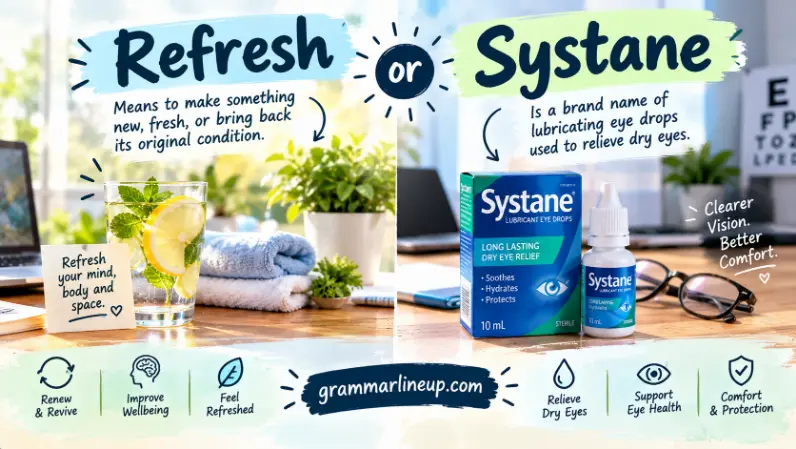
When your eyes feel dry, gritty, tired, or irritated, reaching for artificial tears can feel like a simple solution. But once you see the shelves, the choice may become less simple. Refresh or Systane? Both are well-known brands of lubricating eye drops, yet they offer different product options and formulations, so choosing between them can take a little more thought.
The right option often depends on what is causing your discomfort, how frequently you need drops, and which formulation feels comfortable for your eyes. Some products are designed for occasional dryness, while others are made for more persistent symptoms or specific types of irritation. Ingredients and preservatives can also vary between products, making the label worth a closer look.
This guide compares Refresh and Systane in clear, everyday language. You’ll learn how their products differ, what their common uses are, and what factors may matter when deciding which one suits your needs. Because dry-eye symptoms can have many causes, there isn’t necessarily one brand that is best for everyone.
If you’re simply wondering whether Refresh and Systane are the same, or trying to understand which type of artificial tear may be appropriate for your situation, this comparison will help you make sense of the choices without unnecessary medical jargon.
Refresh and Systane are both brands of lubricating eye drops, but neither brand is one single formula. Refresh Tears, for example, contains carboxymethylcellulose 0.5%, while Systane products use different lubricants depending on the formula. The better choice depends on your symptoms, sensitivity to preservatives, contact-lens use, and the specific product—not simply the brand name.
Refresh or Systane: The Quick Answer
There isn’t one universal winner between Refresh and Systane.
Refresh Tears is a carboxymethylcellulose-based lubricant, while several Systane products use different lubricant systems. Other Refresh and Systane formulas add ingredients or technologies designed for particular dry-eye needs.
For occasional mild dryness, either brand may provide useful lubrication.
If you use artificial tears frequently, a preservative-free formulation may be worth considering. The American Academy of Ophthalmology notes that people using artificial tears more than six times a day, or those sensitive to preservatives, should use preservative-free tears.
The important thing is to compare the exact product, not just the brand printed on the box.
What Is the Difference Between Refresh and Systane?
The biggest difference is formulation.
Refresh Tears, for example, contains carboxymethylcellulose sodium 0.5%, an ophthalmic lubricant used for temporary relief of burning, irritation, and discomfort caused by dry eyes.
Systane products vary considerably. Systane Hydration PF contains polyethylene glycol 400 0.4% and propylene glycol 0.3%, while Systane PRO PF contains propylene glycol 0.6% in an emulsion formulation.
That means you can’t accurately say:
- “Refresh is thinner.”
- “Systane always lasts longer.”
- “Refresh is better for everyone.”
- “Systane is stronger.”
Those statements overlook the different formulas within each product family.
A more accurate comparison looks at the specific active ingredients, preservatives, formulation type, and intended use.
Refresh vs. Systane at a Glance
| Factor | Refresh | Systane |
|---|---|---|
| Product family | Multiple artificial-tear formulas | Multiple artificial-tear formulas |
| Common lubricant | Carboxymethylcellulose in some products | Propylene glycol and other lubricants depending on product |
| Preservative-free choices | Yes | Yes |
| Dry-eye products | Yes | Yes |
| Formula varies by product | Yes | Yes |
| Best comparison | Specific Refresh product | Specific Systane product |
This is why Refresh Tears vs. Systane Hydration PF is a more meaningful comparison than simply Refresh vs. Systane.
What Does Refresh Do?
Refresh is a family of lubricating eye drops designed to relieve symptoms associated with dry or irritated eyes.
Refresh Tears, one commonly recognized formulation, contains carboxymethylcellulose sodium 0.5%. Its FDA-listed uses include temporary relief of burning, irritation, and discomfort caused by eye dryness or exposure to wind or sun.
Other Refresh products have different formulations.
For example, Refresh Optive contains carboxymethylcellulose sodium 0.5% and glycerin 0.9%. Refresh Relieva PF also uses carboxymethylcellulose and glycerin, but in a preservative-free single-use formulation.
So when someone says “Refresh works better for me,” that may be perfectly reasonable—but it doesn’t necessarily mean every Refresh product will feel the same.
What Does Systane Do?
Systane is also a broad family of lubricating eye products.
Different Systane formulas are designed around different approaches to dry-eye relief. The current Systane range includes products such as Systane PRO, Systane COMPLETE, Systane HYDRATION, Systane ULTRA, and preservative-free versions.
For example, Systane Hydration PF contains polyethylene glycol 400 and propylene glycol as active lubricants.
Systane Complete uses propylene glycol 0.6% and includes additional ingredients such as hydroxypropyl guar and mineral oil. The manufacturer describes the formulation as providing hydration and protection against tear evaporation.
Again, the exact bottle matters.
Why the Active Ingredient Matters
The active ingredient tells you more about an eye drop than the brand name alone.
Different lubricants can produce different sensations and may be suited to different people.
For example:
- Carboxymethylcellulose is used as a lubricant in products such as Refresh Tears.
- Propylene glycol is used in several Systane formulations.
- Polyethylene glycol 400 appears in Systane Hydration PF.
- Glycerin is included in several Refresh formulations.
This doesn’t mean one ingredient is automatically better.
Dry eye is not identical for every person, and people can respond differently to artificial tears. The American Academy of Ophthalmology notes that there are many artificial-tear brands and that people may need to try different products to find one that works well for them.
Preservative-Free Refresh or Systane?
This can be one of the most important parts of the comparison.
Preservatives help maintain sterility in many multidose eye-drop bottles, but frequent exposure can be irritating for some people.
The American Academy of Ophthalmology recommends preservative-free artificial tears for people who use artificial tears more than six times per day or who are allergic or sensitive to preservatives.
Both brands offer preservative-free products.
For example, Refresh Relieva PF is labeled preservative-free and contains carboxymethylcellulose sodium 0.5% plus glycerin 1.0%.
Systane also offers preservative-free options, including Systane Complete PF and Systane PRO PF.
When preservative-free drops may make sense
They may be particularly worth discussing with an eye-care professional if:
- You need artificial tears frequently.
- Preserved drops make your eyes feel irritated.
- You have sensitive eyes.
- You have been advised to avoid preservatives.
The exact product instructions still matter, so check the label rather than assuming every preservative-free product is identical.
Refresh or Systane for Contact Lens Wearers?
Contact-lens users need to be especially careful because not every eye drop is intended to be used while lenses are in the eyes.
Some products are specifically designed for contact-lens use, while others are not.
For example, Systane’s product range includes Systane Contacts, which is specifically labeled as a rewetting eye drop for contact lenses.
Systane Complete PF is described by the manufacturer as safe for use with soft contact lenses, although it is not a rewetting drop.
The safest approach is simple:
Check the exact product label for contact-lens instructions.
Don’t assume that because one Systane or Refresh product is compatible with lenses, every product from that brand is.
Which Is Better for Occasional Dry Eyes?
For occasional mild dryness, the choice may come down to which lubricant feels comfortable and provides adequate relief.
Artificial tears are intended to supplement the eye’s natural tears and temporarily relieve symptoms.
Refresh Tears, for example, is labeled for temporary relief of burning, irritation, and discomfort associated with dry eyes.
Several Systane products carry similar lubricant indications.
If one product provides comfortable relief and another causes stinging or leaves an unpleasant sensation, that practical difference matters.
But persistent symptoms deserve more than repeated product switching.
Which Is Better for Frequent Dry-Eye Symptoms?
If you’re reaching for artificial tears many times throughout the day, the question changes.
Instead of simply asking “Refresh or Systane?”, consider:
- How often are you using the drops?
- Are they preserved or preservative-free?
- Do they actually relieve your symptoms?
- Are your symptoms getting worse?
- Do you have redness, pain, or vision changes?
- Are contact lenses contributing to the problem?
The AAO specifically advises preservative-free tears for people using artificial tears more than six times a day or those sensitive to preservatives.
Frequent symptoms can also indicate that something beyond simple temporary dryness needs attention.
What About Systane Complete and Refresh Optive?
These products illustrate why comparing entire brands can be confusing.
Refresh Optive contains carboxymethylcellulose sodium 0.5% and glycerin 0.9%.
Systane Complete uses propylene glycol 0.6% and includes a formulation with hydroxypropyl guar and mineral oil, among other ingredients.
Both are intended for dry-eye lubrication, but they use different formulations.
That means a person comparing these two products should look at:
- Active ingredients
- Preservatives
- Bottle or vial format
- Contact-lens instructions
- How often the drops are needed
- How their eyes respond
Rather than assuming the brand name determines the result.
Common Misunderstandings About Refresh and Systane
“One brand is always better.”
There is no simple evidence-based rule that makes every Refresh formulation better than every Systane formulation, or vice versa.
There are too many different products within both families.
“All artificial tears are basically identical.”
They share the broad goal of lubrication, but their active ingredients and formulations can differ substantially.
“Preservative-free means it is automatically the best choice.”
Not necessarily. Preservative-free products can be especially useful for frequent users or people sensitive to preservatives, but the appropriate product still depends on the individual situation.
“If eye drops are sold over the counter, they can treat every eye problem.”
Lubricating drops are intended for temporary relief of certain dryness and irritation symptoms. They are not a substitute for diagnosing an eye condition.
When Should You See an Eye Doctor?
Artificial tears can be useful for mild dry-eye symptoms, but persistent or concerning symptoms should not simply be masked with more drops.
The AAO recommends seeing an eye doctor when dry-eye symptoms persist, worsen, interfere with daily activities, aren’t relieved by over-the-counter lubricating drops, or occur with significant redness, pain, or vision changes.
Individual product labeling also gives important warning signs.
For example, the Refresh Tears label says to stop use and ask a doctor if you experience eye pain, vision changes, continued redness or irritation, or if the condition worsens or persists for more than 72 hours.
Systane Hydration PF and Systane PRO PF carry similar warnings about eye pain, vision changes, continued redness or irritation, and symptoms that worsen or persist beyond 72 hours.
Don’t ignore those warnings just because the drops are available without a prescription.
How to Choose Between Refresh and Systane
Instead of choosing based only on brand recognition, compare the specific bottles you’re considering.
Look at the active ingredient
Check whether the product contains carboxymethylcellulose, propylene glycol, polyethylene glycol, glycerin, or another lubricant.
Check whether it contains preservatives
If you’re using drops frequently or have sensitivity to preservatives, a preservative-free option may be more appropriate.
Consider your type of dryness
Some formulations are designed around hydration, while others incorporate ingredients intended to support different parts of the tear film.
Check contact-lens instructions
Never assume a general lubricant is suitable for use while wearing contacts.
Pay attention to how your eyes respond
Comfort, relief, and tolerability are useful practical factors when comparing otherwise appropriate artificial tears.
Read the current label
Formulations can differ within the same brand, and product instructions can vary.
FAQs:
Is Refresh or Systane better for dry eyes?
Neither brand can be called universally better. Refresh and Systane each sell multiple artificial-tear formulations with different active ingredients and characteristics. The appropriate choice depends on the specific product and your symptoms.
Can I use Refresh and Systane together?
Don’t routinely combine different eye-drop products without checking their labels or asking a pharmacist, optometrist, or ophthalmologist. If you’re already using several eye medications, professional guidance is especially important.
Is Refresh Tears the same as Systane?
No. Refresh Tears contains carboxymethylcellulose sodium 0.5%, while Systane products vary by formulation. For example, Systane Hydration PF uses polyethylene glycol 400 and propylene glycol.
Which is better for sensitive eyes, Refresh or Systane?
The answer depends on the exact formulation. A preservative-free product may be useful for people with preservative sensitivity or those who need artificial tears frequently. Both brands offer preservative-free options.
Can I use Refresh or Systane with contact lenses?
Some products are specifically compatible with contact lenses, while others aren’t intended for use while lenses are being worn. Always check the individual product label. Systane, for example, has a separate Contacts product specifically intended for lens rewetting.
What if neither Refresh nor Systane helps?
If your symptoms continue, worsen, or are accompanied by pain, significant redness, or vision changes, contact an eye-care professional rather than simply trying more artificial tears.
Conclusion:
The Refresh or Systane question doesn’t have a one-size-fits-all answer.
Both are established families of lubricating eye drops, but each brand contains multiple formulations. Refresh Tears uses carboxymethylcellulose sodium 0.5%, while Systane products can use lubricants such as propylene glycol or polyethylene glycol, depending on the specific product.
If you’re choosing between them, compare the exact product, not just the brand.
For occasional dryness, either may be reasonable if the product is appropriate and provides relief. For frequent use, preservative-free options deserve particular attention. And if dryness persists or comes with pain, redness, or vision changes, it’s time to involve an eye-care professional rather than relying on over-the-counter drops alone.
