
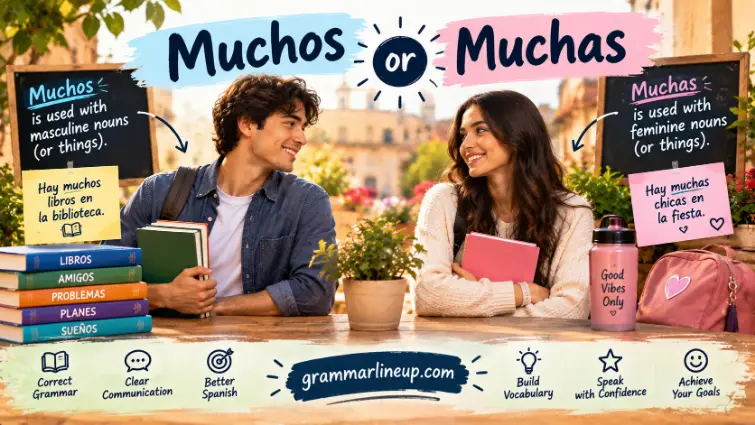
If you are learning Spanish, you may have come across both muchos and muchas and wondered which one is correct. The good news is that the difference is quite simple once you understand how Spanish nouns work. Both words can mean “many” or “a lot of,” but they are not interchangeable in every sentence.
The key is gender and number agreement. Muchos is used with masculine plural nouns, while muchas is used with feminine plural nouns. For example, you can say muchos libros for “many books” and muchas casas for “many houses.” The word changes to match the noun it describes.
This small distinction is important because Spanish adjectives and related words often agree with the nouns they modify. Once you recognize the pattern, choosing between muchos or muchas becomes much easier. In this guide, we’ll look at the meaning, grammar rules, common examples, and everyday uses so you can use both forms naturally and confidently.
Featured Snippet Answer:
Muchos and muchas are plural forms of the Spanish word mucho, meaning “many,” “a lot of,” or “lots of.” Use muchos with masculine plural nouns and muchas with feminine plural nouns: muchos libros (many books) and muchas casas (many houses). The correct form depends on the noun’s gender and number.
Quick Answer
If you’re wondering whether to say muchos or muchas, the key is simple: match the word with the plural noun it refers to.
- Muchos = masculine plural
- Muchas = feminine plural
For example:
- muchos amigos = many friends
- muchas amigas = many female friends
- muchos libros = many books
- muchas páginas = many pages
The four common forms are mucho, mucha, muchos, and muchas. They are forms of the same word, and their endings change when mucho functions with a noun. The Royal Spanish Academy’s grammatical reference likewise shows muchos with masculine plural nouns and muchas with feminine plural nouns.
The important point is that muchos and muchas do not have completely different meanings. Both generally express a large quantity or number. The difference is grammatical agreement.
What Does “Muchos or Muchas” Mean?
Muchos and muchas usually translate into English as “many,” “a lot of,” or sometimes “lots of.”
The choice between them depends on the noun that follows.
| Spanish | Grammar | English |
|---|---|---|
| mucho | masculine singular | much / a lot of |
| mucha | feminine singular | much / a lot of |
| muchos | masculine plural | many / a lot of |
| muchas | feminine plural | many / a lot of |
For instance:
- mucho tiempo = a lot of time
- mucha comida = a lot of food
- muchos días = many days
- muchas personas = many people
Spanish nouns have grammatical gender, so quantity words such as mucho generally agree with the noun in gender and number when they modify it.
Muchos vs. Muchas: The Main Difference
The easiest way to remember the difference is to look at the noun.
Use “muchos” with masculine plural nouns
Use muchos when the plural noun is masculine.
Examples:
- muchos libros — many books
- muchos perros — many dogs
- muchos años — many years
- muchos problemas — many problems
- muchos estudiantes — many students
Notice that the noun is plural, and the ending -os agrees with it.
Use “muchas” with feminine plural nouns
Use muchas when the plural noun is feminine.
Examples:
- muchas casas — many houses
- muchas flores — many flowers
- muchas personas — many people
- muchas preguntas — many questions
- muchas ideas — many ideas
Here, -as signals feminine plural agreement.
The distinction is grammatical rather than a difference in the basic idea of quantity.
How Gender and Number Affect the Word
Spanish commonly marks both gender and number through word endings.
Consider these four combinations:
Masculine singular: mucho
Tengo mucho trabajo.
“I have a lot of work.”
Trabajo is masculine and singular, so mucho is used.
Feminine singular: mucha
Tengo mucha paciencia.
“I have a lot of patience.”
Paciencia is feminine and singular, so mucha is used.
Masculine plural: muchos
Tengo muchos libros.
“I have many books.”
Libros is masculine and plural, so muchos is correct.
Feminine plural: muchas
Tengo muchas preguntas.
“I have many questions.”
Preguntas is feminine and plural, so muchas is correct.
This agreement is one of the most useful patterns to learn because it works across countless ordinary Spanish sentences.
Why “Muchas Gracias” Is Correct
One of the most familiar phrases that causes confusion is:
Muchas gracias.
It means “Thank you very much” or literally something close to “many thanks.”
Why is it muchas, rather than muchos?
Because gracias is a feminine plural noun, so the quantity word agrees with it:
muchas + gracias
Therefore:
- ✅ Muchas gracias
- ❌ Muchos gracias
This is not because muchas means “more thankful.” It is simply grammatical agreement.
The same pattern appears in phrases such as:
- muchas felicidades — congratulations
- muchas veces — many times
- muchas cosas — many things
- muchas personas — many people
Many vs. Much: Why English Can Be Misleading
English uses both many and much, and Spanish uses forms of mucho to express similar ideas.
The important difference is that Spanish marks gender as well as number when mucho modifies a noun.
Compare:
muchos libros
many books
muchas revistas
many magazines
English simply uses many in both cases. Spanish changes the ending because libros and revistas have different grammatical genders.
This is why translating word-for-word can sometimes lead to mistakes.
Can “Muchos” and “Muchas” Stand Alone?
Yes. Forms of mucho can also be used without repeating the noun when the noun is understood from context.
For example:
¿Tienes muchos libros?
Do you have many books?
Sí, tengo muchos.
Yes, I have many.
Here, muchos stands in for the understood masculine plural noun libros.
Likewise:
¿Tienes muchas revistas?
Do you have many magazines?
Sí, tengo muchas.
Yes, I have many.
The noun revistas is understood, so muchas carries the agreement.
Spanish dictionaries describe mucho as having uses in which it can stand for an omitted noun as well as uses where it modifies a noun.
Many Real-Life Examples
Here are some natural sentences showing how the forms work.
With “muchos”
Hay muchos restaurantes aquí.
There are many restaurants here.
Tengo muchos amigos en California.
I have many friends in California.
Hemos tenido muchos problemas.
We’ve had many problems.
Compré muchos regalos.
I bought many gifts.
With “muchas”
Hay muchas opciones.
There are many options.
Tengo muchas cosas que hacer.
I have many things to do.
Ella tiene muchas preguntas.
She has many questions.
Vimos muchas películas.
We watched many movies.
The pattern remains the same: identify the noun, determine its grammatical gender and number, and choose the matching form.
“Muchos” Can Refer to Mixed Groups
A useful detail is that Spanish traditionally uses the masculine plural form for groups that include both males and females in contexts where a plural gendered noun form is required.
For example:
muchos estudiantes
can refer to a group of students that includes males and females.
By contrast:
muchas estudiantes
refers specifically to female students when estudiantes is being used with a feminine interpretation.
The exact interpretation can depend on context, so the surrounding sentence matters.
What About “Mucha” and “Mucho”?
Although your search is specifically about muchos or muchas, understanding the singular forms makes the whole system easier.
Mucho
Use mucho with masculine singular nouns:
- mucho dinero — a lot of money
- mucho tiempo — a lot of time
- mucho trabajo — a lot of work
Mucha
Use mucha with feminine singular nouns:
- mucha agua — a lot of water
- mucha suerte — lots of luck
- mucha energía — a lot of energy
Then pluralize according to the noun:
- muchos dólares
- muchas botellas
So the basic pattern is:
mucho → mucha → muchos → muchas
The endings reflect the noun’s gender and number.
“Muchos” and “Muchas” Are Not Always About Physical Objects
Quantity does not have to refer to objects you can count visually.
You can use these forms with people, occasions, ideas, events, and other countable nouns.
For example:
- muchos años — many years
- muchos días — many days
- muchas veces — many times
- muchas ideas — many ideas
- muchas preguntas — many questions
- muchas oportunidades — many opportunities
The underlying idea is simply a large number or quantity.
Don’t Confuse “Muchos” With “Muy”
A very common learner mistake is confusing mucho with muy.
They are not interchangeable.
Mucho is associated with quantity or degree and can modify nouns or function in other grammatical roles.
Muy is an adverb used before adjectives and adverbs to express a high degree.
Compare:
Tengo muchos libros.
I have many books.
El libro es muy interesante.
The book is very interesting.
You would not normally replace muchos with muy in the first sentence.
The distinction is also recognized in Spanish reference materials: mucho has quantity-related uses, while muy is used to intensify adjectives and certain adverbs.
What About “Mucho” After a Verb?
Here’s another important point: mucho does not always change to muchos or muchas.
When mucho functions as an adverb after a verb, it generally remains mucho.
For example:
Trabajo mucho.
I work a lot.
Estudio mucho.
I study a lot.
Me gusta mucho.
I like it a lot.
You would not change mucho to muchos just because the person doing the action is plural or feminine.
The form depends on the grammatical function, not simply on who is performing the action. Spanish grammatical references distinguish these uses of mucho from its noun-modifying forms.
Common Mistakes With Muchos or Muchas
Using “muchos” before every plural noun
Not every plural noun takes muchos.
❌ muchos casas
✅ muchas casas
The noun casas is feminine plural.
Using “muchas” with masculine nouns
❌ muchas libros
✅ muchos libros
Libros is masculine plural.
Assuming the English word “many” determines the Spanish ending
English does not mark grammatical gender in many, but Spanish does.
So:
- many books → muchos libros
- many houses → muchas casas
Changing adverbial “mucho”
❌ Trabajo muchas.
✅ Trabajo mucho.
When mucho means “a lot” and modifies the verb, it does not agree with the subject in gender or number.
A Simple Memory Trick
When mucho directly describes a plural noun, look at the noun’s ending and grammatical gender.
Think:
-os → muchos
-as → muchas
For example:
- libros → muchos libros
- amigos → muchos amigos
- casas → muchas casas
- preguntas → muchas preguntas
This is a useful shortcut, although learners should remember that grammatical gender is not always perfectly predictable from the noun’s final letter.
When Should You Use Muchos or Muchas?
Use muchos when you mean a large number of masculine plural nouns.
Use muchas when you mean a large number of feminine plural nouns.
You will encounter them in:
- everyday conversation
- texting and messaging
- travel Spanish
- shopping
- social conversations
- school and work
- Spanish-language media
Examples:
¿Tienes muchos amigos?
Do you have many friends?
¿Tienes muchas amigas?
Do you have many female friends?
Hay muchos hoteles cerca.
There are many hotels nearby.
Hay muchas tiendas cerca.
There are many stores nearby.
FAQs:
Is “muchas” the feminine form of “muchos”?
Yes. Muchas is the feminine plural form, while muchos is the masculine plural form of mucho when it agrees with a noun.
Is “muchas gracias” correct?
Yes. Muchas gracias is the standard Spanish expression for “thank you very much.” Muchas agrees with the feminine plural noun gracias.
Does “muchos” mean “many”?
Yes. When it modifies a masculine plural noun, muchos commonly means “many,” “a lot of,” or “lots of,” depending on context.
Does “muchas” mean “many”?
Yes. Muchas has the same basic quantity meaning as muchos, but it agrees with feminine plural nouns.
Can “muchos” and “muchas” be used without a noun?
Yes. When the noun is understood from context, these forms can stand on their own. For example, Tengo muchos can mean “I have many” when the omitted noun is masculine plural.
What is the difference between “mucho” and “muy”?
Mucho is associated with quantity or degree, while muy generally means “very” and intensifies adjectives or adverbs. For example, mucho dinero means “a lot of money,” while muy caro means “very expensive.”
Conclusion:
The choice between muchos or muchas is mainly a matter of gender and number agreement.
- muchos = masculine plural
- muchas = feminine plural
- mucho = masculine singular
- mucha = feminine singular
So:
muchos libros = many books
muchas casas = many houses
And remember the important exception: when mucho is functioning adverbially, as in Trabajo mucho (“I work a lot”), it does not change to muchos or muchas.
Once you identify the noun and its grammatical role, choosing between muchos and muchas becomes much easier.
