
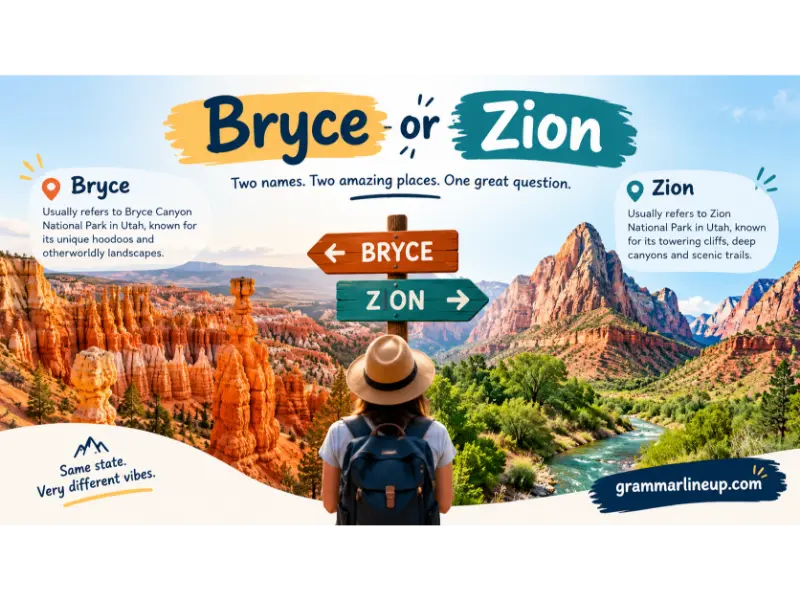
Choosing between Bryce or Zion can be surprisingly tricky. Both Utah national parks offer unforgettable scenery, memorable hikes, and plenty of reasons to bring a camera, but they create very different experiences.
Bryce Canyon is known for its remarkable hoodoos, colorful rock formations, and high elevation views, while Zion is famous for its towering canyon walls, dramatic landscapes, and iconic trails.
So, which one should you visit? The answer depends on what you want from your trip. Are you looking for unusual rock formations and shorter scenic walks, or do you prefer a grand canyon setting with more famous hiking adventures? Your travel time, fitness level, season, and interests can all make a difference.
In this guide, we’ll compare Bryce and Zion in a simple, practical way. You’ll learn how they differ in scenery, hiking, accessibility, crowds, weather, and overall experience, helping you decide which park fits your plans best.
And if you have time for both, we’ll also explain why combining them can make for a memorable Utah adventure.
Featured Snippet Answer:
Bryce or Zion depends on what you want from a Utah national park. Bryce Canyon is known for its high-elevation amphitheaters and distinctive hoodoos, while Zion is known for towering canyon walls, sandstone cliffs, and hikes such as Angels Landing and The Narrows. The parks offer very different landscapes and hiking experiences.
Bryce or Zion: What Does the Phrase Mean?
When someone searches “Bryce or Zion,” they are usually comparing Bryce Canyon National Park and Zion National Park in Utah.
The question often comes up when planning a Utah road trip and there is limited time to visit both parks. Travelers want to know how the two destinations differ in scenery, hiking, elevation, difficulty, and overall experience.
They are both part of Utah’s famous red-rock landscape, but they are not interchangeable.
Bryce Canyon is especially associated with its unusual hoodoos—tall, irregular rock spires concentrated around a series of amphitheaters. Zion, by contrast, is centered around dramatic canyon landscapes with towering sandstone walls and deep canyon routes.
So, “Bryce or Zion?” is better understood as a travel-planning comparison, rather than a question with one universal answer.
Quick Comparison: Bryce Canyon vs. Zion
| Feature | Bryce Canyon | Zion |
|---|---|---|
| Main landscape | Hoodoos and natural amphitheaters | Massive canyon walls and sandstone cliffs |
| Typical visual experience | Looking down into a colorful amphitheater | Looking up at towering canyon walls |
| Elevation | Generally much higher | Lower than Bryce’s main high-elevation areas |
| Signature landscape | Bryce Amphitheater and hoodoos | Zion Canyon |
| Well-known hikes | Queen’s Garden, Navajo Loop, Peekaboo Loop | Angels Landing, The Narrows, canyon trails |
| Hiking character | Hoodoo-filled trails with steep sections | Canyon walks, steep climbs, and water-based routes |
| High-altitude consideration | Important | Generally less significant than at Bryce |
| Best known geological feature | Eroded hoodoos | Deeply carved sandstone canyon |
| Trip atmosphere | Open, elevated, unusual rock formations | Enclosed, towering canyon scenery |
The National Park Service describes Bryce as a high-altitude park, with elevations averaging around 8,000 feet and reaching above 9,000 feet. Zion’s visitor-center area is substantially lower.
What Makes Bryce Canyon Different?
Bryce Canyon is famous for a landscape that looks almost otherworldly.
Despite its name, Bryce Canyon is technically not a single traditional canyon. It consists of a series of horseshoe-shaped natural amphitheaters carved into the edge of the Paunsaugunt Plateau. The most recognizable formations are its hoodoos, which are rock spires created through erosion and weathering.
The combination of orange, red, pink, white, and other earthy tones makes the amphitheaters visually distinctive.
Another important difference is altitude.
Bryce Canyon’s elevations average roughly 8,000 feet and reach more than 9,000 feet in some areas. The National Park Service specifically warns that even mild exertion can feel harder at these elevations because there is less available oxygen than at sea level.
That means elevation should be part of your planning, particularly if you are arriving from a much lower elevation.
What Makes Zion Different?
Zion offers a very different visual scale.
Instead of concentrating primarily on hoodoos, Zion is famous for its enormous sandstone cliffs and the dramatic canyon carved by the Virgin River.
The park’s geology is part of the larger Grand Staircase, a sequence of colorful rock layers extending through the region between Bryce Canyon and the Grand Canyon. The National Park Service explains that the rock layers at Bryce and Zion are connected within this larger geological story.
Zion also has a wide range of hiking experiences.
The National Park Service lists easy, moderate, and strenuous routes. Some strenuous trails involve steep cliffs and chains, while other routes travel through the canyon itself. Angels Landing, for instance, requires a permit for hikers going beyond Scout Lookout.
The result is a park where the surrounding canyon walls can become part of the hiking experience itself.
Bryce or Zion for Scenery?
The scenery differs more than the names might suggest.
At Bryce Canyon, many visitors encounter the landscape from viewpoints around the rim of the Bryce Amphitheater. From above, the hoodoos form dense collections of narrow spires and eroded formations.
At Zion, the visual experience is more strongly shaped by scale and verticality. Large sandstone walls rise around the canyon, creating a more enclosed environment in many areas.
The distinction can be summarized simply:
- Bryce: look across and down at intricate rock formations.
- Zion: look around and upward at enormous canyon walls.
- Bryce: concentrated hoodoo scenery.
- Zion: large-scale canyon scenery.
Neither description captures every part of either park, but it helps explain why travelers can enjoy both without feeling that they are visiting the same type of landscape.
Bryce or Zion for Hiking?
Hiking is one of the biggest reasons travelers compare the two parks.
Hiking at Bryce Canyon
Bryce Canyon has numerous trails around the amphitheater and beyond.
The Queen’s Garden/Navajo Combination Loop is one of the park’s prominent hikes. The National Park Service lists it at about 2.9 miles, with approximately 625 feet of elevation change. It combines the Queen’s Garden and Navajo Loop trails and provides an opportunity to descend among the hoodoos.
Other options include:
- Rim Trail
- Queen’s Garden
- Navajo Loop
- Peekaboo Loop
- Fairyland Loop
- Bristlecone Loop
- Tower Bridge
The hiking experience often involves descending from the rim into the formations and then climbing back up.
Hiking at Zion
Zion provides a different collection of experiences.
Its trails range from short, relatively easy walks to strenuous routes involving significant elevation gain. The National Park Service notes that some strenuous Zion trails include steep cliffs and chains.
Notable hiking destinations include:
- Angels Landing
- The Narrows
- Scout Lookout
- Canyon Overlook
- Emerald Pools area
- Riverside Walk
Trail conditions, weather, access rules, and permits can vary, so visitors should check official park information before hiking.
Bryce or Zion for Families?
There is no single family experience because age, hiking ability, weather, and comfort with elevation all matter.
Bryce offers some relatively easy viewpoints and walks. For example, the paved section between Sunset Point and Sunrise Point is about one mile and provides views of the Bryce Amphitheater.
Zion also has easy trails. The National Park Service lists several easy Zion Canyon trails ranging from 0.4 to 3.5 miles, with no more than 100 feet of elevation gain for the category.
For families, it can therefore be more useful to ask:
- How far can everyone comfortably walk?
- Is high elevation a concern?
- Does the group prefer canyon walls or hoodoos?
- Are steep trails appropriate?
- How much time is available?
- What are the current trail and access conditions?
Those questions provide a more practical answer than simply asking which park is “better.”
Bryce or Zion for a Short Visit?
If your schedule is tight, the type of experience you want becomes particularly important.
Bryce Canyon’s major viewpoints are concentrated around the Bryce Amphitheater area. The National Park Service identifies Bryce Point, Inspiration Point, Sunset Point, and Sunrise Point as four major viewpoints, with many located within the first few miles of the park.
That concentration can make a short visit feel focused around a distinctive central landscape.
Zion has its own concentrated canyon experience, but the park also contains numerous trails and areas requiring more planning.
A short visit should therefore be planned around one or two specific experiences, rather than attempting to cover every trail.
Bryce or Zion for Serious Hikers?
Both parks can challenge experienced hikers, but the challenges are different.
Bryce’s high elevation can make exertion more demanding, even when a trail does not appear extreme on paper. The National Park Service specifically advises visitors to prepare for high-altitude hiking.
Zion has strenuous trails involving significant elevation gain and, on certain routes, exposure to steep drop-offs. The park also includes routes where water conditions can become an important factor.
For example, Zion’s strenuous trail category includes hikes with elevation gains of up to 2,148 feet, according to the National Park Service.
Experienced hikers should therefore consider terrain, elevation, exposure, weather, water, permits, and current conditions, not simply trail mileage.
The Geology Behind Bryce and Zion
The two parks are connected by the geology of southern Utah.
At Bryce, erosion has transformed rock into hoodoos, fins, windows, and other unusual formations. Frost wedging and rainwater play important roles in shaping the landscape.
Zion displays a different stage of the region’s geological story. Its sandstone layers have been uplifted and eroded, helping create the enormous canyon landscape seen today.
One fascinating detail from the National Park Service is that the bottom rock layer at Bryce Canyon corresponds to the top rock layer at Zion, while the bottom layer at Zion continues into the geological story of the Grand Canyon.
So visiting both parks can provide a useful visual introduction to the larger geological history of the Colorado Plateau.
Common Misunderstandings About Bryce or Zion
“Bryce Canyon is a normal canyon.”
Not exactly.
Bryce Canyon is technically a collection of natural amphitheaters rather than one conventional canyon. Its most famous feature is the hoodoo-filled Bryce Amphitheater.
“The parks have basically the same scenery.”
They share the broader red-rock environment of southern Utah, but their signature landscapes are noticeably different.
Bryce is especially associated with hoodoos and amphitheaters. Zion is especially associated with towering canyon walls and sandstone formations.
“Bryce is easier because the hikes are short.”
Mileage alone does not tell the whole story.
Bryce’s high elevation can make physical effort feel more demanding. Some trails also involve substantial elevation changes.
“Every Zion hike is extremely difficult.”
That is also inaccurate.
Zion has easy, moderate, and strenuous hiking categories, including short trails suitable for visitors with limited time.
“You have to choose only one.”
Not necessarily.
Many Utah road trips can include both parks. The practical question is whether your available time, transportation, hiking plans, and travel pace allow you to experience each without rushing.
How to Decide Between Bryce and Zion
Instead of looking for a universal winner, match the park to the experience you want.
| If you want… | Consider the park associated with… |
|---|---|
| Dense fields of hoodoos | Bryce Canyon |
| Towering canyon walls | Zion |
| High-elevation scenery | Bryce Canyon |
| Canyon hiking | Zion |
| Short scenic rim walks | Bryce Canyon |
| More dramatic vertical canyon surroundings | Zion |
| A geological focus on hoodoos | Bryce Canyon |
| Steep canyon routes and varied hiking challenges | Zion |
These are descriptions rather than rankings. Both parks contain more variety than a single category can capture.
When to Visit Both
If your itinerary allows it, visiting both can make sense because their landscapes complement each other.
Bryce Canyon gives you the opportunity to see an elevated landscape shaped into thousands of distinctive rock formations. Zion provides a contrasting canyon environment dominated by large sandstone walls and deeper vertical terrain.
The parks are also geographically close enough to be commonly incorporated into the same southern Utah road-trip itinerary, although actual driving time depends on your route, road conditions, stops, and seasonal circumstances.
If you plan to visit both, check official National Park Service information for current conditions, trail closures, permits, shuttle information, weather, and seasonal restrictions before departure.
FAQs:
Is Bryce or Zion better for first-time visitors?
There is no universal answer because the parks offer different experiences. Bryce is centered around hoodoos and high-elevation amphitheaters, while Zion emphasizes large canyon landscapes and varied hiking opportunities. Your interests and available time are more useful decision factors.
Are Bryce Canyon and Zion National Park close to each other?
Yes. They are both in southern Utah and are frequently included in the same regional road trips. The actual travel time depends on your starting point, route, traffic, road conditions, and stops.
Is Bryce Canyon higher than Zion?
Yes. Bryce Canyon is a high-elevation park, averaging around 8,000 feet and reaching above 9,000 feet. The National Park Service notes that Bryce is nearly 4,000 feet higher than the visitor centers at Zion and Arches.
Which park has hoodoos?
Bryce Canyon is particularly famous for hoodoos. The National Park Service identifies these intricately carved rock spires as one of the park’s defining geological features.
Does Zion have difficult hikes?
Yes, but it also has easy and moderate trails. Zion’s strenuous routes can involve substantial elevation gain, steep terrain, cliffs, or chains. Angels Landing also requires a permit for hikers going beyond Scout Lookout.
Can you visit Bryce and Zion on the same trip?
Yes. Their different landscapes make them natural candidates for a southern Utah itinerary. The amount of time you should allocate depends on how many hikes, viewpoints, and other destinations you want to include.
Final Takeaway:
Bryce or Zion is ultimately a comparison between two different types of Utah landscapes.
Choose your itinerary based on the experience you want to have rather than trying to identify one universally superior park. Bryce Canyon is characterized by high-elevation amphitheaters and distinctive hoodoos, while Zion is characterized by dramatic canyon walls and a broad range of hiking experiences.
If your trip allows enough time, seeing both can provide a much fuller picture of southern Utah’s remarkable geology. Before heading out, use the National Park Service’s current park information for trail conditions, closures, permits, weather, and other time-sensitive details.
