
When it comes to family roles and legal responsibilities, the terms guardian and parent can sometimes seem interchangeable. After all, both may care for a child, make important decisions, and provide support. However, guardian or parent can describe very different relationships, especially when legal rights and responsibilities are involved.
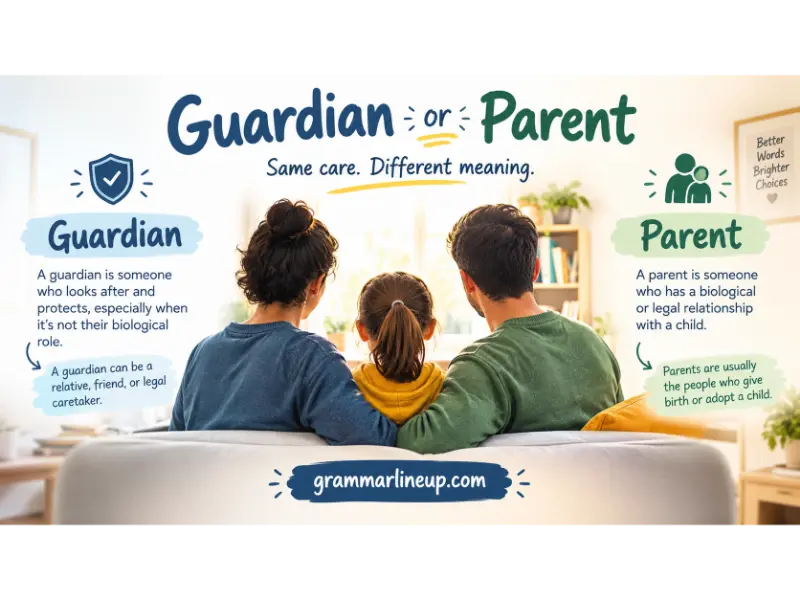
A parent is generally a child’s biological or adoptive parent and usually has parental rights and responsibilities from birth or adoption. A guardian, on the other hand, is someone who has been given legal responsibility for caring for a child and making certain decisions on the child’s behalf. A guardian may be a relative, family friend, or another suitable adult, depending on the circumstances and local law.
Understanding the difference matters because the two roles can involve different legal authority, responsibilities, and relationships with the child. In everyday conversation, the distinction may not always seem important, but it can become significant in matters involving education, healthcare, living arrangements, finances, and legal decisions.
This guide explains guardian or parent in clear, simple terms, helping you understand what each term means, how the roles differ, and when one person may be both a parent and a guardian.
Featured Snippet Answer
A parent is generally a child’s biological or adoptive mother or father, while a guardian is a person legally responsible for caring for a child who may not be their biological or adoptive child. However, the exact legal meaning varies by jurisdiction, and some laws specifically include guardians within the term “parent.”
Guardian or Parent: What Is the Difference?
If you have seen “parent or guardian” on a school form, medical document, permission slip, or official website, you may wonder why both words are used.
The reason is simple: parent and guardian can refer to different legal relationships with a child.
In everyday English, a parent is usually the child’s mother or father. A guardian is someone who has legal responsibility for the child’s care, particularly when that person is not the child’s parent.
Cambridge Dictionary defines a guardian as someone with the legal right and responsibility to care for a person who cannot care for themselves, such as a child.
However, there is an important qualification: the distinction is not identical in every law or jurisdiction. For example, U.S. federal education regulations can expressly include a guardian within the legal definition of “parent.”
Quick Answer: Guardian vs. Parent
| Term | General meaning | Relationship to child |
|---|---|---|
| Parent | A person who is a child’s biological or adoptive parent; some laws include other people acting in a parental role | Usually biological or legal parent |
| Guardian | A person legally responsible for caring for a child | May or may not be the child’s parent |
| Legal guardian | A guardian whose authority is established under applicable law | Has legally defined responsibilities and powers |
| Parent or guardian | A phrase designed to include both categories | Used when either person may have authority |
The key difference is how the legal relationship is established.
A parent generally has a parental relationship with the child. A guardian receives legal responsibility or authority through the applicable guardianship rules. In U.S. law, guardianships are generally regulated by state and local law.
What Does “Parent” Mean?
In ordinary conversation, parent means a mother or father.
For example:
- “My parents are coming to the meeting.”
- “Ask your parent before you sign the form.”
- “Her parents moved to another city.”
But the legal meaning of parent can be broader than everyday usage.
For instance, U.S. federal regulations concerning special education define “parent” to include biological and adoptive parents, certain foster parents, guardians, and people acting in the place of a biological or adoptive parent.
This means you should not assume that the legal definition of parent always means only a biological mother or father.
What Does “Guardian” Mean?
A guardian is generally a person who has legal responsibility for caring for someone who cannot fully care for themselves.
When the word refers to a child, it commonly describes someone who has legal responsibility for the child’s care but is not necessarily the child’s parent.
For example, a court or applicable legal process might establish a guardianship involving a relative who cares for a child.
A guardian may have authority involving matters such as:
- Education
- Medical care
- Daily welfare
- Living arrangements
- Other decisions defined by the applicable law or guardianship order
The precise authority depends on the jurisdiction and the type of guardianship.
Can a Parent Also Be a Guardian?
Yes, depending on the legal context.
This is where the phrase “guardian or parent” can become confusing.
Some laws use guardian in a way that specifically distinguishes that person from the child’s parent. Other laws define parent broadly enough to include a guardian for a particular purpose.
For example, U.S. federal special-education regulations explicitly include a guardian who is generally authorized to act as the child’s parent within their definition of “parent.”
So the safest approach is:
Do not assume that “parent” and “guardian” are always mutually exclusive legal categories. Check the definition being used by the particular organization or law.
Guardian or Parent in Forms and Documents
You will often see wording such as:
“Parent or guardian signature required.”
This wording is usually intended to make clear that the required authorization may come from either:
- A parent with the appropriate authority, or
- A guardian with the appropriate authority.
For example:
Parent or guardian must sign the permission form.
This does not necessarily mean that the organization believes parents and guardians have exactly the same legal status.
It usually means the organization needs authorization from the person who is legally or institutionally permitted to provide it.
Guardian or Parent in Everyday Conversations
Outside legal and administrative settings, parent is normally the more natural word when you are talking about someone’s mother or father.
Natural uses
“I need to ask my parent first.”
“Her parents are visiting this weekend.”
“The school contacted the child’s parents.”
Use guardian when the person’s legal caregiving role matters or when you know the person is responsible for the child without being the child’s parent.
Natural uses
“His aunt is his legal guardian.”
“The child lives with a guardian.”
“A parent or guardian must sign the form.”
The phrase “parent or guardian” is particularly common in formal communication because it covers both possibilities.
Meaning by Context
The meaning can become clearer when you look at the situation.
School
A school may ask for a parent or guardian to sign a document.
Here, the important issue is not simply who raised the child. The school may need authorization from a person legally or institutionally recognized as able to provide it.
Medical Care
Medical forms may use parent or guardian when consent is required for a minor.
The exact consent rules vary according to the jurisdiction, the child’s circumstances, and the type of medical treatment.
Travel
Travel documents may distinguish between a parent, legal guardian, and another person accompanying a child.
Because travel requirements can be jurisdiction-specific, the wording on the relevant official document matters.
Legal Matters
In legal contexts, guardian has a more precise meaning than it does in casual conversation.
U.S. legal resources describe guardians as legal representatives whose responsibilities are governed by applicable state or local law.
Common Examples of a Guardian
A guardian might be:
- A relative who has been legally appointed to care for a child
- Another adult legally responsible for the child’s welfare
- A person given authority over particular decisions concerning the child
A guardian does not automatically have the same legal powers in every situation. Guardianship arrangements can differ, and some may be limited to particular responsibilities.
That is why phrases such as “legal guardian” and “parent or legal guardian” are often used in formal documents.
Common Misunderstandings
“A guardian is always a non-parent.”
Not necessarily.
The answer depends on the law or policy being applied. Some legal definitions expressly include guardians under the broader term parent.
“A parent and guardian always have identical rights.”
Not necessarily.
A guardian’s authority can depend on the applicable law, court order, or type of guardianship.
“Guardian only means someone who raises an orphan.”
No.
That is one situation in which guardianship can arise, but the word has a broader legal meaning.
“Parent always means biological parent.”
Not in every legal context.
Adoptive parents are parents, and some laws also recognize foster parents, guardians, or people acting in a parental role for particular purposes.
Guardian vs. Parent: Which Word Should You Use?
Use parent when you mean the child’s mother or father in ordinary conversation.
😊Use guardian when you mean someone who has legal responsibility for the child and the person’s guardianship status is relevant.
Use parent or guardian when you want to include both groups, particularly in formal instructions.
A simple rule
Parent = parental relationship.
Guardian = legal caregiving or decision-making responsibility.
Parent or guardian = wording that can cover both.
There can be overlap, so the surrounding legal or organizational definition should take priority.
Similar Terms and Alternatives
Several related expressions can appear in the same context.
Legal guardian
A person with guardianship recognized under applicable law.
Biological parent
A child’s genetic mother or father.
Adoptive parent
A person who becomes the child’s legal parent through adoption.
Foster parent
An adult who cares for a child through a foster-care arrangement. Whether a foster parent is treated as a “parent” for a particular legal purpose depends on the applicable rules.
Caregiver
A broader everyday term for someone who provides care. Caregiver does not necessarily mean legal guardian.
This distinction matters: someone can provide substantial day-to-day care without having the legal authority associated with guardianship.
When Should You Say “Parent or Guardian”?
The phrase is especially useful when writing instructions intended for a broad group of families.
For example:
“A parent or guardian must complete the registration form.”
This is clearer than assuming every child lives with or is legally represented by a biological parent.
It is also common in:
- School communications
- Permission forms
- Youth programs
- Medical paperwork
- Government documents
- Child-care policies
- Research consent materials
The exact legal effect of the phrase depends on the organization and jurisdiction.
FAQs:
Is a guardian the same as a parent?
Not always. A parent generally has a parental relationship with the child, while a guardian has legal responsibility or authority concerning the child’s care. Some laws, however, include guardians within the definition of “parent” for specific purposes.
Is a legal guardian a parent?
A legal guardian is not necessarily the child’s parent. A guardian can be another person who has legally recognized responsibility for the child. However, particular laws may treat a guardian as a “parent” for specific purposes.
Can an aunt or grandparent be a guardian?
Yes. An aunt, grandparent, or another adult can potentially become a child’s guardian when the applicable legal requirements are met. The precise process and authority vary by jurisdiction.
Why do forms say “parent or guardian”?
The phrase recognizes that the person legally responsible for a child may be a parent or a guardian. It avoids limiting the requirement to biological or adoptive parents.
Does a guardian have parental rights?
A guardian can have significant authority concerning a child’s care, but the specific rights and responsibilities depend on the applicable law and guardianship arrangement. Guardianship should not automatically be assumed to provide every right a parent has.
Which is correct: “parent” or “guardian”?
Both can be correct. Use parent when referring to a parent, and guardian when referring to someone with guardianship. If a form or policy uses “parent or guardian,” follow its terminology and any definition it provides.
Final Takeaway:
“Guardian or parent” describes two related but potentially different roles. A parent is generally the child’s biological or adoptive parent, while a guardian is someone legally responsible for the child’s care. The two categories can overlap under some laws, so legal meaning should always be determined from the relevant jurisdiction or document.
In everyday English, the easiest distinction is: parent describes the relationship; guardian emphasizes legal responsibility or authority.
