
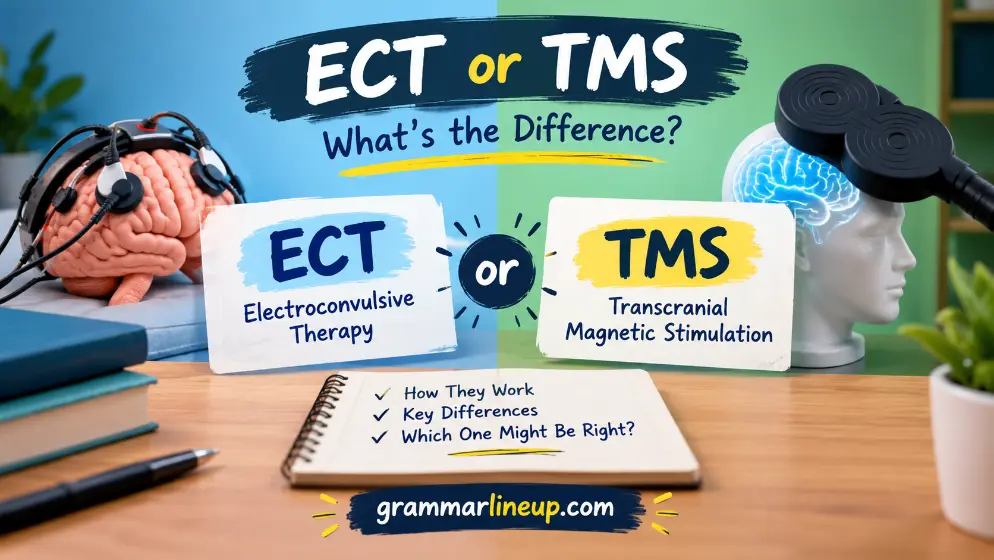
When you come across the terms ECT or TMS, it is easy to wonder what they mean and how they are different. Both are medical treatments used in certain mental health situations, but they work in very different ways.
If you are researching these terms for yourself, a family member, or simply trying to understand a conversation with a healthcare professional, knowing the basics can make things much clearer.
ECT stands for electroconvulsive therapy, while TMS means transcranial magnetic stimulation. Although both involve stimulating the brain, their procedures, uses, and treatment experiences are not the same. That difference is often what makes people search for “ECT or TMS” in the first place.
In this guide, we’ll explain ECT and TMS in straightforward language, look at their key differences, and cover common questions people have about how they work, what treatment involves, and why a clinician might consider one approach over another. The goal is simple: clear information without unnecessary medical jargon.
ECT and TMS are two types of brain-stimulation therapy with different approaches. ECT uses a carefully controlled electrical current to trigger a therapeutic seizure while the patient is under anesthesia. TMS uses magnetic pulses to target specific areas of the brain without intentionally causing a seizure. ECT may provide faster relief in severe cases, while TMS is noninvasive and generally has fewer memory-related side effects.
Quick Answer:
ECT means electroconvulsive therapy. It uses an electrical current to intentionally trigger a controlled seizure while the patient is under anesthesia. Despite the word “seizure,” the procedure is medically controlled and performed by a specialized clinical team.
TMS means transcranial magnetic stimulation. More specifically, depression treatment commonly involves repetitive TMS (rTMS). It uses rapidly changing magnetic fields to produce weak electrical currents in targeted areas of the brain. Unlike ECT, TMS does not intentionally induce a therapeutic seizure.
The simplest distinction is:
| ECT | TMS |
|---|---|
| Electroconvulsive therapy | Transcranial magnetic stimulation |
| Uses electrical stimulation | Uses magnetic stimulation |
| Produces a controlled therapeutic seizure | Does not intentionally produce a seizure |
| Usually performed under anesthesia | Usually performed while the patient is awake |
| Can be used when a rapid response is needed | Generally delivered as a course of repeated sessions |
| Memory problems can occur | Common side effects are generally milder |
| Requires more preparation and recovery | Usually allows normal activities shortly afterward |
Neither treatment is automatically appropriate for everyone. The choice depends on the diagnosis, severity of symptoms, previous treatment, medical history, urgency, and the clinician’s assessment.
ECT vs. TMS: How Are They Different?
The biggest difference is how each treatment stimulates the brain.
How ECT works
During ECT, electrodes deliver a carefully controlled electrical stimulus to the brain. This produces a therapeutic seizure. The patient receives general anesthesia and medication to relax the muscles, so the visible physical movements associated with a seizure are greatly reduced.
ECT has been used for many years and remains an important treatment for severe depressive episodes. NIMH notes that it may be considered when depression is severe and treatment-resistant or when a rapid response is needed in circumstances such as catatonia, severe nutritional problems, or high suicide risk.
How TMS works
TMS uses an electromagnetic coil positioned against the scalp. The device produces repeated magnetic pulses that stimulate electrical activity in specific brain circuits. Repetitive TMS is commonly delivered during multiple outpatient sessions.
Because TMS does not intentionally induce a seizure and generally does not require general anesthesia, the treatment experience is substantially different from ECT.
ECT or TMS for Depression: Which One Is More Effective?
Research comparing ECT and TMS has produced important evidence, but the answer is not simply that one treatment is universally suitable for every person.
Recent reviews generally find that ECT has a stronger and more consistent acute antidepressant effect in severe or highly treatment-resistant depression, while TMS has a favorable tolerability profile and can be useful for people who meet appropriate clinical criteria.
A 2025 systematic review of direct comparisons reported stronger short-term antidepressant effects for ECT than high-frequency rTMS, although the researchers also emphasized limitations in the available evidence.
A separate network meta-analysis of randomized trials in adults with major depressive episodes also found a statistically significant advantage for ECT over TMS on the depression-scale outcome examined.
However, treatment effectiveness should not be reduced to a single number. TMS protocols differ in frequency, target, duration, and stimulation method, while ECT also has different treatment parameters. Researchers continue to study how these differences affect outcomes.
What Does ECT Feel Like?
Because ECT is performed under anesthesia, the patient is asleep during the treatment itself.
Afterward, some people experience temporary confusion, headache, muscle aches, nausea, or memory problems. Memory effects are among the most important concerns associated with ECT. NIMH reports that memory problems often improve over the days or weeks following treatment, although the extent can vary.
ECT also requires preparation for anesthesia and typically involves arranging transportation and allowing time for recovery after treatment.
NIMH states that a typical acute ECT course may be administered about three times a week, with improvement often occurring within approximately 6–12 treatments, although individual treatment plans vary.
What Does TMS Feel Like?
TMS is generally performed while the patient is awake.
During treatment, a person may hear clicking sounds and feel tapping or pressure around the scalp. Some people experience temporary scalp discomfort or headache.
NIMH describes common TMS-related adverse effects as generally less severe than those associated with ECT. TMS is commonly delivered as an outpatient treatment, meaning patients can generally return to their normal activities after a session.
The exact experience depends on the type of TMS device and protocol being used.
Side Effects: ECT vs. TMS
The side-effect profiles are one of the most important differences between these treatments.
ECT side effects
Reported effects can include:
- Temporary confusion
- Headache
- Nausea
- Muscle aches
- Memory loss
- Anesthesia-related risks
- Temporary disorientation
Memory effects deserve particular attention because they can involve memories surrounding the treatment period and, in some cases, more extensive memory difficulties.
TMS side effects
TMS is commonly associated with:
- Scalp discomfort
- Headache
- Tingling or muscle twitching around the face
- Temporary discomfort during stimulation
A recent review of ECT and rTMS literature found that adverse effects were generally more substantial with ECT, while TMS was more often associated with mild, short-lived effects such as headache and scalp discomfort.
That does not mean TMS is risk-free. A clinician should review medical history and treatment-specific contraindications before starting either therapy.
ECT or TMS: What About Treatment Time?
Treatment schedules are another major practical difference.
ECT is generally delivered as a series of treatments rather than a single procedure. NIMH reports that acute ECT is often administered three times per week until symptoms improve.
TMS also normally requires a series of sessions. Depending on the specific protocol, treatment can involve frequent outpatient visits over several weeks.
This means that neither treatment should be thought of as a one-time procedure for ordinary treatment planning.
The exact schedule depends on the technology, diagnosis, clinical protocol, and response to treatment.
When Might ECT Be Considered?
ECT may be considered when depression is particularly severe, has not responded adequately to other treatments, or requires a rapid clinical response.
According to NIMH, ECT may be considered for severe treatment-resistant depression and for situations where rapid improvement is needed, including certain life-threatening circumstances. It may also be used in conditions such as catatonia and some forms of bipolar disorder or mania.
This is one reason ECT can remain an important option even though it involves anesthesia and has a greater burden of cognitive side effects than TMS.
When Might TMS Be Considered?
TMS may be considered when someone has depression that has not responded adequately to medication or when a noninvasive outpatient brain-stimulation approach is appropriate.
NIMH notes that rTMS is FDA-cleared for treatment-resistant depression and several other conditions, including OCD, migraine, anxiety with depression, and smoking dependence. The exact indications depend on the device and regulatory authorization involved.
Unlike ECT, TMS generally does not require general anesthesia, which can make the logistics of treatment different for patients.
Can ECT and TMS Be Used for the Same Person?
Potentially, yes, but treatment decisions are individualized.
ECT and TMS are not necessarily competing treatments in every clinical situation. A person’s diagnosis, severity, previous response to treatment, urgency, medical conditions, preferences, and access to treatment can all affect which approach a clinician considers.
Research has also examined sequential or combined approaches, but evidence for specific combination strategies is less established than the evidence for the individual treatments. A recent scoping review noted that studies have investigated sequential use, while also emphasizing limitations and variation across protocols.
Common Misunderstandings About ECT and TMS
“ECT is the same as being shocked.”
This is an oversimplification. ECT is a medically controlled procedure performed with anesthesia and muscle-relaxing medication. The electrical stimulus is intentionally administered to produce a therapeutic seizure under clinical supervision.
“TMS uses electricity directly on the brain.”
Not in the same way as ECT. TMS primarily uses magnetic fields generated by a coil outside the skull. These magnetic pulses induce weak electrical currents in targeted brain tissue.
“TMS has no side effects.”
TMS can cause side effects, most commonly temporary discomfort or headache. It should still be administered according to an appropriate clinical protocol.
“ECT always causes permanent memory loss.”
Memory effects can occur, and they are an important consideration. However, NIMH notes that memory problems often improve after the course of treatment. The experience varies between individuals.
“ECT and TMS work equally well in every situation.”
The research does not support such a simple conclusion. Comparative studies generally find stronger acute antidepressant effects with ECT, especially in severe or treatment-resistant depression, while TMS has advantages in tolerability and treatment logistics.
Similar Terms You May See
If you are researching ECT or TMS, you may encounter several related terms:
- ECT: Electroconvulsive therapy
- TMS: Transcranial magnetic stimulation
- rTMS: Repetitive transcranial magnetic stimulation
- MDD: Major depressive disorder
- TRD: Treatment-resistant depression
- Neuromodulation: A broad term covering treatments that alter nervous-system activity
- Brain stimulation therapy: A broader category that includes ECT and TMS
Knowing these abbreviations can make medical information easier to understand, especially when reading clinical websites or discussing treatment options with a healthcare professional.
FAQs:
Is ECT stronger than TMS?
Research comparing the two treatments generally finds ECT produces a stronger acute antidepressant effect, particularly in severe or treatment-resistant depression. However, individual outcomes vary, and effectiveness must be considered alongside side effects, urgency, medical history, and treatment goals.
Is TMS safer than ECT?
“Safer” depends on the specific risk being considered, but TMS generally has a less burdensome side-effect profile and does not require general anesthesia. ECT has additional anesthesia-related considerations and is more strongly associated with temporary cognitive and memory effects.
Does TMS cause a seizure?
TMS is designed to stimulate targeted brain regions without intentionally inducing a therapeutic seizure. Seizures are a rare potential adverse event, rather than the intended mechanism of treatment.
How many ECT treatments are usually needed?
NIMH states that ECT is often administered three times per week, with improvement commonly occurring within about 6–12 treatments. The actual number depends on the individual’s response and clinical plan.
How long does TMS treatment take?
TMS usually requires a course of repeated outpatient sessions rather than one treatment. The schedule varies according to the particular TMS protocol and clinical indication.
Can ECT or TMS treat conditions other than depression?
Yes. ECT may also be used in certain cases involving catatonia, bipolar disorder, mania, schizophrenia, or schizoaffective disorder. TMS has regulatory clearances for several conditions, including OCD, migraine, anxiety with depression, and smoking dependence, depending on the device and indication.
Conclusion:
ECT and TMS are different forms of brain-stimulation therapy, not two names for the same treatment. ECT uses a controlled electrical stimulus to induce a therapeutic seizure under anesthesia, while TMS uses magnetic pulses to stimulate specific brain circuits without intentionally producing a seizure.
Current comparative evidence generally indicates that ECT can provide a stronger acute antidepressant effect, particularly in severe or treatment-resistant depression, while TMS generally offers a less invasive treatment experience with fewer cognitive side effects.
The appropriate choice depends on the individual’s diagnosis, symptom severity, urgency, previous treatments, medical circumstances, and preferences. Anyone considering either treatment should discuss the potential benefits and risks with a qualified mental-health professional rather than choosing solely from an online comparison.
