
If you’ve ever looked at a picture of a huge, long-necked dinosaur and wondered whether it was a Brachiosaurus or Brontosaurus, you’re certainly not alone. These two dinosaur names are often mixed up because both are associated with enormous bodies, long necks, and the classic image of a gentle plant-eating giant. But they are not simply two names for the same dinosaur.
The confusion becomes even more interesting because the name Brontosaurus has a complicated history, while Brachiosaurus has a very distinctive body shape. Their differences can help you identify them more easily when reading dinosaur books, visiting museums, or answering a curious child’s question.
In this guide, we’ll look at Brachiosaurus or Brontosaurus in simple terms, compare their appearance and history, and explain how to tell them apart without getting lost in complicated dinosaur terminology. By the end, these two prehistoric giants should be much easier to recognize.
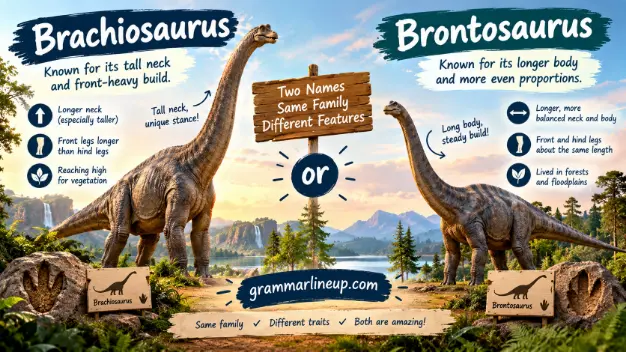
Brachiosaurus and Brontosaurus were different kinds of long-necked sauropod dinosaurs. Brachiosaurus had unusually long front legs and a high, sloping body, while Brontosaurus had a more robust build and shorter front legs. They also belonged to different dinosaur families. Brontosaurus was historically grouped with Apatosaurus, although modern research has revived it as a separate genus.
Quick Answer:
The easiest way to remember the difference is to look at their front legs and body shape.
Brachiosaurus had front legs that were longer than its hind legs. This gave it a distinctive high-shouldered, upward-sloping posture. Its long neck also helped it reach vegetation high above the ground.
Brontosaurus, by contrast, had a more robust body and relatively shorter front legs. It belonged to a different branch of the sauropod family tree and was more closely associated with dinosaurs such as Apatosaurus and Diplodocus.
There is also an important naming detail:
Brontosaurus is not simply another word for Brachiosaurus, and it is not currently treated as the same genus as Brachiosaurus.
The real historical confusion is between Brontosaurus and Apatosaurus, not Brachiosaurus.
What Does Brachiosaurus Mean?
The name Brachiosaurus comes from Greek roots associated with an “arm” or “arm-like” structure and “lizard.”
The name refers to one of its most noticeable anatomical features: its unusually long front limbs.
Unlike many four-legged sauropods, Brachiosaurus had forelimbs that were longer than its hind limbs. This changed the angle of its torso and gave the animal a distinctive elevated front end.
That body design is one of the easiest visual clues for identifying Brachiosaurus.
Imagine two long-necked dinosaurs standing next to each other:
- Brachiosaurus looks taller at the shoulders.
- Its front legs are unusually long.
- Its body rises toward the shoulders.
- Its long neck extends upward from that elevated body.
This is why Brachiosaurus is often portrayed with a giraffe-like silhouette.
It was a sauropod, meaning it was part of the broad group of large, long-necked, four-legged herbivorous dinosaurs.
What Does Brontosaurus Mean?
The name Brontosaurus comes from Greek roots meaning “thunder lizard.”
It was named in the late 19th century by American paleontologist Othniel Charles Marsh.
Brontosaurus belonged to a different sauropod lineage from Brachiosaurus. It is associated with the diplodocid group, which includes long-necked dinosaurs characterized by long tails and other distinctive skeletal features.
Brontosaurus had a powerful, relatively robust body, a long neck, and a long tail.
The name became extremely famous in popular culture. In fact, Brontosaurus became one of the best-known dinosaur names even during the period when many paleontologists no longer regarded it as a valid genus.
That unusual history is a major reason the word remains familiar today.
Brachiosaurus vs. Brontosaurus: Key Differences
The simplest comparison looks like this:
| Feature | Brachiosaurus | Brontosaurus |
|---|---|---|
| Dinosaur group | Brachiosaurid sauropod | Diplodocid sauropod |
| Body shape | High-shouldered and elevated | More robust and lower-slung |
| Front legs | Longer than hind legs | Shorter than hind legs |
| Neck | Long and elevated | Long and relatively thick |
| Tail | Long | Very long |
| Diet | Plants | Plants |
| Walking style | Four-legged | Four-legged |
| Jurassic connection | Late Jurassic forms are known | Late Jurassic |
| Famous naming issue | Relatively straightforward | Historically confused with Apatosaurus |
| Meaning of name | “Arm lizard” | “Thunder lizard” |
The most useful visual distinction is limb proportion.
If the dinosaur has extremely long front legs that make the shoulders stand high, you may be looking at Brachiosaurus.
If it has a more horizontally balanced body, a powerful build, and the classic long-neck-and-long-tail profile associated with Brontosaurus, it is a different animal.
How Their Body Shapes Differ
Body shape is more useful than size when trying to tell these dinosaurs apart.
Brachiosaurus had longer front legs
Brachiosaurus is unusual among well-known sauropods because its forelimbs were longer than its hind limbs.
This produced a body that rose toward the shoulders.
That arrangement also affected the way its neck was positioned. Its overall anatomy made it particularly well suited to reaching vegetation at considerable height.
The important point is that its height was not simply a matter of having an exceptionally long neck. Its limb proportions contributed significantly to its elevated posture.
Brontosaurus had a different build
Brontosaurus had a more robust appearance.
Its front legs did not produce the same dramatically elevated shoulder profile seen in Brachiosaurus. 😁Its body plan was closer to other diplodocid sauropods, although Brontosaurus itself had a particularly sturdy build.
Its long tail was another important feature.
Rather than thinking of Brontosaurus as a shorter version of Brachiosaurus, it is better to picture them as different designs of giant sauropod.
Were Brachiosaurus and Brontosaurus Related?
Yes, but not as closely as their names might suggest.
Both were sauropod dinosaurs and therefore shared a much more distant common ancestry.
However, they belonged to different branches of the sauropod evolutionary tree.
Brachiosaurus belongs to the Brachiosauridae family.
Brontosaurus is placed within Diplodocidae, specifically the apatosaurine group.
That means their similarities are partly the result of belonging to the same broad dinosaur group rather than being evidence that they were the same animal.
Both evolved the familiar sauropod body plan:
- Four sturdy legs
- Small head relative to the body
- Long neck
- Long tail
- Plant-based diet
But evolution modified that basic design in different ways.
Why Do People Confuse Brachiosaurus and Brontosaurus?
There are several good reasons.
First, both names start with “Bra/Br”, making them easy to mix up when remembered from childhood.
Second, both dinosaurs were enormous, long-necked herbivores.
Third, popular dinosaur illustrations often simplify sauropods into the same general shape: four legs, a long neck, a small head, and a long tail.
Fourth, dinosaur names can be difficult to remember because many of them come from Greek or Latin roots.
There is also a historical naming complication.
People sometimes remember that scientists changed the name “Brontosaurus” to “Apatosaurus.” That is true historically, but it has nothing to do with Brachiosaurus.
The more accurate comparison is:
Brachiosaurus vs. Brontosaurus: two different sauropods.
Brontosaurus vs. Apatosaurus: a much more complicated taxonomic story.
Brontosaurus and Apatosaurus: The Naming Twist
This is where the story gets interesting.
Othniel Charles Marsh named Apatosaurus ajax in 1877.
Two years later, he named another sauropod Brontosaurus excelsus.
For decades, the two names were treated separately.
Then, in 1903, paleontologist Elmer Riggs argued that the differences between the fossils were not sufficient to justify keeping Brontosaurus as a separate genus.
Because Apatosaurus had been named first, the rules of zoological nomenclature gave that earlier genus name priority.
As a result, Brontosaurus was generally treated as a synonym of Apatosaurus.
For much of the 20th century, scientists therefore used Apatosaurus where the public often continued saying Brontosaurus.
That explains why the name Brontosaurus never really disappeared from popular culture.
Is Brontosaurus a Real Dinosaur Name?
Yes, but there is an important scientific qualification.
A 2015 study by Emanuel Tschopp, Octávio Mateus, and Roger B. J. Benson analyzed a large collection of diplodocid specimens and anatomical characteristics. The study concluded that Brontosaurus could be recognized as a distinct genus from Apatosaurus.
This represented a major change from the classification that had dominated for more than a century.
However, taxonomy is an evidence-based scientific process, and classifications can remain debated. The status of Brontosaurus has therefore been discussed by paleontologists rather than being a simple case of a name being permanently “wrong” and then permanently “right.”
The safest way to explain the history is:
Brontosaurus was historically treated as a synonym of Apatosaurus, but research published in 2015 argued that the genus should be recognized separately again.
That distinction matters because it avoids presenting a changing scientific classification as if it were a simple spelling correction.
Where Did Brachiosaurus and Brontosaurus Live?
Both are associated with the Late Jurassic, but their fossil histories are not identical.
Brachiosaurus is strongly associated with North American Jurassic fossil deposits, including the Morrison Formation. Fossils assigned to Brachiosaurus have also contributed to research on sauropod anatomy and evolution.
Brontosaurus is also associated with the Late Jurassic of North America and the Morrison Formation.
The Morrison Formation is particularly important because it preserves a remarkable variety of Jurassic dinosaurs.
This means the two animals were not merely imaginary dinosaurs invented from unrelated fossils. Both belong to a real fossil record from an important period in dinosaur history.
What Did They Eat?
Both Brachiosaurus and Brontosaurus were herbivorous sauropods.
They did not hunt other dinosaurs for food.
However, their different body designs may have allowed them to exploit vegetation in somewhat different ways.
Brachiosaurus, with its elevated shoulders and long neck, had anatomy suited to reaching vegetation higher above the ground.
Brontosaurus had a different body plan and feeding anatomy. Like other sauropods, it could use its long neck to reach vegetation without constantly moving its enormous body.
Scientists cannot observe their feeding behavior directly, so specific claims about exactly which plants they preferred should be treated cautiously.
The safest conclusion is that both were large plant-eating dinosaurs with body designs adapted to consuming substantial amounts of vegetation.
Did They Live at the Same Time?
Broadly speaking, yes.
Both Brachiosaurus and Brontosaurus are associated with the Late Jurassic world.
That does not mean every Brachiosaurus individual and every Brontosaurus individual lived in exactly the same place at exactly the same moment. Fossil records are incomplete, and dinosaur species occupied particular regions and environments.
But they belong to the same broad chapter of Jurassic dinosaur history.
This is another reason the comparison is interesting: two giant sauropods could live in overlapping prehistoric ecosystems while having noticeably different body plans.
Brachiosaurus or Brontosaurus: Which One Was Taller?
If you are asking which dinosaur had the more towering body profile, Brachiosaurus is the obvious visual choice.
Its unusually long front legs raised the shoulders and contributed to its distinctive high-standing appearance.
Brontosaurus was also a huge animal, but its proportions were different.
It is important, however, not to turn dinosaur size estimates into exact measurements when the fossil evidence is incomplete. Scientists reconstruct body size using available fossils, anatomical comparisons, and mathematical methods, and those estimates can change as new evidence appears.
For a quick identification:
High shoulders + very long front legs = think Brachiosaurus.
Robust sauropod + long neck and long tail = think Brontosaurus.
Common Misunderstandings
“Brontosaurus is just another name for Brachiosaurus.”
No.
The historical naming confusion involving Brontosaurus concerns Apatosaurus, not Brachiosaurus.
Brachiosaurus and Brontosaurus are separate dinosaur genera.
“Brontosaurus was proven to be fake.”
That is an oversimplification.
Brontosaurus was a scientifically named dinosaur genus. Its classification was later changed when researchers considered it insufficiently distinct from Apatosaurus. A 2015 study subsequently argued for recognizing Brontosaurus again.
“Brachiosaurus and Brontosaurus were basically the same animal.”
They shared the general sauropod body plan, but their anatomy and evolutionary relationships were different.
Their limb proportions are especially useful for distinguishing them.
“A dinosaur with a long neck must be Brachiosaurus.”
Not at all.
Long necks evolved in many sauropod dinosaurs, including Brontosaurus, Apatosaurus, Diplodocus, and numerous others.
A long neck alone is not enough for identification.
“Brontosaurus was renamed because someone spelled it incorrectly.”
No.
The issue was scientific classification, not spelling.
The name Brontosaurus was published in the 19th century. The later change involved whether its fossils represented a separate genus from Apatosaurus.
How to Remember the Difference
A simple memory trick can make the names much easier.
Think of Brachiosaurus as the high-shouldered sauropod.
Its front legs were longer than its hind legs, giving it a raised front end.
Think of Brontosaurus as the “thunder lizard” with a powerful body, long neck, and long tail.
And remember the important third name:
Brontosaurus ↔ Apatosaurus is the famous naming debate.
Brachiosaurus ↔ Brontosaurus is a comparison between two different dinosaurs.
That distinction will prevent most mix-ups.
FAQs:
Is Brachiosaurus the same as Brontosaurus?
No. Brachiosaurus and Brontosaurus are different sauropod dinosaurs. Brachiosaurus belonged to the brachiosaurid lineage, while Brontosaurus belongs to the diplodocid lineage.
Which dinosaur had longer front legs?
Brachiosaurus had unusually long front legs, longer than its hind legs. This gave its body a distinctive elevated, high-shouldered posture.
Is Brontosaurus the same as Apatosaurus?
Historically, scientists treated Brontosaurus as a synonym of Apatosaurus for more than a century. A major 2015 study argued that Brontosaurus was sufficiently distinct to be recognized as a separate genus again. The taxonomic history is therefore more complicated than a simple name change.
What does Brachiosaurus mean?
Brachiosaurus is derived from Greek roots referring to an arm and a lizard. The name relates to the dinosaur’s unusually long forelimbs.
What does Brontosaurus mean?
Brontosaurus means “thunder lizard,” from Greek-derived word elements. It was named by Othniel Charles Marsh in 1879.
Which dinosaur was taller, Brachiosaurus or Brontosaurus?
Brachiosaurus had the more elevated body profile because its front legs were longer than its hind legs. Brontosaurus was also enormous, but its proportions produced a different overall shape.
Conclusion:
If you are choosing between Brachiosaurus or Brontosaurus, remember that they are two different dinosaurs.
Brachiosaurus was the high-shouldered sauropod with exceptionally long front legs. Brontosaurus was a robust diplodocid sauropod with a long neck and tail.
The confusing name history belongs mainly to Brontosaurus and Apatosaurus. Brontosaurus was treated as a synonym of Apatosaurus for much of the 20th century, but research published in 2015 argued that the two should be recognized as separate genera.
So the easiest memory rule is:
Brachiosaurus = long front legs and high shoulders.
Brontosaurus = “thunder lizard,” robust body, long neck and tail.
And neither one is simply another spelling or pronunciation of the other.
