
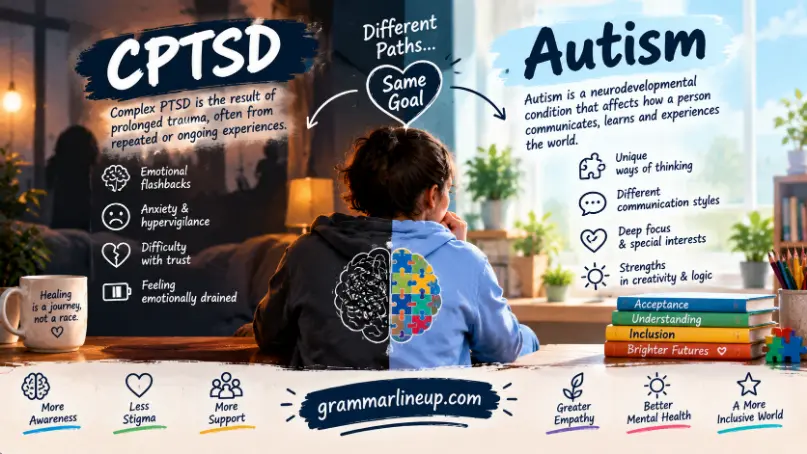
If you’re searching for CPTSD or autism, you may be trying to understand why certain thoughts, behaviors, sensory experiences, or social difficulties feel familiar. The two can sometimes look similar on the surface, but they are different conditions with different underlying causes.
That overlap can make it difficult to know what you’re seeing, especially when symptoms such as emotional overwhelm, social challenges, shutdowns, or difficulty coping with change are involved.
CPTSD, or complex post-traumatic stress disorder, is associated with prolonged or repeated trauma. Autism is a neurodevelopmental condition that begins early in life and can affect communication, sensory processing, behavior, and patterns of interests or routines.
This guide explains CPTSD or autism in clear, simple language, highlights where they may overlap, and explores important differences. It is intended for general understanding, not self-diagnosis.
CPTSD and autism are different conditions that can sometimes look similar. CPTSD is a trauma-related disorder involving PTSD symptoms plus difficulties with emotional regulation, self-concept, and relationships. Autism is a neurodevelopmental condition involving persistent social-communication differences and restricted or repetitive behaviors. They can also co-occur, so overlapping traits alone cannot determine a diagnosis.
What Does “CPTSD or Autism” Mean?
The phrase “CPTSD or autism” is not itself a medical term. It is usually a comparison people make when trying to understand whether particular experiences could be related to complex post-traumatic stress disorder, autism spectrum disorder (ASD), or potentially both.
The comparison can be confusing because some outward behaviors overlap.
For instance, someone may:
- avoid certain social situations
- become overwhelmed by sensory input
- struggle with emotional regulation
- have difficulty maintaining relationships
- withdraw or shut down under stress
- prefer predictability
- have trouble communicating feelings
- feel disconnected from other people
Those observations alone do not identify the underlying cause.
The same outward behavior can arise for very different reasons. That is one reason professional assessment looks at developmental history, trauma history, symptom patterns, context, and functional impact, rather than simply counting individual traits.
A 2025 Delphi study involving international professionals found substantial overlap between autism and CPTSD and specifically examined difficulties in differential diagnosis.
CPTSD vs Autism at a Glance
| Feature | CPTSD | Autism |
|---|---|---|
| Main category | Trauma-related disorder | Neurodevelopmental condition |
| Diagnostic framework | Recognized separately in ICD-11 | Recognized in DSM-5 and ICD-11 |
| Central concept | Response to traumatic experiences | Developmental differences in social communication and restricted/repetitive patterns |
| Trauma required? | Yes, within the diagnostic framework | No |
| Early developmental signs required? | No | Yes, characteristics must originate in the early developmental period |
| Re-experiencing trauma | Central PTSD feature | Not a defining feature |
| Avoidance of trauma reminders | Central PTSD feature | Not a defining feature |
| Restricted interests/repetitive behaviors | Not a defining CPTSD feature | Core diagnostic feature |
| Sensory differences | Can occur but are not defining | Can be part of autism |
| Negative self-concept | Part of CPTSD’s disturbances in self-organization | Not a defining diagnostic criterion |
| Can they co-occur? | Yes | Yes |
The distinction is especially important because a diagnosis is based on a pattern of symptoms and their history, not one isolated characteristic.
What Is CPTSD?
CPTSD stands for complex post-traumatic stress disorder.
It is formally recognized as a separate diagnosis in the ICD-11, the World Health Organization’s international classification system. The WHO’s clinical diagnostic guidance includes CPTSD among disorders specifically associated with stress.
CPTSD includes the three core areas of ICD-11 PTSD:
- Re-experiencing traumatic experiences in the present
- Avoidance of trauma-related reminders
- A persistent sense of current threat
CPTSD also includes what the ICD-11 framework calls disturbances in self-organization (DSO):
- difficulty regulating emotions
- a persistently negative view of oneself
- significant difficulties with relationships
The U.S. Department of Veterans Affairs’ National Center for PTSD notes that CPTSD was first formalized as a diagnosis in ICD-11. It also explains that the DSM-5 does not list CPTSD as a separate diagnosis.
That distinction matters when reading information online because diagnostic terminology can differ depending on which classification system is being discussed.
What Is Autism?
Autism spectrum disorder (ASD) is a neurodevelopmental condition.
According to the CDC, autism involves persistent differences in social communication and social interaction together with restricted or repetitive patterns of behavior, interests, or activities. The characteristics originate in the early developmental period, although they may not become obvious until later when social demands increase.
Autistic people can have characteristics such as:
- differences in back-and-forth social communication
- differences in interpreting or using nonverbal communication
- difficulty adjusting to certain social contexts
- repetitive movements, speech, or behaviors
- a strong preference for routines or sameness
- highly focused interests
- unusual sensitivity or reduced sensitivity to sensory input
Not every autistic person has the same characteristics, and autism exists across a broad spectrum.
Importantly, experiencing one or two of these traits does not establish autism. The CDC notes that autism diagnosis relies on a broader clinical assessment rather than a single screening tool or isolated behavior.
Why Can CPTSD and Autism Look Similar?
This is where the comparison becomes difficult.
Imagine two people who both avoid crowded social events.
For one person, the avoidance might be related to sensory overload, social-communication differences, or the need to recover from a demanding environment.
For another, the same avoidance might be connected to trauma reminders, fear, hypervigilance, or a learned effort to avoid situations associated with danger.
The observable behavior is similar, but the underlying process may be different.
Research on autism and trauma has repeatedly identified this diagnostic challenge. A recent Delphi study involving 106 international professionals found overlapping and differentiating features between autism and CPTSD and highlighted the difficulty of differential diagnosis.
This is why statements such as “I have sensory issues, so I must be autistic” or “I avoid people, so I must have CPTSD” are too simplistic.
Key Differences Between CPTSD and Autism
Developmental history
One of the most useful distinctions is when the relevant characteristics began.
Autism is developmental. According to CDC diagnostic guidance, its characteristics must be present in the early developmental period, although they may be masked or become more noticeable later.
CPTSD does not follow that same developmental requirement. It is a trauma-related condition that develops in relation to traumatic experiences.
Therefore, a detailed childhood history can be highly relevant when autism is being considered.
Trauma-related symptoms
CPTSD includes PTSD symptoms such as re-experiencing, avoidance, and a persistent sense of threat.
These are not defining characteristics of autism.
Someone with autism can certainly experience trauma and PTSD-related symptoms, but trauma symptoms are not what defines autism.
Restricted and repetitive patterns
Restricted interests, repetitive behaviors, insistence on sameness, and sensory differences are part of the diagnostic framework for autism.
They are not the defining core of CPTSD.
A person with CPTSD may develop routines or avoidance behaviors, but that does not automatically make those behaviors equivalent to autistic restricted or repetitive patterns.
Self-concept
Persistent negative beliefs about oneself are part of CPTSD’s disturbances in self-organization.
The ICD-11 framework describes this as a negative self-concept involving beliefs such as feeling diminished, defeated, or worthless.
Low self-esteem can occur for many reasons, including experiences associated with autism, but negative self-concept itself is not a defining diagnostic criterion for autism.
Relationships
Both conditions can affect relationships, but again, the reasons can differ.
Autism can involve differences in social communication and understanding social relationships. CPTSD can involve difficulties sustaining relationships and feeling emotionally close to others as part of disturbances in self-organization.
That distinction can be subtle, which is one reason a comprehensive assessment matters.
Can Autism and CPTSD Happen Together?
Yes.
Autism does not make someone immune to trauma, and having trauma-related symptoms does not rule out autism.
Research has specifically examined PTSD and trauma in autistic populations. A 2026 systematic review reported that adverse life events and mental health conditions are important considerations for autistic people and identified challenges in assessing PTSD in autistic individuals.
A 2025 systematic review and meta-analysis also examined PTSD prevalence among autistic children, young people, and adults. The authors noted substantial variation across studies and cautioned that existing diagnostic criteria and assessment methods may not fully capture how trauma-related symptoms are experienced or expressed by autistic people.
So the question does not always have to be:
“Is it CPTSD or autism?”
Sometimes the more accurate question is:
“Could autism, trauma-related symptoms, or both be contributing to what I am experiencing?”
Signs That Need More Careful Assessment
Certain patterns can be especially important to discuss with a qualified clinician.
A lifelong pattern of differences
If social, communication, sensory, or repetitive-behavior differences were present from early childhood, that history may be relevant when assessing autism.
A clear change after trauma
If major difficulties appeared or became substantially worse after a traumatic experience, trauma-related conditions may need to be considered.
This does not automatically rule out autism, because autistic characteristics may have been present but unrecognized before the trauma.
Re-experiencing and trauma avoidance
Flashbacks, intrusive trauma memories, trauma-related nightmares, avoidance of reminders, and a persistent sense of danger are particularly relevant to a PTSD/CPTSD assessment.
Restricted interests and repetitive behaviors
Strong focused interests, repetitive movements or speech, insistence on sameness, and sensory differences may be relevant to an autism assessment when they form part of the broader developmental pattern.
Difficulties with self-concept and emotional regulation
Persistent emotional-regulation problems, deeply negative self-beliefs, and relationship difficulties can be relevant to CPTSD when they occur alongside the required PTSD features.
Common Misunderstandings
“If I have trauma, I cannot be autistic.”
Not true.
Trauma and autism can coexist. A trauma history does not erase developmental characteristics associated with autism.
“If I am autistic, every difficult experience must be autism.”
Also not true.
Autistic people can experience PTSD, CPTSD, anxiety, depression, grief, and other mental health difficulties. Autism should not automatically be used to explain every new psychological symptom.
“CPTSD is just severe autism.”
No.
They are different diagnostic concepts. CPTSD is a trauma-related disorder, while autism is a neurodevelopmental condition.
“CPTSD is officially the same diagnosis everywhere.”
No.
Diagnostic systems differ. CPTSD is a distinct diagnosis in ICD-11, while the DSM-5 does not list CPTSD as a separate diagnosis.
“A checklist can tell me which one I have.”
Online questionnaires can sometimes help someone organize concerns, but they cannot reliably establish a diagnosis on their own.
The CDC specifically notes that autism diagnostic tools should not be used as the sole basis for diagnosis.
How Professionals May Tell the Difference
A thorough assessment may consider several types of information rather than focusing on one symptom.
Developmental history
For autism, clinicians may explore early childhood communication, social interaction, play, routines, sensory experiences, and repetitive behaviors.
Trauma history
For CPTSD, assessment considers relevant traumatic experiences and whether the person’s symptoms fit the required PTSD pattern and additional disturbances in self-organization.
Symptom timing
When did the difficulties begin?
Were they present before a traumatic experience? Did they appear afterward? Did existing difficulties change following trauma?
Timing can provide important context, although it is not always straightforward.
Context
A clinician may ask whether a behavior occurs:
- everywhere or only in particular situations
- mainly after trauma reminders
- during sensory overload
- during social interactions
- during periods of stress
- across different stages of life
Functional impact
The assessment also considers how symptoms affect everyday functioning.
The WHO emphasizes accurate diagnosis as an important foundation for appropriate care and support.
Why Self-Diagnosis Can Be Difficult Here
The overlap between autism and trauma can make online self-assessment particularly complicated.
For example, shutdown is a word commonly used in autism communities, but withdrawing or becoming unable to engage can also occur for other reasons. Similarly, hypervigilance, social avoidance, sensory sensitivity, emotional dysregulation, and relationship difficulties can have multiple possible explanations.
A symptom is therefore not the same thing as a diagnosis.
The strongest clue often comes from the overall pattern across time, including developmental history and trauma history.
This is particularly important because researchers have identified diagnostic overshadowing and other challenges when autism and trauma-related symptoms overlap.
When to Seek Professional Help
Consider talking with a qualified mental health or medical professional if these difficulties are significantly affecting daily life, relationships, school, work, sleep, or your sense of safety.
You may find it useful to bring a short written history covering:
- important childhood developmental characteristics
- social and communication patterns
- sensory experiences
- repetitive behaviors or strong interests
- major traumatic experiences, if you feel safe discussing them
- when specific symptoms began
- what situations make them better or worse
- previous assessments or diagnoses
You do not need to decide beforehand whether the answer is CPTSD, autism, both, or something else.
The goal of an assessment is to understand the pattern accurately.
If you are experiencing immediate danger, thoughts of harming yourself or someone else, or another mental-health emergency, seek urgent local professional or emergency support rather than relying on an online article.
FAQs:
Can CPTSD be mistaken for autism?
Some features can overlap, including social difficulties, emotional dysregulation, withdrawal, and relationship problems. Research on differential diagnosis confirms that distinguishing autism from CPTSD can be challenging. However, the two conditions have different diagnostic frameworks and core features.
Can trauma cause autism?
Trauma is not considered a cause of autism. Autism is a neurodevelopmental condition with characteristics that originate in early development. Trauma can, however, affect an autistic person’s mental health and may create additional symptoms that overlap with some autistic traits.
Can someone have both autism and CPTSD?
Yes. Autism does not prevent someone from developing a trauma-related disorder. Research has specifically examined trauma and PTSD among autistic people, including challenges in recognizing trauma-related symptoms.
Is CPTSD an official diagnosis?
CPTSD is an official diagnosis in the ICD-11, the World Health Organization’s classification system. The DSM-5 used in the United States does not list CPTSD as a separate diagnosis.
What is the biggest difference between CPTSD and autism?
The central distinction is their clinical basis. Autism is a neurodevelopmental condition characterized by persistent social-communication differences and restricted or repetitive patterns originating in early development. CPTSD is a trauma-related disorder involving PTSD symptoms plus disturbances in self-organization.
Can an online test tell whether I have CPTSD or autism?
An online questionnaire may help you identify concerns worth discussing with a professional, but it cannot by itself establish either diagnosis. Autism assessment in particular involves more than a single screening result, and CPTSD assessment requires consideration of the full trauma-related symptom pattern.
Conclusion:
CPTSD and autism can overlap, but they describe different clinical conditions. Autism is a neurodevelopmental condition with developmental social-communication and restricted/repetitive patterns, while CPTSD is a trauma-related condition involving PTSD symptoms plus disturbances in self-organization.
The overlap can make the distinction difficult, and having one does not automatically rule out the other. A person’s developmental history, trauma history, symptom timing, specific symptom pattern, and functional impact all matter.
If you’re trying to understand your own experiences, it is usually more useful to look at the whole pattern over time than to match individual symptoms to an online checklist.
