
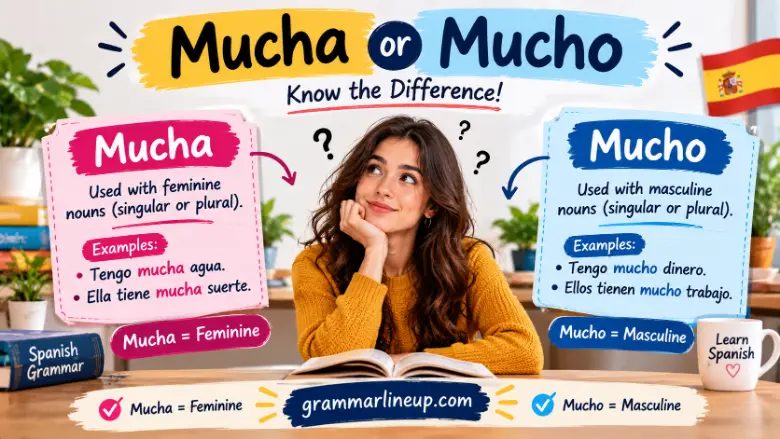
If you have ever come across the Spanish words mucha and mucho, you may have wondered whether they mean different things or are simply two forms of the same word. They are closely related, but choosing between them depends on the noun they describe. That small difference can make a sentence sound natural or slightly off.
Both words generally express the idea of “much,” “a lot,” or “many,” but Spanish uses grammatical gender and number to determine which form is appropriate. Mucho is used with masculine singular nouns, while mucha is used with feminine singular nouns. There are also plural forms, muchos and muchas, which follow the same basic pattern.
For English speakers learning Spanish, this can feel unfamiliar at first because English does not normally change “much” according to the gender of a noun. The good news is that the rule becomes much easier once you see it in everyday phrases.
In this guide, we’ll explain mucha vs. mucho, show how each word works in real sentences, and cover common mistakes so you can use the right form with confidence.
Mucha and mucho are Spanish forms of the word meaning “much” or “a lot,” but they agree differently with nouns. Mucho is used with masculine singular nouns, while mucha is used with feminine singular nouns. For example, mucho tiempo means “a lot of time,” while mucha agua means “a lot of water.”
Mucha or Mucho: What Is the Difference?
The difference between mucha and mucho is mainly grammatical: both come from the Spanish word mucho, meaning “much,” “a lot,” or “many” depending on context.
When mucho directly describes a noun, it changes form to agree with that noun’s gender and number.
| Form | Typical use | English meaning | Example |
|---|---|---|---|
| mucho | masculine singular noun | much / a lot of | mucho tiempo |
| mucha | feminine singular noun | much / a lot of | mucha agua |
| muchos | masculine plural noun | many / a lot of | muchos libros |
| muchas | feminine plural noun | many / a lot of | muchas personas |
So, mucha or mucho is not really a choice based on meaning. The noun or grammatical role usually determines which form you need.
For instance:
- mucho dinero = a lot of money
- mucha comida = a lot of food
- muchos amigos = many friends
- muchas preguntas = many questions
The key idea is simple: the form agrees with the noun when it functions as a determiner or adjective.
What Does Mucho Mean?
Mucho is a common Spanish word used to express a large quantity or degree. Depending on the sentence, it can correspond to much, many, a lot, or very much in English.
Examples include:
- Tengo mucho trabajo. — “I have a lot of work.”
- Hay mucho ruido. — “There is a lot of noise.”
- Me gusta mucho. — “I like it very much.”
- Hay muchos estudiantes. — “There are many students.”
Notice that mucho does not always modify a noun.
In mucho trabajo, it describes the quantity of a masculine singular noun.
In me gusta mucho, however, mucho functions differently. It expresses degree and does not change to mucha simply because the thing being liked might be feminine.
That distinction is important for avoiding common mistakes.
What Does Mucha Mean?
Mucha is the feminine singular form of mucho when it modifies a feminine singular noun.
Examples:
- mucha agua — a lot of water
- mucha paciencia — a lot of patience
- mucha gente — a lot of people
- mucha energía — a lot of energy
- mucha suerte — a lot of luck
For example:
Necesito mucha paciencia.
This means:
“I need a lot of patience.”
Because paciencia is feminine and singular, mucho becomes mucha.
Mucho and Mucha With Nouns
When mucho or mucha comes before a noun, the noun’s grammatical gender matters.
Masculine singular nouns
Use mucho:
- mucho tiempo — a lot of time
- mucho dinero — a lot of money
- mucho trabajo — a lot of work
- mucho frío — a lot of cold
- mucho interés — a lot of interest
Feminine singular nouns
Use mucha:
- mucha agua — a lot of water
- mucha comida — a lot of food
- mucha suerte — a lot of luck
- mucha paciencia — a lot of patience
- mucha atención — a lot of attention
This is why saying mucho comida or mucha dinero would normally be incorrect.
The form needs to agree with the noun.
Mucho, Mucha, Muchos, and Muchas
The same agreement principle continues when the noun is plural.
Mucho becomes muchos with masculine plural nouns.
Mucha becomes muchas with feminine plural nouns.
For example:
- mucho libro → a lot of book
- muchos libros → many books
- mucha pregunta → a lot of question
- muchas preguntas → many questions
More natural examples:
- Tengo muchos libros. — I have many books.
- Hay muchas personas aquí. — There are many people here.
- Necesitamos muchos días. — We need many days.
- Ella tiene muchas ideas. — She has many ideas.
A useful pattern is:
masculine singular → mucho
feminine singular → mucha
masculine plural → muchos
feminine plural → muchas
When Mucho Does Not Change to Mucha
One of the most useful distinctions is that mucho does not always agree with a noun.
When mucho is used as an adverb meaning something like “very much” or “a lot,” it normally stays mucho.
For example:
Me gusta mucho.
This means:
“I like it very much.”
You would not change mucho to mucha based on whether the object being discussed is grammatically feminine.
Compare:
- Me gusta mucho la música. — I like music very much.
- Me gusta mucho el café. — I like coffee very much.
In both sentences, mucho remains unchanged because it is expressing degree rather than directly modifying música or café.
This is one of the most important differences to remember.
Mucha or Mucho in Everyday Spanish
In everyday Spanish, you will encounter these forms constantly.
Talking about quantity
Tengo mucho trabajo hoy.
“I have a lot of work today.”
Talking about a feminine noun
Tengo mucha hambre.
“I am very hungry.”
Here, hambre is grammatically feminine, although it takes el in the singular in standard usage because of the initial stressed /a/ sound: el hambre. That does not make it masculine, so mucha hambre is correct.
Talking about enjoyment
Me gusta mucho esta canción.
“I like this song very much.”
Here, mucho is an adverb, so it does not agree with canción.
Talking about plural nouns
Hay muchas opciones.
“There are many options.”
These examples show why simply memorizing “mucho = masculine” and “mucha = feminine” is useful but incomplete.
The grammatical role also matters.
Common Mistakes With Mucha and Mucho
Using mucho before every noun
A common beginner mistake is treating mucho as an unchanging word.
For example:
mucho comida
The correct form is:
mucha comida
Because comida is feminine singular.
Using mucha with masculine nouns
The opposite mistake also occurs:
mucha dinero
The correct expression is:
mucho dinero
Dinero is masculine.
Changing adverbial mucho
Another mistake is changing mucho simply because the nearby noun is feminine.
For example:
Me gusta mucha la película.
The natural form is:
Me gusta mucho la película.
Here, mucho means “very much” and functions as an adverb.
Mucha vs. Mucho: Quick Comparison
| Question | Mucho | Mucha |
|---|---|---|
| Basic meaning | much / a lot | much / a lot |
| Singular noun | masculine | feminine |
| Example | mucho tiempo | mucha agua |
| Plural counterpart | muchos | muchas |
| Can work as an adverb? | Yes | No in the same standard adverbial role |
| Main grammatical clue | masculine singular noun | feminine singular noun |
The easiest rule is:
If it directly describes a feminine singular noun, use mucha. If it directly describes a masculine singular noun, use mucho.
But if it means “very much” or “a lot” as an adverb, keep mucho.
How to Know Whether a Spanish Noun Is Masculine or Feminine
Knowing whether to use mucha or mucho requires knowing the grammatical gender of the noun.
Many Spanish nouns ending in -o are masculine:
- libro
- trabajo
- dinero
Many nouns ending in -a are feminine:
- casa
- comida
- pregunta
However, these endings are not absolute rules. Spanish has many exceptions and nouns whose gender cannot be predicted reliably from the final letter.
For that reason, learners often benefit from learning a noun together with its article:
- el libro
- la casa
- el problema
- la mano
This makes gender agreement easier later.
Mucha or Mucho in Questions
Both forms can appear naturally in questions.
For masculine singular nouns:
¿Tienes mucho tiempo?
“Do you have much time?”
😉For feminine singular nouns:
¿Tienes mucha experiencia?
“Do you have much experience?”
For plural nouns:
¿Tienes muchos amigos?
“Do you have many friends?”
¿Tienes muchas preguntas?
“Do you have many questions?”
The same agreement pattern applies whether the sentence is a statement or a question.
Mucho With Verbs
When mucho modifies a verb rather than a noun, it commonly means “a lot” or “very much.”
Examples:
Trabajo mucho.
“I work a lot.”
Ella estudia mucho.
“She studies a lot.”
Nos gusta mucho viajar.
“We really like traveling.”
In these cases, you do not use mucha merely because the activity or object is feminine.
For instance:
Me gusta mucho la comida.
Not:
Me gusta mucha la comida.
The first sentence means “I like the food very much.” The second incorrectly treats mucho as though it were directly modifying comida.
Common Expressions With Mucho and Mucha
Some everyday expressions are especially useful to memorize.
Mucho tiempo
Mucho tiempo means “a lot of time.”
No tengo mucho tiempo.
“I don’t have much time.”
Mucha suerte
Mucha suerte means “good luck” or literally “a lot of luck.”
¡Mucha suerte en tu examen!
“Good luck on your exam!”
Muchas gracias
Muchas gracias means “thank you very much.”
This is an especially important expression because gracias is plural and feminine.
Mucho gusto
Mucho gusto is commonly used when meeting someone and can be translated as “Nice to meet you.”
Here, gusto is masculine singular, so mucho is used.
These fixed expressions are worth learning as complete phrases rather than trying to translate each word mechanically.
Is Mucha or Mucho More Correct?
Neither is inherently “more correct.”
They are different grammatical forms of the same word.
Use the form that matches the context:
- mucho → masculine singular noun
- mucha → feminine singular noun
- muchos → masculine plural noun
- muchas → feminine plural noun
- mucho → also used unchanged as an adverb in expressions such as me gusta mucho
So the real question is not “Which word is correct?”
It is:
What grammatical role does the word have, and what noun does it agree with?
That approach is much more reliable.
FAQs:
Is mucha the feminine form of mucho?
Yes. Mucha is the feminine singular form of mucho when it modifies a feminine singular noun, such as mucha comida or mucha paciencia.
Does mucho mean “many”?
It can, depending on its form and context. Muchos and muchas commonly mean “many,” while mucho and mucha commonly mean “much” or “a lot of” with singular nouns.
Why is it “mucha agua” but “mucho dinero”?
Because agua is grammatically feminine, while dinero is masculine. Therefore, the quantity word agrees as mucha agua and mucho dinero.
Why do people say “me gusta mucho” instead of “me gusta mucha”?
Because mucho is functioning as an adverb in me gusta mucho. It means “very much” and does not agree with the noun that may appear elsewhere in the sentence.
Is “muchas gracias” correct?
Yes. Muchas gracias is the standard Spanish expression for “thank you very much.” Gracias is plural, so the form is muchas.
What is the easiest way to remember mucha vs. mucho?
Think about the noun immediately connected to the quantity expression. Use mucho with a masculine singular noun and mucha with a feminine singular noun. Then remember that adverbial mucho stays unchanged.
Conclusion:
Mucha and mucho both express quantity or degree, but their form depends on grammar and context.
Use mucho with masculine singular nouns:
mucho dinero
Use mucha with feminine singular nouns:
mucha comida
For plural nouns, use muchos or muchas:
muchos libros
muchas preguntas
And when mucho means “very much” or “a lot” as an adverb, it normally remains mucho:
Me gusta mucho.
The most useful rule is therefore not simply “mucho is masculine and mucha is feminine.” Instead, check what the word is modifying and whether it needs to agree with a noun. That small distinction makes Spanish quantity expressions much easier to use naturally.
