
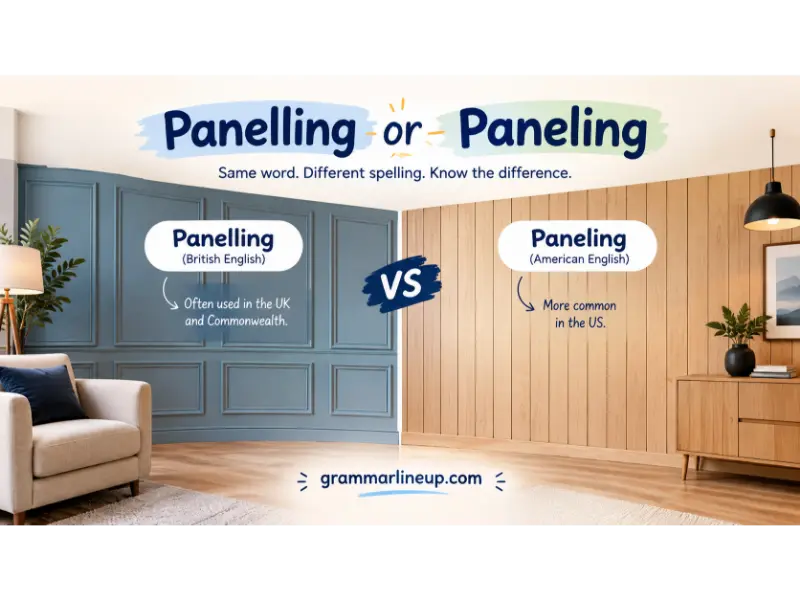
If you have ever wondered whether to write panelling or paneling, you are certainly not alone. Both spellings are correct, but the preferred form depends largely on which variety of English you are using. The difference is mainly a matter of regional spelling rather than meaning, so choosing the right version is usually quite simple once you know the pattern.
Panelling is the standard spelling in British English and is commonly used in the UK and other regions that follow British spelling conventions. Paneling, with one “l,” is the standard American English spelling. Both words refer to the same idea, such as covering or decorating a wall with panels.
This small spelling difference follows a wider pattern in English. British English often doubles the final consonant when adding certain endings, while American English frequently keeps the single consonant. Understanding this pattern can help you recognize similar differences without having to memorize every word individually.
In this guide, we will compare panelling and paneling, explain where each spelling is preferred, and show you how to use both naturally in everyday writing.
Featured Snippet Answer
Panelling and paneling have the same meaning: covering or decorating a surface with panels. Panelling is the usual British English spelling, while paneling is the usual American English spelling. For example, British English uses “wood panelling,” while American English commonly uses “wood paneling.”
What Does Panelling or Paneling Mean?
Panelling/paneling is the use of panels to cover, decorate, or form part of a surface. The panels may be made from wood, metal, cloth, or other materials.
It is especially common when talking about walls, doors, ceilings, furniture, and interior design.
For example:
- The library has beautiful oak panelling.
- The library has beautiful oak paneling.
- We are considering wooden paneling for the living room.
- The dining room features traditional wall panelling.
The meaning does not change when the spelling changes. The difference is primarily regional spelling.
Cambridge defines the noun as flat, usually rectangular pieces of materials such as wood, metal, or cloth that fit into or onto something larger.
Panelling vs. Paneling: The Main Difference
The easiest way to remember the distinction is by the variety of English you are writing.
| Spelling | Common variety | Example |
|---|---|---|
| panelling | British English | The room has dark wood panelling. |
| paneling | American English | The room has dark wood paneling. |
Both spellings are correct in their respective varieties of English.
British English commonly doubles the final l before adding -ing in words such as panelling. American English often uses a single l in the corresponding form, producing paneling. Cambridge identifies this exact UK/US distinction.
So, if you are writing for a British audience, panelling is the natural choice. If your audience is primarily American, paneling is generally preferable.
Why Are There Two Spellings?
The difference comes from broader spelling conventions in British and American English.
British English frequently retains doubled consonants in certain forms when a suffix is added. American English often simplifies the spelling in some of these words.
Compare:
- panelling → paneling
- panelled → paneled
- panellist → panelist
These patterns are not completely random, but English spelling has developed through different historical conventions rather than one perfectly consistent system.
Cambridge lists panelling as the UK form and paneling as the US form. It similarly gives panellist as the UK form and panelist as the US form.
The important point is that neither spelling is inherently more correct worldwide. The appropriate choice depends on the English variety you are using.
Origin and Evolution of the Word
The history of panelling/paneling goes back to the older word panel.
Etymological sources trace panel to Middle English and Old French, ultimately connecting it with Latin pannus, meaning a piece of cloth. The word initially referred to a piece of material and later developed several related meanings.
Over time, panel acquired meanings connected with distinct sections or pieces of a surface. It also developed a legal meaning associated with a group of people summoned for jury service and later the broader sense of a group of people selected to advise, judge, or discuss something.
The sense associated with a section of a wall or door is recorded from around the 17th century, while panelling/paneling developed from the verb panel. Etymonline dates the noun panelling/paneling to around 1800.
This history helps explain why panel today can refer both to a physical section and to a group of people, such as a discussion panel.
How to Use Panelling in British English
Use panelling when writing in British English.
Interior design
The Victorian house still has its original wooden panelling.
Home improvement
We are thinking about adding wall panelling to the hallway.
Architecture
The room was decorated with traditional oak panelling.
Furniture
The cabinet features decorative wood panelling on its doors.
In British English, related forms may also use the doubled l:
- panel → panelling
- panel → panelled
- panel → panellist
Cambridge’s British English entries support these forms.
How to Use Paneling in American English
Use paneling when writing in American English.
Interior design
The house has beautiful walnut paneling.
Remodeling
They removed the old wall paneling during the renovation.
Architecture
The office uses decorative wood paneling throughout the reception area.
Home décor
Light-colored paneling can make a small room feel brighter.
American English generally uses the corresponding single-l forms:
- panel → paneling
- panel → paneled
- panel → panelist
Cambridge’s American entries use these forms.
Meaning by Context
The word can appear in several contexts, although the spelling distinction remains the same.
Wall paneling
This refers to panels used to cover or decorate a wall.
The designer recommended wood paneling for the feature wall.
In British English:
The designer recommended wood panelling for the feature wall.
Decorative paneling
Here, the focus is on appearance rather than simply covering a surface.
The decorative paneling gave the room a more traditional appearance.
Wood paneling
This is one of the most common uses.
The den has dark wood paneling.
British spelling:
The den has dark wood panelling.
Architectural paneling
This can refer to panels incorporated into walls, doors, ceilings, or other architectural features.
The building contains elaborate carved paneling.
The spelling still depends on the intended variety of English.
Panelling or Paneling: Which One Should You Use?
Choose according to your audience and the style of English you are following.
Use “panelling” when:
- You are writing primarily for the UK.
- Your publication follows British English.
- You are using British spelling consistently.
- Your audience is accustomed to forms such as panelled and panellist.
Use “paneling” when:
- You are writing primarily for the United States.
- Your publication follows American English.
- Your other spelling choices are American.
- You normally write paneled and panelist.
The key is consistency.
If an American publication uses paneling, suddenly switching to panelling can look like an accidental spelling inconsistency. Likewise, British writing generally looks more natural when it uses panelling consistently.
Common Misunderstandings
“Panelling” is British slang
No. Panelling is not slang. It is the standard British English spelling of the noun referring to panels collectively or the use of panels as a covering or decorative treatment.
“Paneling” is a different word
Not in this context. Paneling and panelling have the same basic meaning. The difference is mainly regional spelling.
One spelling is grammatically wrong
Neither is inherently wrong. The choice depends on the English variety being used.
The extra “l” changes the pronunciation
Generally, no. Cambridge gives the same pronunciation for the two forms.
The word only refers to wooden walls
Not necessarily. Panels can be made from different materials, including wood, metal, and cloth. The context determines what kind of paneling or panelling is meant.
Panelling vs. Paneling vs. Paneled vs. Panelled
These related forms can make the spelling difference easier to understand.
| British English | American English |
|---|---|
| panelling | paneling |
| panelled | paneled |
| panellist | panelist |
For example:
British:
The walls were panelled in oak, and the original panelling was carefully restored.
American:
The walls were paneled in oak, and the original paneling was carefully restored.
The underlying word is the same; the spelling convention changes according to the variety of English.
Real Conversation Examples
At a home-improvement store
British English
Alex: What are you doing with the living room?
Sam: We’re adding wood panelling to one wall.
Alex: That should give it a classic look.
American English
Alex: What are you doing with the living room?
Sam: We’re adding wood paneling to one wall.
Alex: That should give it a classic look.
The meaning remains unchanged.
Discussing an older house
“The original panelling has been preserved.”
This is natural British English.
“The original paneling has been preserved.”
This is natural American English.
Talking about renovation
“We removed the outdated wall paneling.”
This follows American spelling.
For British English:
“We removed the outdated wall panelling.”
When to Use It
Use panelling/paneling when you are discussing the material, design, construction, or decorative treatment involving panels.
Common contexts include:
- interior design
- home renovation
- architecture
- furniture
- wall coverings
- doors
- ceilings
- woodworking
- historical buildings
- decorative finishes
For example:
The restoration included repairing the original wall panelling.
Or in American English:
The restoration included repairing the original wall paneling.
If you are writing an article, report, product description, or academic document, follow the spelling convention used by the rest of your text.
When Not to Use It
Do not use panelling/paneling when you actually mean a panel, panel discussion, or panel of people.
For example:
The panel discussed the proposal.
Here, panel means a group of people, not a wall covering.
Likewise:
The car’s control panel contains several switches.
Here, panel refers to a control surface.
The word panel has several meanings, so the surrounding context matters. Cambridge lists meanings involving physical sections, control surfaces, and groups of people.
Similar Words and Related Forms
Depending on the context, you may encounter related terms such as:
- panel — a flat section or a group of people
- wall paneling/panelling — panels applied to a wall
- wood paneling/panelling — paneling made from wood
- panelled/paneled — covered or decorated with panels
- panellist/panelist — a person who belongs to a panel
- wainscoting — a type of wall covering or decorative treatment, often associated with the lower portion of a wall
These words are related, but they are not always interchangeable. For instance, paneling is a broad term, while wainscoting can refer to a more specific type of wall treatment.
FAQs:
Is panelling or paneling correct?
Both are correct. Panelling is the standard British English spelling, while paneling is the standard American English spelling. They have the same basic meaning.
Is panelling British or American?
Panelling is British English. American English generally uses paneling.
What does panelling mean?
Panelling means panels used collectively or the covering or decoration of a surface with panels. It is commonly used for walls, doors, ceilings, and furniture.
What is the American spelling of panelling?
The usual American spelling is paneling, with one l before the -ing ending.
Is it wall panelling or wall paneling?
Both can be correct. Use wall panelling in British English and wall paneling in American English.
Is it panelled or paneled?
Panelled is the usual British English form, while paneled is the usual American English form. Cambridge identifies the underlying spelling pattern in its British and American entries for panel.
Final Takeaway:
Panelling and paneling mean the same thing. The main difference is regional spelling: panelling is used in British English, while paneling is used in American English.
If you are writing for a UK audience, choose panelling. If you are writing for a US audience, choose paneling. Most importantly, keep your spelling consistent throughout the same piece of writing.
The word itself has a long history, ultimately tracing back through Old French to Latin terms connected with cloth or a piece of material, while its modern architectural sense developed over time.
So, if you are deciding between the two spellings, there is no need to overthink it: British = panelling; American = paneling.
