
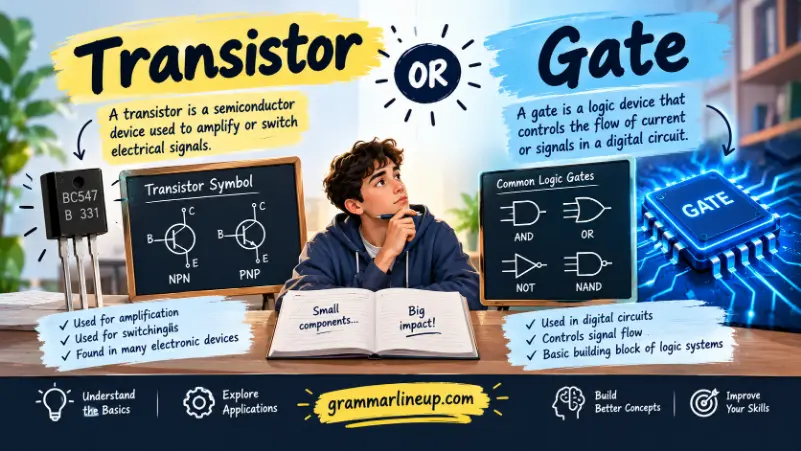
The terms transistor and gate often appear together when people start learning about electronics, digital circuits, and computer hardware. Because both are closely connected to how electronic signals are controlled, it can be easy to wonder whether a transistor and a gate are actually the same thing. They are not, although the relationship between them is important.
A transistor is a semiconductor device that can control or amplify electrical signals. It is one of the fundamental building blocks of modern electronics and is found in everything from simple circuits to smartphones and computers. A gate, on the other hand, usually refers to a digital logic gate, such as an AND, OR, or NOT gate, which performs a specific logical operation on input signals.
The confusion becomes understandable because logic gates can be built using transistors. In other words, transistors are often the physical components used to create the logic gates that digital systems rely on.
So, transistor or gate is not really a choice between two identical terms. They describe different levels of an electronic system. Understanding that distinction makes digital electronics much easier to follow and helps explain how simple electronic components can work together to perform complex tasks.
Featured Snippet Answer
A transistor is a semiconductor device that controls electrical current and can work as a switch or amplifier. A logic gate is a circuit that performs a Boolean operation on binary inputs. Transistors are commonly combined to build logic gates, so they are related but not interchangeable terms.
What Does “Transistor or Gate” Mean?
The phrase “transistor or gate” is not normally a single technical term. It is best understood as a comparison between a transistor and a logic gate.
A transistor controls electrical behavior. Depending on its type and configuration, it can switch current, amplify signals, or perform other circuit functions. A logic gate takes one or more binary inputs and produces an output according to a defined Boolean rule.
For instance:
- A transistor can act like an electronic switch.
- An AND gate produces 1 only when its required inputs are 1.
- An OR gate produces 1 when at least one input is 1.
- A NOT gate reverses the input.
- Multiple transistors can be interconnected to implement these logic functions.
So, the simplest distinction is:
Transistor = electronic building component.
Logic gate = logical function implemented by a circuit.
Transistor vs. Logic Gate at a Glance
| Feature | Transistor | Logic Gate |
|---|---|---|
| What it is | Semiconductor device | Digital circuit/function |
| Main role | Controls current or voltage; can switch or amplify | Performs Boolean logic |
| Typical inputs | Control voltage or current | One or more binary signals |
| Typical output | Controlled electrical signal | Binary logic result |
| Examples | BJT, MOSFET, FET | AND, OR, NOT, NAND, NOR, XOR |
| Can it be used alone? | Yes, depending on circuit purpose | Usually represents a circuit function |
| Relationship | Building block | Often built from transistors |
The important point is that a gate is generally a higher-level concept than an individual transistor.
What Is a Transistor?
A transistor is a semiconductor device that controls current between terminals in response to an electrical signal applied to a control terminal. Transistors can function as switches and amplifiers and are fundamental components of modern electronic circuits.
Two broad transistor families are commonly discussed:
- BJT (condition junction transistor)
- FET (field-effect transistor)
A BJT uses terminals called the base, collector, and emitter. A field-effect transistor uses a gate, source, and drain.
When used as a digital switch, a transistor can be controlled so that the circuit treats it as being approximately on or off. Those two states are useful for representing binary information such as 1 and 0.
Why Transistors Matter
Modern processors and integrated circuits contain enormous numbers of interconnected transistors. These devices provide the physical switching behavior from which increasingly complex digital circuits can be constructed.
That means a transistor is not merely a component found in old radios. It is one of the fundamental physical elements underlying modern computing.
What Is a Logic Gate?
A logic gate is a circuit that implements a Boolean operation on binary inputs and generates a binary output.
The input and output are commonly represented as:
- 0 = low/false
- 1 = high/true
The exact voltage corresponding to 0 or 1 depends on the technology and circuit design; 0 and 1 are logical states rather than universal fixed voltages.
Common logic gates include:
- AND
- OR
- NOT
- NAND
- NOR
- XOR
- XNOR
For example, an AND gate follows this basic rule:
1 AND 1 = 1
But:
1 AND 0 = 0
An OR gate behaves differently:
1 OR 0 = 1
A NOT gate simply reverses its input:
NOT 1 = 0
These rules allow digital circuits to make logical decisions and process information.
How Are Transistors and Gates Connected?
This is where the comparison becomes especially useful.
A transistor can serve as a switch, while a logic gate requires a particular arrangement of switching devices that produces the desired logical relationship between inputs and outputs.
For example, transistors can be connected in ways that implement an inverter or more complex functions such as NAND and NOR. Modern CMOS logic uses complementary transistor arrangements to implement digital functions efficiently.
A simplified hierarchy looks like this:
Transistor → Logic Gate → Larger Circuit → Processor
Intel describes the progression similarly: transistors are combined to create logic gates, and gates can then be combined into more complex circuits.
This is why saying “a transistor is a gate” can be misleading. A transistor can be used as a switching element, but a logic gate describes the behavior of an entire logical circuit.
Is a Transistor the Same as a Logic Gate?
No.
They are related, but they are not interchangeable terms.
Consider a simple analogy:
A transistor is somewhat like an individual switch.
A logic gate is more like a designed switching arrangement that follows a particular rule.
One transistor may be enough for certain simple switching or inversion arrangements, while other logic functions require multiple transistors.
The exact transistor count depends on the technology and circuit implementation, so there is no universal rule such as “one gate always equals X transistors.”
What Does “Gate” Mean on a Transistor?
There is another source of confusion: gate is also the name of a terminal on a field-effect transistor.
A MOSFET, for example, has three commonly discussed terminals:
- Gate
- Source
- Drain
Here, the word gate does not mean logic gate.
The transistor’s gate terminal is a control terminal. A voltage applied to it influences the electrical conduction between the source and drain.
So these two expressions mean different things:
Gate terminal: a physical terminal of a field-effect transistor.
Logic gate: a circuit that performs a Boolean operation.
This distinction is particularly important when reading electronics textbooks, schematics, or chip documentation.
Transistor Gate vs. Logic Gate
The word gate can therefore refer to two different concepts in electronics.
| Term | Meaning |
|---|---|
| Transistor gate | Control terminal of a FET |
| Logic gate | Circuit performing a Boolean function |
| AND gate | Logic circuit implementing AND |
| OR gate | Logic circuit implementing OR |
| NOT gate | Logic circuit implementing inversion |
For example, when someone says “the voltage on the transistor’s gate,” they are talking about a transistor terminal.
When someone says “the output of the AND gate,” they are talking about a digital logic function.
How a Transistor Can Behave Like a Switch
A useful way to understand the relationship is to imagine a transistor as an electronically controlled switch.
Instead of physically moving a lever, an electrical signal controls whether the device conducts.
In a simplified digital model:
- ON state → approximately allows conduction
- OFF state → approximately blocks conduction
Digital circuits exploit this switching behavior to represent binary states and create logical operations. OpenStax describes the transistor at this level as the fundamental building block beneath logic gates.
Real transistor behavior is more nuanced than a perfect mechanical switch, but the switch analogy is useful for learning digital logic.
Why Multiple Transistors Are Used in Logic Gates
A logic gate needs to respond correctly to combinations of inputs.
Suppose a circuit needs to implement an AND function. Its output should be high only when both inputs satisfy the required high condition.
A carefully arranged transistor network can make that behavior happen.
Different arrangements create different logical relationships.
For example:
- Transistor arrangements can implement inversion.
- Networks can implement NAND or NOR.
- More elaborate combinations can implement XOR, arithmetic circuits, memory elements, and processors.
This is why digital electronics can be understood as layers of abstraction rather than a collection of unrelated components.
What Is the Difference Between a Transistor and a Gate in a Computer?
Inside a computer, the distinction is mainly about function versus physical implementation.
A transistor is part of the physical hardware.
A logic gate represents a particular logical operation performed by hardware.
Many gates can be combined to create larger circuits such as:
- Adders
- Multiplexers
- Decoders
- Registers
- Control circuits
- Arithmetic logic units
- Processor components
Those larger structures ultimately depend on transistor-based electronic circuitry.
So if you zoom in, you can see transistors. If you zoom out to a logical level, you can describe groups of those transistors as gates and larger circuits.
Common Misunderstandings
“A transistor and a gate are identical.”
They are not.
A transistor is a semiconductor device. A logic gate is a circuit or functional building block that performs Boolean logic.
“Every transistor is a logic gate.”
Not necessarily.
Transistors have many applications outside digital logic, including amplification and other forms of signal control.
“The gate terminal is the same as a logic gate.”
No.
The gate terminal belongs to a field-effect transistor. A logic gate is a circuit-level concept.
“One transistor always makes one gate.”
That is an oversimplification.
The implementation depends on the logic function and the circuit technology. Some simple circuits can use very few devices, while other gates require multiple transistors.
“A logic gate is only software.”
No.
A logic gate can describe a physical electronic circuit. Logic gates are implemented in hardware using technologies such as CMOS and other circuit families.
When Should You Use the Term “Transistor”?
Use transistor when you’re discussing the physical semiconductor component or its electrical behavior.
For example:
“The transistor switches the signal.”
“This circuit uses a MOSFET.”
“The transistor amplifies the input signal.”
These statements focus on the device itself.
When Should You Use the Term “Logic Gate”?
Use logic gate when you’re discussing a Boolean operation or digital circuit behavior.
For example:
“The AND gate requires both inputs to be high.”
“The processor uses many logic gates.”
“The circuit contains an XOR gate.”
Here, the focus is on the logical operation rather than the individual semiconductor devices.
Why the Difference Matters
Understanding the distinction helps you move between different levels of electronics.
If you’re studying semiconductors, you may focus on transistor construction and electrical behavior.
😊If you’re studying digital logic, you’ll usually focus on gates, truth tables, Boolean algebra, and binary signals.
If you’re studying computer architecture, you’ll move another level upward and examine how gates combine into functional circuits.
The concepts are connected, but each describes a different layer.
A helpful mental model is:
Semiconductor device → transistor → logic gate → digital circuit → computer system
This layered view makes technical explanations much easier to follow.
FAQs:
Is a transistor a gate?
A transistor is not the same thing as a logic gate. A transistor is a semiconductor device that can act as a switch or amplifier, while a logic gate performs a Boolean operation. Transistors are commonly used to construct logic gates.
Is a MOSFET gate the same as an AND gate?
No. The gate of a MOSFET is a physical control terminal. An AND gate is a digital logic function. MOSFETs can be interconnected to build circuits that perform AND-related logic, but the two uses of “gate” refer to different concepts.
Can one transistor make a logic gate?
A transistor can form very simple switching or inversion circuits under appropriate conditions, but many practical logic functions require multiple transistors. The number depends on the circuit technology and implementation.
Are logic gates made from transistors?
Yes. Modern digital logic commonly uses transistor-based technologies, especially CMOS. Logic gates can be constructed by arranging transistors so their switching behavior produces the desired Boolean output.
Which comes first, a transistor or a logic gate?
At the physical-device level, the transistor is the lower-level building block. Logic gates can then be constructed from interconnected transistors. OpenStax describes the transistor as the basic building block beneath logic gates.
Why are transistors important to computers?
Transistors provide controllable electronic switching and amplification. Large numbers of interconnected transistors form the logic and other circuitry used in integrated circuits, including processors and memory-related devices.
Conclusion:
Transistor or gate is really a question about two connected levels of electronics.
A transistor is a physical semiconductor device that can control electrical current and act as a switch or amplifier. A logic gate is a circuit-level function that processes binary inputs according to Boolean logic.
The key relationship is simple:
Transistors are commonly used to build logic gates, and logic gates are combined to build more complex digital circuits.
Also remember that “transistor gate” and “logic gate” are not the same phrase. In a MOSFET, the gate is a control terminal. In digital logic, a gate is a circuit that performs an operation such as AND, OR, or NOT.
That distinction removes most of the confusion surrounding transistor vs. gate and gives you a useful foundation for understanding digital electronics.
