
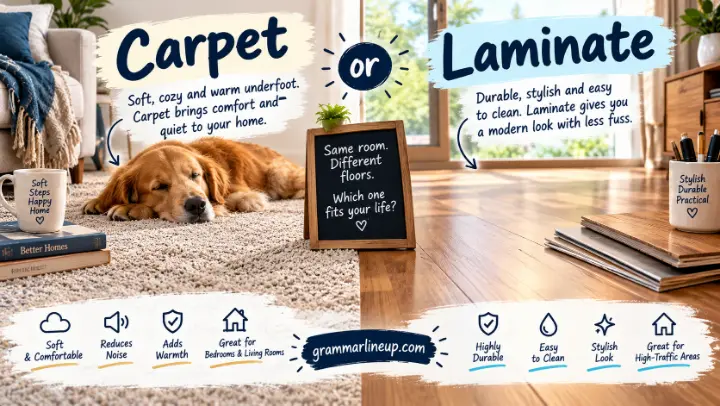
Choosing between carpet or laminate can feel like a small decision until you start thinking about comfort, cleaning, durability, style, and everyday family life. Both flooring options can look great, but they create very different experiences under your feet and around your home.
Carpet is soft, warm, and often a comfortable choice for bedrooms, living rooms, and quiet spaces. Laminate, on the other hand, offers a smooth, practical surface that can suit busy areas and a wide range of interior styles. The better option depends less on which material is universally “best” and more on what your room actually needs.
In this guide, we’ll compare carpet and laminate in simple terms, including comfort, maintenance, durability, appearance, cost, and suitability for different rooms. Whether you’re renovating one room or planning flooring for an entire home, understanding these differences can make the choice much easier.
Carpet and laminate serve different needs. Carpet is soft, warm, quiet, and comfortable underfoot, making it popular for bedrooms and cozy living spaces. Laminate is a hard-surface flooring option that is generally easier to clean and offers strong scratch resistance. The right choice depends on moisture, traffic, comfort, maintenance, and room use.
Quick Answer
If your priority is softness, warmth, and sound absorption, carpet has clear advantages. Lowe’s notes that carpet is comfortable underfoot, absorbs sound, and works particularly well in bedrooms.
If your priority is a hard surface that’s easy to clean and resistant to everyday wear, laminate may be more suitable. Laminate is available in wood- and stone-inspired designs and is generally low-maintenance and stain-resistant.
The room itself should influence the decision just as much as your personal taste.
Quick comparison:
| Factor | Carpet | Laminate |
|---|---|---|
| Underfoot comfort | Excellent | Moderate |
| Warmth | Generally warmer | Can feel cooler |
| Sound absorption | Strong | Usually less sound-absorbing |
| Cleaning | Requires regular vacuuming and stain care | Generally easy to clean |
| Scratch resistance | Not applicable in the same way | Generally strong |
| Moisture tolerance | Varies; moisture can be problematic | Varies by product |
| Appearance | Soft, textured, many colors | Wood/stone-style appearance |
| Installation | Often professionally installed | Many products use click systems |
| Bedrooms | Often well suited | Also possible |
| High-spill areas | Requires careful product selection | Requires a water-resistant product |
| Uneven subfloor | Can hide minor imperfections | Requires a suitable, prepared surface |
These are broad characteristics, not guarantees for every product. Carpet construction, fiber, backing, laminate construction, installation method, and manufacturer specifications can change the result.
What Is Carpet?
Carpet is a textile floor covering made with fibers attached to a backing system. It comes in numerous constructions and fibers, including nylon, polyester, polypropylene, triexta, and wool.
Its biggest distinction from laminate is simple: carpet is soft and textile-based, while laminate is a hard-surface flooring product.
Carpet can be made with cut pile, loop pile, multi-level loop, or cut-and-loop construction. These choices affect its appearance, feel, and performance.
For example, dense construction and shorter pile can be useful in higher-traffic areas. The Carpet and Rug Institute also notes that construction—not simply fiber type—is an important part of carpet durability.
That means choosing carpet isn’t simply a matter of asking, “Which fiber is best?” The complete carpet system matters.
What Is Laminate Flooring?
Laminate is a layered hard-surface flooring product designed to reproduce the appearance of materials such as wood or stone.
Modern laminate products can offer realistic textures, scratch resistance, and relatively straightforward installation. Lowe’s describes laminate as durable, scratch-resistant, low-maintenance, and commonly installed using click-together systems.
However, not all laminate is equally resistant to water.
Some modern products are specifically designed with enhanced water resistance. For example, Pergo describes certain laminate ranges with sealed surfaces and water-resistant construction.
This is why “laminate is waterproof” should not be treated as a universal rule. Always check the specifications and installation requirements for the exact product.
Carpet vs Laminate for Comfort
If comfort underfoot is your biggest concern, carpet has an obvious advantage.
Walking barefoot across carpet generally feels softer and warmer than walking across a hard floor. Carpet cushion can also contribute to comfort and can help with acoustics and insulation. The Carpet and Rug Institute specifically identifies cushion as an important part of the carpet system.
Laminate is firmer. It can still be comfortable, particularly with appropriate underlayment, but it doesn’t provide the same plush sensation.
Carpet works well when you want:
- A soft surface for bare feet
- A cozy bedroom
- A quieter-feeling room
- More cushioning underfoot
- A warmer visual and tactile atmosphere
Laminate works well when you want:
- A firm walking surface
- A wood-inspired appearance
- Easy everyday surface cleaning
- A consistent hard-floor look
If your first thought when entering a room is “I want this to feel cozy,” carpet deserves serious consideration.
Carpet vs Laminate for Cleaning
Cleaning is one of the most noticeable differences between the two.
Carpet requires regular vacuuming because dirt and debris can become embedded among its fibers. Stains also need appropriate treatment, and cleaning methods can vary depending on the fiber and manufacturer’s recommendations. The Carpet and Rug Institute recommends following the carpet manufacturer’s cleaning instructions.
Laminate generally has a simpler surface-cleaning routine. Shaw Floors, for example, recommends care practices such as spot cleaning and using appropriate floor protection to reduce scratches and indentations.
But laminate isn’t a license to flood the floor with water. Maintenance requirements vary between products, particularly regarding water exposure.
Pergo’s current installation and maintenance guidance, for example, distinguishes between water-resistant products and non-water-resistant ranges.
So, in everyday terms:
Carpet: vacuuming + stain management + occasional deeper cleaning.
Laminate: sweeping/vacuuming + appropriate damp cleaning + prompt spill management according to product instructions.
Carpet Or Laminate Price
When comparing carpet or laminate price, carpet is often the cheaper option upfront, while laminate can offer excellent value through easy maintenance and a durable surface.
The final cost depends on material quality, room size, underlay, labour and the condition of the existing floor. In the USA, carpet installation typically costs around $2 to $8 per square foot, while laminate installation ranges from $4 to $14 per square foot.
In the UK, carpet generally costs around £15 to £50 per square metre supplied and fitted, compared with approximately £25 to £55 per square metre for laminate. These are indicative estimates, and prices vary by region, product quality and installation requirements.
| Cost Factor | Carpet | Laminate |
|---|---|---|
| Initial installation | Usually cheaper | Often costs more |
| Underlay | Usually required | Depends on the product and installation system |
| Cleaning costs | Vacuuming and occasional professional cleaning | Sweeping and damp cleaning |
| Repair costs | Small repairs may be possible | Damaged planks may need replacing |
| Best value | Comfortable bedrooms and cosy living spaces | Busy living areas and easy maintenance |
To compare prices fairly, ask for a quote that includes the flooring, underlay, fitting, removal of the old floor, waste disposal and any subfloor repairs. A low material price can look appealing, but the extras can quickly change the total.
Which is cheaper overall? Carpet is often the more affordable choice for initial installation, particularly in bedrooms. Laminate may be worth the extra cost in high traffic areas where straightforward cleaning and a hard wearing finish are priorities. The best option is the one that suits your budget, lifestyle and the room you are flooring.
Carpet or Laminate for Durability
Durability depends heavily on the specific product and how the room is used.
For carpet, construction, density, pile height, twist, fiber, backing, and cushion all contribute to performance. The Carpet and Rug Institute recommends considering traffic levels when selecting carpet.
Laminate is designed as a hard-wearing surface, and many products have protective top layers intended to resist scratches and wear.
However, neither material is indestructible.
A heavy object can damage laminate. Carpet can stain, mat, pull, or show wear. Repairs can also work differently: damaged laminate boards may sometimes be replaced individually, while carpet repair may involve patching or replacing a section depending on the damage and installation.
The better question is therefore not “Which lasts forever?”
It’s:
“Which material is better suited to the type of wear this room receives?”
Carpet or Laminate for Bedrooms
Bedrooms are one area where personal preference matters enormously.
Carpet is often attractive for bedrooms because it is soft, quiet, and comfortable when getting out of bed. Lowe’s specifically lists bedrooms among spaces where carpet works well.
Laminate can also work well if you prefer a clean, hard-floor appearance or want a surface that’s straightforward to sweep and clean.
Consider:
- Do you walk barefoot often?
- Do you want a quieter room?
- Do you have pets?
- Are spills common?
- Do you prefer soft or hard flooring?
- Is the room prone to moisture?
For a cozy bedroom, carpet is a natural fit. For a bedroom where easy surface cleaning is particularly important, laminate may appeal more.
Carpet or Laminate for Living Rooms
Both can work in a living room.
Carpet creates a softer, more relaxed environment and can help reduce sound. The Carpet and Rug Institute notes that carpet can contribute to sound absorption and insulation.
Laminate can provide a more continuous hard-floor appearance and can imitate wood or stone without being solid hardwood. It is also generally easy to clean.
Your lifestyle matters here.
A quiet household that values softness may lean toward carpet. A household that frequently deals with food, dirt, pets, or high surface traffic may prefer the cleaning characteristics of a hard surface.
Carpet or Laminate for Pets and Children
This is where the comparison becomes more practical.
Children and pets can introduce spills, dirt, scratches, accidents, and general wear.
Carpet can be comfortable for children to play on and can reduce noise, but stains and odors require attention. Lowe’s specifically notes that carpet can hold odors and stains and recommends considering stain-resistant and pet-friendly options where appropriate.
Laminate avoids many of the cleaning challenges associated with textile fibers, but pets can scratch hard flooring, and water exposure still needs to be managed according to the product’s specifications.
For either choice, product selection matters.
A durable, appropriately constructed carpet can perform very differently from a delicate plush carpet. Likewise, a basic laminate product may have different moisture and wear characteristics from a premium water-resistant product.
Moisture: A Major Difference to Consider
Moisture deserves special attention because it can change the suitability of both materials.
Traditional carpet isn’t an obvious choice for areas that routinely experience standing water or significant moisture. Water can affect carpet, padding, backing, and the underlying floor.
Laminate isn’t automatically moisture-proof either.
Lowe’s notes that excess moisture can cause non-waterproof laminate to buckle, while Pergo explains that water-resistant laminate products have specific construction and sealing requirements.
This leads to an important rule:
Never choose laminate based only on the word “laminate.” Check the exact product’s water-resistance rating and installation requirements.
The same principle applies to carpet. Check the carpet, cushion, backing, and installation specifications rather than assuming all carpet behaves the same way.
Installation Differences
Installation can influence both the initial cost and the final performance of your floor.
Carpet installation requires careful preparation, measurement, seaming, stretching, and appropriate cushion. The Carpet and Rug Institute maintains residential installation standards covering planning and subfloor preparation.
Many laminate products use click-together systems and can be more accessible to experienced DIY installers. However, the subfloor still matters.
Pergo’s installation guidance emphasizes preparing the surface, checking for unevenness, and allowing the laminate to adapt to its environment before installation.
So laminate may have a reputation for being easy to install, but easy does not mean “skip the preparation.”
An uneven or unsuitable base can create problems later.
Cost: Look Beyond the Price per Square Foot
It’s tempting to compare flooring prices by looking only at the material cost.
That’s rarely enough.
Your actual project cost can include:
- Flooring material
- Carpet cushion or laminate underlayment
- Removal of existing flooring
- Subfloor preparation
- Installation labor
- Trim and transitions
- Delivery
- Repairs or replacement of damaged areas
Prices also vary significantly by product quality, region, room size, installation complexity, and time of purchase.
Laminate is generally positioned as a lower-cost alternative to solid hardwood, while carpet is available across a broad range of price and quality levels.
Instead of asking “Which is cheaper?”, calculate the complete installed cost for the exact products you’re considering.
That gives you a much more useful comparison.
Common Misunderstandings About Carpet and Laminate
“Laminate is completely waterproof.”
Not necessarily.
Some modern laminate products have strong water-resistant or waterproof characteristics, but these are product-specific features. Always check the manufacturer’s specifications and installation requirements.
“All carpet is difficult to clean.”
That’s too broad.
Carpet fibers and constructions differ. Modern carpets can include stain- and soil-resistant technologies, and cleaning requirements depend on the specific product.
“The most expensive carpet is automatically the most durable.”
Not necessarily.
Durability depends on construction, fiber, density, pile characteristics, backing, cushion, and expected traffic.
“Laminate never scratches.”
It can.
Many laminate floors are designed to resist scratches and wear, but no ordinary residential flooring should be treated as completely scratch-proof.
“One flooring type is best for every room.”
That’s rarely practical.
A bedroom, kitchen, hallway, basement, and home office can have completely different requirements.
How to Choose Between Carpet and Laminate
A useful way to narrow the decision is to answer these questions:
1. How important is softness?
If softness is a top priority, carpet has an advantage.
2. How much cleaning do you expect?
If you want a hard surface that is generally straightforward to clean, laminate may be attractive.
3. Is the room exposed to moisture?
Check the exact specifications of either material before deciding.
4. How much foot traffic will the floor receive?
Look for construction and performance specifications designed for the expected traffic.
5. Do you have pets or young children?
Think about stains, scratches, accidents, cleaning routines, and comfort.
6. How important is noise control?
Carpet generally absorbs more sound than hard flooring.
7. Are you installing the floor yourself?
Some laminate systems are designed for click installation, while carpet generally involves more specialized installation requirements.
8. What does the complete project cost?
Include removal, preparation, materials, accessories, and labor.
FAQs:
Is carpet or laminate better for bedrooms?
Both can work. Carpet is particularly suited to bedrooms when softness, warmth, and noise reduction are important. Laminate may be preferable when you want a hard surface that’s generally easy to clean.
Is laminate easier to clean than carpet?
Generally, yes. Laminate has a hard surface that can be swept, vacuumed, and cleaned according to the manufacturer’s instructions. Carpet requires regular vacuuming and appropriate stain and deep-cleaning methods.
Is carpet warmer than laminate?
Carpet generally feels warmer and softer underfoot. Carpet cushion can also contribute to insulation and comfort.
Can laminate handle water?
Some laminate products are specifically designed to resist water, but the level of protection varies. Other laminate products can be damaged by excessive moisture. Check the manufacturer’s specifications before using laminate in moisture-prone rooms.
Which is better for pets, carpet or laminate?
Neither is automatically the right choice for every pet household. Carpet can provide comfort but may require more attention to stains and odors. Laminate can be easier to clean but may be vulnerable to scratches and moisture. Consider your pet’s habits and the exact flooring product.
Does laminate cost less than carpet?
It can, but there is no universal price difference. Material quality, installation, subfloor preparation, removal of old flooring, and local labor can all change the final project cost. Compare complete installed estimates rather than material prices alone.
Conclusion:
The choice between carpet or laminate comes down to what you want the room to do.
Choose carpet when softness, warmth, quietness, and comfort are high priorities. Choose laminate when you prefer a hard, wood-inspired surface with generally straightforward cleaning and strong everyday wear resistance.
But don’t stop at the flooring category. Compare the specific product, construction, moisture rating, installation requirements, maintenance instructions, and total installed cost.
That’s the difference between choosing a floor because it looks good in a sample and choosing one that actually fits your home.
