
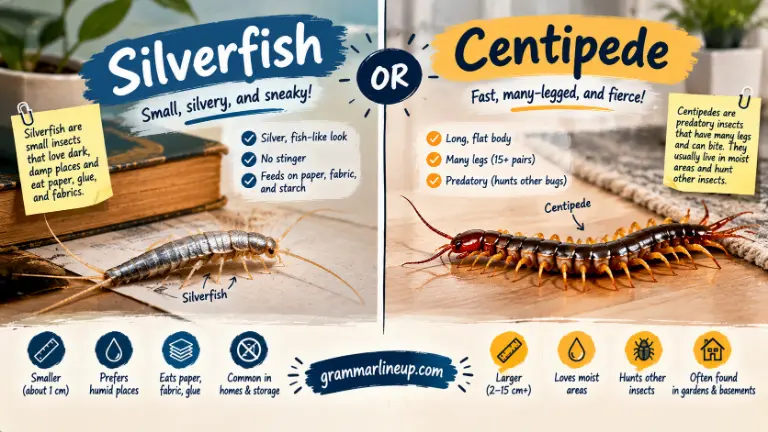
At first glance, silverfish or centipede might sound like a simple question, but these two small household creatures are quite different. Both can appear unexpectedly indoors, move quickly, and leave you wondering what exactly just crossed the floor. That is where the confusion begins.
Silverfish are small, wingless insects with a flattened, silvery body and distinctive tail-like bristles. They usually move with a quick, fish-like wiggling motion and are often found in damp, dark places such as bathrooms, basements, or storage areas. Centipedes, on the other hand, have long, segmented bodies and many pairs of legs. Their appearance can be rather dramatic, especially when they suddenly dart across a wall or floor.
Knowing the difference is useful because their body shape, habits, and typical behavior are not the same. In this guide, we’ll compare silverfish and centipedes in clear, everyday language, so you can identify each one more confidently and understand why they may show up around your home.
A silverfish and a centipede are different arthropods. Silverfish are small, wingless insects with six legs, a silvery tapered body, long antennae, and three tail-like filaments. House centipedes have 15 pairs of long legs, a flattened body, and two long antennae. Both prefer damp, dark areas, but silverfish feed on various organic materials while centipedes hunt other small arthropods.
Quick Answer
The simplest distinction is six legs versus many legs.
| Feature | Silverfish | House Centipede |
|---|---|---|
| Animal group | Insect | Centipede |
| Legs | 6 | 15 pairs in adults |
| Body | Small, tapered, carrot-shaped | Long, flattened |
| Typical color | Silvery or gray | Yellowish/brown with dark stripes |
| Antennae | Long | Long |
| Tail | 3 long filaments | No three-filament silverfish-style tail |
| Movement | Very fast | Extremely fast |
| Food | Starchy and other organic materials | Insects, spiders, and other arthropods |
| Common indoor habitat | Damp, dark areas | Damp, dark areas |
| Role indoors | Mostly nuisance pest | Predator of other small pests |
Silverfish adults are generally around 6–13 mm long, while adult house centipedes may have a body around 1–1½ inches long, with their long legs and antennae making them appear considerably larger.
What Does a Silverfish Look Like?
A silverfish is a small, wingless insect with a distinctive tapered body. Its body is generally silver or gray and is covered with scales.
Three long appendages extend from the rear of the body, while two long antennae extend from the head. This combination gives the insect an unusual, almost fish-like appearance.
Silverfish are also remarkably quick. When disturbed, they can dart away and squeeze into narrow cracks and crevices because of their flattened bodies.
They commonly occur in:
- Basements
- Closets
- Bookcases
- Storage areas
- Bathrooms
- Other cool, damp locations
Their presence does not automatically mean a home is seriously infested. Penn State Extension describes them primarily as nuisance pests, although they can damage materials such as paper, books, wallpaper, and some starch-containing products.
What Does a House Centipede Look Like?
The house centipede is much easier to recognize once you notice its legs.
An adult has 15 pairs of long, jointed legs. The legs are banded, and the body is generally yellowish or brownish with three darker longitudinal stripes.
The centipede’s legs are extremely long compared with its body. This makes it look much larger and more dramatic than its body length alone would suggest.
House centipedes also have two long antennae and move rapidly across floors, walls, and ceilings.
Unlike silverfish, house centipedes are predators. They hunt other small arthropods, including silverfish, cockroaches, spiders, and carpet beetle larvae.
The Biggest Difference Between Silverfish and Centipedes
The most useful identification clue is the number and appearance of the legs.
A silverfish has the standard six legs of an insect. Its body is compact, tapered, and covered with silvery scales.
A house centipede has 15 pairs of legs, and those legs are so long that they form a noticeable fringe around its body.
There is another important difference: their diets.
Silverfish are scavenging/feeding insects that can consume starch-containing materials and other organic food sources. Centipedes are hunters that actively prey on other small creatures.
So, if the creature has many conspicuous legs, it is not a silverfish.
Why Do Silverfish and Centipedes Appear in the Same Places?
The confusion is understandable because both can favor dark, damp environments.
Silverfish commonly inhabit cool, moist, dark areas such as basements, closets, bookcases, and storage spaces.
House centipedes also spend daylight hours in dark, damp locations and commonly become active at night.
That shared habitat can create an interesting relationship.
A house centipede may actually be present because there are other small arthropods nearby. Silverfish are among the prey house centipedes eat. Therefore, seeing a centipede can sometimes be a clue that the building has a broader population of small insects or other arthropods.
Silverfish vs. Centipede: Diet and Behavior
😍Silverfish Diet
Silverfish can feed on materials containing starch and carbohydrates, including:
- Flour
- Cereal
- Books
- Wallpaper
- Glue and paste
- Other organic materials
They can also consume protein-rich food sources and dead insects.
This explains why silverfish can occasionally become a concern around stored paper products or food materials.
Centipede Diet
House centipedes have a completely different lifestyle.
They are predators that hunt small arthropods such as:
- Silverfish
- Cockroaches
- Spiders
- Carpet beetle larvae
- Other small insects and arthropods
They typically hunt at night.
So while a silverfish may be the creature you are trying to identify as a household nuisance, a house centipede may be there hunting that very creature.
Are Silverfish or Centipedes Dangerous?
For most household situations, neither should be treated as a major threat to people.
Silverfish are primarily considered nuisance pests. Their main concern is potential damage to certain household materials, particularly paper and starch-containing products.
House centipedes are also generally considered harmless to homeowners. Penn State Extension notes that they feed on pest insects and other small arthropods.
Centipede bites are uncommon. The University of Minnesota Extension notes that centipedes are shy and that their jaws generally cannot break human skin easily; when bites occur, symptoms may include swelling, with severe pain not expected in typical cases.
That does not mean every centipede species should be handled casually. If you cannot identify an arthropod confidently, it is safer not to pick it up.
How to Identify What You Saw
If you saw a fast-moving bug and are unsure whether it was a silverfish or centipede, check these features.
Look at the Legs
Six legs: likely an insect such as a silverfish.
Many long legs: likely a centipede.
This is usually the fastest way to separate the two.
Look at the Body
A silverfish has a relatively small, tapered, carrot-like body.
A house centipede has a long, flattened body surrounded by extremely long legs.
Look at the Rear
Silverfish have three long, tail-like filaments projecting from the rear of the abdomen.
This is one of their signature features.
Consider What It Was Doing
A silverfish generally runs away when disturbed and may hide in cracks.
A house centipede may race across a wall or floor while actively searching for prey. House centipedes are particularly active at night.
What Does It Mean If You Find Both?
Finding both a silverfish and a centipede in the same home is not impossible.
In fact, the relationship makes biological sense: house centipedes eat silverfish.
A recurring centipede problem can therefore indicate that other small arthropods are available as food. Penn State specifically notes that frequent house centipedes can indicate an abundance of prey species.
That does not prove silverfish are present. But it is a useful reason to inspect damp, dark areas if you repeatedly see centipedes.
How to Reduce Silverfish and Centipedes Indoors
The basic strategy for both involves reducing the conditions they favor.
Reduce Moisture
Damp environments can support both silverfish and centipedes.
Consider:
- Repairing leaking pipes
- Improving ventilation
- Using a dehumidifier in damp areas
- Addressing persistent moisture around basements or storage areas
Penn State recommends moisture reduction as part of silverfish and house-centipede management.
Seal Cracks and Gaps
Seal openings around:
- Baseboards
- Windows
- Doors
- Pipes
- Wall penetrations
- Foundation cracks
Reducing entry points also reduces hiding places.
Reduce Clutter
Cardboard boxes, stored materials, and other clutter can provide shelter for small arthropods.
Keeping storage areas organized makes it easier to spot and address moisture or pest problems.
Protect Stored Food and Materials
For silverfish, store cereals, flour, pasta, pet food, and similar products in tightly sealed containers. Regular cleaning and vacuuming can also reduce accessible food sources.
Common Misunderstandings About Silverfish and Centipedes
“Silverfish have lots of legs.”
No. Silverfish have six legs because they are insects.
Their three rear filaments can sometimes be mistaken for additional legs, but they are tail-like appendages, not walking legs.
“Centipedes eat paper like silverfish.”
No. House centipedes are predators. They hunt other arthropods rather than feeding on paper or wallpaper.
“A centipede means the house is dirty.”
Not necessarily.
House centipedes prefer damp, dark areas and may enter or live in buildings because suitable prey is available. Their presence alone does not establish that a home is dirty.
“Silverfish and centipedes are the same kind of pest.”
They are not.
Silverfish are insects. Centipedes belong to a different arthropod group and are not insects. The University of Minnesota specifically distinguishes centipedes from true insects.
Silverfish or Centipede: Which One Did You See?
Use this quick checklist:
Small, silvery, tapered body + six legs + three rear filaments = silverfish.
Long, flattened body + 15 pairs of long legs + very long antennae = adult house centipede.
If you only remember one thing, remember the legs. It is the quickest visual clue.
FAQs:
Is a silverfish a type of centipede?
No. Silverfish are insects with six legs. Centipedes are a separate group of arthropods with multiple pairs of legs.
Do centipedes eat silverfish?
Yes. House centipedes are predators and silverfish are among the small arthropods they can eat.
Which is bigger, a silverfish or a house centipede?
A house centipede is generally much larger in overall appearance. Silverfish adults are commonly around 6–13 mm long, while an adult house centipede has a body around 1–1½ inches long, with its legs and antennae extending its apparent size considerably.
Why do I keep finding silverfish in my house?
Silverfish favor cool, moist, dark locations. Persistent sightings can be associated with moisture, hiding places, and accessible food sources. Reducing humidity, sealing cracks, reducing clutter, and protecting food and paper materials can help.
Why are house centipedes appearing in my home?
House centipedes prefer dark, damp locations and hunt other arthropods. Frequent sightings may indicate that suitable prey is present in the building.
Should I be worried if I see a house centipede?
Usually, a single house centipede is not a major cause for concern. They are predators of small arthropods and are generally considered harmless to homeowners. Repeated sightings, however, can be a reason to investigate moisture and other pest activity.
Conclusion:
Silverfish or centipede? Look at the legs first.
A silverfish is a small, silvery, tapered insect with six legs and three tail-like filaments. A house centipede has a long, flattened body and 15 pairs of long legs.
They may share damp indoor habitats, but their lifestyles are very different. Silverfish feed on various organic and starchy materials, while house centipedes hunt other small arthropods—including silverfish.
If you repeatedly find either one, focus first on the environment: reduce excess moisture, remove clutter, seal gaps, and investigate other pest activity. Those measures address the conditions that can make indoor arthropods more comfortable.
