
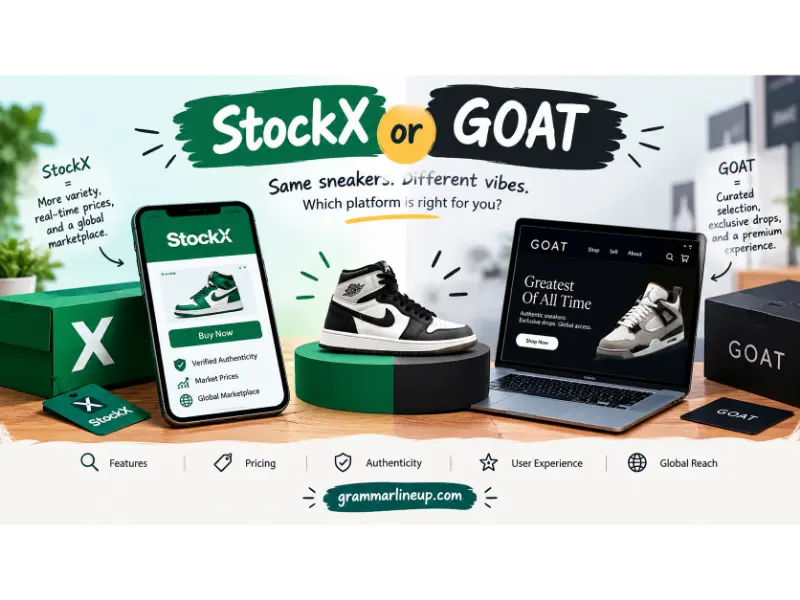
Choosing between Stockx Or Goat can feel surprisingly tricky, especially when both platforms are popular for buying and selling sneakers, streetwear, and sought after releases.
At first glance, they may seem almost identical, but the shopping experience, authentication process, fees, shipping, and overall selection can differ in ways that matter.
If you are trying to decide where to buy your next pair, sell sneakers you no longer wear, or simply understand which marketplace offers better value, comparing Stockx Or Goat side by side is a sensible place to start. Neither platform is automatically the right choice for everyone.
Your best option depends on what you value most, such as price, availability, convenience, buyer protection, or the confidence that your purchase is genuine.
This guide breaks down the key differences in simple terms, so you can see what each marketplace does well and where one may have an advantage. By the end, you should have a clearer idea of which platform fits your shopping or selling needs without having to decode a mountain of sneaker marketplace jargon.
StockX and GOAT are major online marketplaces for buying and selling sneakers, apparel, and other streetwear products. Neither is automatically better for every purchase. StockX is especially useful for transparent market pricing and its bid and ask system, while GOAT stands out for its mix of new and pre-owned products. The best choice depends on the specific item, final checkout price, authentication options, and return terms.
StockX or GOAT: Quick Answer
If you are deciding between StockX and GOAT for the same sneaker, do not choose based only on the headline price.
The cheaper listing can become more expensive after processing fees, shipping, taxes, duties, or other charges. StockX says its buyer processing fees can vary according to the item price, buyer and seller locations, and market conditions. GOAT also applies different costs depending on the order and location.
A simple rule works well:
| If you care most about | Consider |
|---|---|
| Bid and ask market pricing | StockX |
| Comparing market demand | StockX |
| New sneakers | Either |
| Pre-owned sneakers | GOAT |
| Wider product presentation | GOAT |
| A potentially easier return window | Check GOAT and StockX eligibility |
| Lowest total price | Compare both at checkout |
| Authentication | Either, while checking the exact verification method |
The important point is that prices and policies can change. A sneaker that is cheaper on StockX today may be cheaper on GOAT tomorrow.
For expensive purchases, compare the final amount you will actually pay, not just the displayed sneaker price.
What Is the Difference Between StockX and GOAT?
StockX and GOAT are both marketplaces that connect buyers with sellers, but their shopping experiences are different.
StockX is strongly associated with a market-style buying system. Buyers can purchase at an available price or, where supported, place an Offer. StockX publicly displays marketplace pricing information and has built much of its experience around supply, demand, Bids, and Asks.
GOAT takes a more traditional shopping approach while also offering marketplace features. Its catalog includes new and pre-owned products, and GOAT provides authentication or verification through several methods depending on the product and fulfillment method.
Neither platform simply means “safe” or “unsafe.” Both have systems designed to identify authenticity and product condition, but the exact process can differ by marketplace, product, and order type.
That distinction matters when you are buying a rare or expensive pair.
StockX vs GOAT at a Glance
| Feature | StockX | GOAT |
|---|---|---|
| New sneakers | Yes | Yes |
| Pre-owned sneakers | Available through eligible marketplace listings | Yes |
| Offers or bids | Yes | Yes, for eligible products |
| Authentication | Yes, depending on marketplace and order | Yes, with multiple verification methods |
| Market-style pricing | Strong focus | Available, but more shopping-oriented |
| Returns | Eligible products can qualify for returns | Eligible products generally have a return process |
| Refund format | Depends on policy and situation | Standard returns are generally issued as GOAT Credit |
| International shopping | Yes | Yes |
| Best approach | Compare total checkout cost | Compare total checkout cost |
The table is intentionally broad because both companies now have multiple marketplace and fulfillment options. StockX, for example, has different rules for its Verified Marketplace and Listings Marketplace.
Which Is Cheaper: StockX or GOAT?
There is no permanent winner.
The same sneaker can have noticeably different prices on StockX and GOAT because each marketplace has its own sellers, inventory, demand, and fee structure.
StockX states that buyer processing fees on its Verified Marketplace are dynamic. They can depend on factors including the item price, buyer and seller locations, and market conditions. Applicable taxes and duties can also affect the final total.
GOAT also shows applicable costs during the purchasing process, and international orders can involve currency conversion, taxes, duties, and other charges depending on location.
This is why comparing only the product pages can be misleading.
The better price comparison
Suppose you find:
- StockX listing: $210
- GOAT listing: $220
You might assume StockX is cheaper.
But after processing, shipping, tax, and other applicable charges, GOAT could potentially have the lower final total.
Always compare:
Item price + processing fees + shipping + tax + duties = actual cost
For international buyers, this becomes even more important.
StockX Authentication
Authentication is one of the biggest reasons people use StockX instead of buying directly from an unknown marketplace seller.
StockX says its verification process checks products before they are sent to buyers on its applicable verified marketplace. The company describes checks involving the product, size, listing information, and other characteristics.
However, it is important not to interpret authentication as an absolute mathematical guarantee that no mistake can ever happen.
Human and technological verification systems can make errors. StockX itself has publicly discussed its authentication program and its efforts to detect counterfeit products.
StockX also now has different marketplace models. Some Listings Marketplace purchases can be sent directly from the seller to the buyer, while eligible listings can have StockX verification added at checkout for an additional fee.
So if authentication is especially important to you, check whether your specific purchase includes verification.
GOAT Authentication
GOAT also uses multiple methods to verify products.
According to GOAT, its authentication system can include digital authentication, in-hand verification, machine learning technology, and other methods. GOAT also says that some products are verified without a physical examination, depending on the verification method used.
For Ship-to-Verify orders, GOAT says authentication specialists inspect product details such as labels, stitching, texture, and color. If an item is found to be inauthentic or not as described, GOAT says it may provide the same item from another seller or a full refund, depending on the circumstances and its policies.
This is an important distinction.
Do not assume that every GOAT order follows exactly the same physical inspection process. The verification method can depend on how the product is sourced and shipped.
Is StockX or GOAT Safer?
For most buyers, the better question is not simply “Which one is safer?”
A more useful question is:
What protection applies to this exact order?
Both platforms have authentication and buyer protection systems, but neither should be treated as infallible.
Community opinions are also mixed. Some sneaker buyers prefer GOAT, others prefer StockX, while many say they simply compare the final price for each purchase. Recent sneaker community discussions show all three viewpoints, which suggests that personal experiences vary considerably.
That is useful context, but Reddit experiences should not be treated as proof that one marketplace always authenticates better than the other.
For a high-value purchase, review:
- Whether authentication applies
- Whether the product is new or pre-owned
- The seller or fulfillment method
- The return eligibility
- The total checkout price
- The marketplace’s buyer protection policy
StockX Returns vs GOAT Returns
Returns are another major difference.
StockX currently offers a 14-day return option for eligible purchases, but eligibility depends on the exact product and size. The item must also remain in the required condition, including applicable StockX tags or stickers. StockX says eligible returns generally result in StockX Credit rather than a refund to the original payment method.
StockX also has its separate Buyer Promise. If an order is materially different from its description, buyers can submit a Buyer Promise request within 14 days of delivery, subject to the policy.
GOAT provides a return process for eligible products. Its current US policy states that eligible buyers generally have 30 days after receiving an item to submit a return request. Returned items must meet GOAT’s condition requirements, and refunds can be reduced by shipping and applicable return processing fees.
GOAT says standard return refunds are generally issued as GOAT Credit. For US buyers, that credit generally expires one year after issuance unless an exception applies.
So, if returns matter to you, GOAT can look more flexible on the request window, but you still need to check the exact product’s eligibility and the costs involved.
Which Is Better for New Sneakers?
Both platforms can work well for new sneakers.
StockX may appeal more if you enjoy watching market prices and using Bids or Asks. It can feel closer to a marketplace or trading platform than a traditional online shoe store.
GOAT may appeal more if you want a shopping experience that includes new and pre-owned inventory and more product-oriented browsing.
For a standard brand-new sneaker, neither platform automatically wins.
The deciding factor should usually be:
Which platform gives you the better final price and the buyer protection you prefer?
Which Is Better for Used Sneakers?
GOAT has a strong advantage if you specifically want pre-owned sneakers.
GOAT supports new and pre-owned products, giving shoppers more choices when a brand-new pair is too expensive or unavailable.
StockX has also expanded beyond its original model and now supports different listing types, including eligible used or unique items through its Listings Marketplace. However, its marketplace rules can differ depending on the listing.
If condition matters, read the listing carefully.
“Used” does not automatically mean “bad.”
A lightly worn sneaker in excellent condition may be a better purchase than an expensive new pair if you are comfortable with pre-owned footwear.
StockX or GOAT for Buying Expensive Sneakers?
For an expensive sneaker, do not make the decision based on brand reputation alone.
Instead, compare the complete transaction.
Look at:
- Final checkout price
- Authentication method
- Return eligibility
- Seller or fulfillment method
- Product condition
- Box condition if relevant
- Delivery estimate
- Buyer protection
For a $150 pair, a modest price difference may not matter much.
For a $1,000 pair, even a small percentage difference can become significant.
This is also where checking both marketplaces becomes particularly useful. A rare sneaker can have very different seller pricing on two marketplaces at the same moment.
How to Decide Between StockX and GOAT
Use this simple decision framework.
Choose StockX if:
- You like market-style pricing
- You want to follow Bids and Asks
- You are comfortable comparing marketplace prices
- The exact sneaker is significantly cheaper after all fees
- The purchase qualifies for the verification and protection you want
Choose GOAT if:
- You want new and pre-owned options
- You prefer a more traditional shopping experience
- GOAT has the better total price
- You value its available return options
- The specific product has a verification method you are comfortable with
Compare both if:
- The sneaker is expensive
- The price difference is substantial
- You are buying internationally
- You care strongly about returns
- You are unsure whether a particular listing includes verification
Common Mistakes Buyers Make
Comparing only the listed price
The number shown next to a sneaker is not always the amount you will pay.
Fees, shipping, taxes, duties, and other charges can change the final total.
Assuming authentication works exactly the same everywhere
It does not.
StockX and GOAT both use multiple verification processes, and marketplace or fulfillment type can affect how an item is handled.
Ignoring return conditions
A return window does not mean every item can automatically be returned.
Product eligibility, condition, tags, packaging, shipping deadlines, and fees can matter.
Treating Reddit as definitive proof
Community discussions can reveal useful experiences, but individual experiences are not the same thing as marketplace-wide data.
Buying quickly because the price looks low
A suspiciously cheap listing deserves more attention, not less.
Check the seller, product details, fulfillment method, total cost, and applicable buyer protections before paying.
StockX or GOAT: Which One Should You Choose?
There is no universal winner.
For a buyer who enjoys market pricing and wants to watch supply and demand, StockX may be the better fit.
For someone who wants new and pre-owned sneakers and prefers a more shopping-focused experience, GOAT may be the better fit.
For everyone else, the smartest strategy is surprisingly simple:
Check both.
Search for the exact sneaker, exact size, and exact condition. Then compare the final checkout total and the protections attached to the order.
That approach is more reliable than assuming StockX is always cheaper or GOAT is always safer.
FAQs:
Is StockX or GOAT better?
Neither is always better. StockX can be attractive for market-style pricing and Bids or Asks, while GOAT offers new and pre-owned inventory. Compare the final price, authentication method, and return terms for the specific sneaker.
Is StockX cheaper than GOAT?
Not consistently. Prices vary according to sellers, demand, inventory, location, and applicable fees. The best comparison is the final checkout total rather than the displayed sneaker price.
Is GOAT more trustworthy than StockX?
Both have authentication and buyer protection systems. GOAT says it uses digital authentication, in-hand verification, machine learning, and other methods, while StockX operates verification processes for applicable marketplace purchases.
Can you return sneakers bought from StockX?
Eligible StockX purchases can qualify for a 14-day return option, subject to product and account requirements. StockX also has its Buyer Promise for certain issues involving items that materially differ from their descriptions.
Can you return sneakers bought from GOAT?
Eligible GOAT purchases can generally be returned within 30 days in the US, although return conditions and fees apply. Standard return refunds are generally issued as GOAT Credit.
Should I check StockX and GOAT before buying?
Yes. Prices can differ significantly between marketplaces. Comparing both can help you find a lower final cost and lets you evaluate the return and verification terms before completing the purchase.
Conclusion:
StockX and GOAT are both established sneaker marketplaces, but they serve slightly different shopping preferences.
StockX is a strong choice for buyers who like market-driven pricing, Bids, Asks, and a marketplace experience.
GOAT is particularly useful for shoppers interested in new and pre-owned sneakers, along with its range of verification methods.
The smartest choice is not automatically the platform with the lower advertised price. Check the exact sneaker, size, condition, authentication method, final checkout cost, and return policy before buying.
For a high-value pair, spending a few extra minutes comparing StockX and GOAT can save considerably more than rushing into the first attractive listing.
