
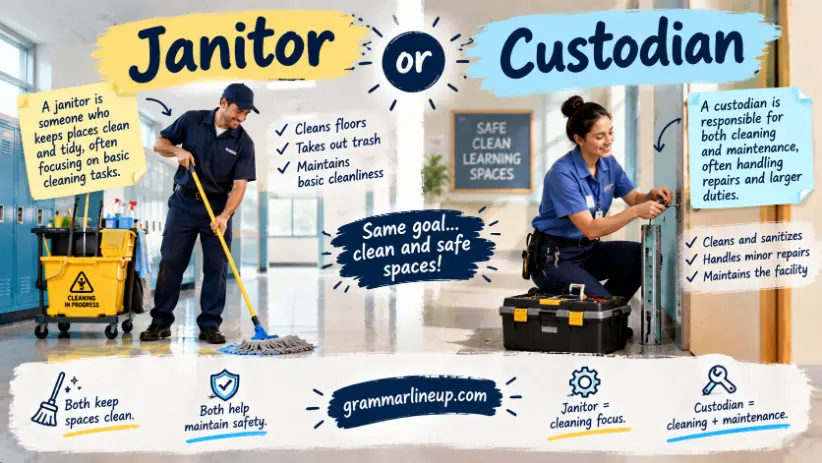
Janitor or custodian? At first glance, these two words seem almost interchangeable and in many everyday situations, they are. Both can describe someone responsible for keeping a building clean, orderly, safe, and well maintained. But there are small differences in meaning, usage, and tone that can make one term more suitable than the other.
The word janitor is common in American English and is often associated with cleaning, routine maintenance, and taking care of schools, offices, apartment buildings, or other facilities. Custodian, meanwhile, can have a broader sense. It may describe someone who not only cleans a property but also helps maintain it, looks after its facilities, or takes responsibility for its general care.
The choice between these words can also depend on region, workplace culture, and the job itself. In some settings, custodian may sound more formal or professional, while janitor remains perfectly natural in everyday conversation.
If you’re unsure which word to use, don’t worry. This guide breaks down janitor vs. custodian in simple language, explains their differences, and provides clear examples so you can choose the right term with confidence.
Janitor and custodian are often interchangeable terms for a person who cleans and maintains a building. In U.S. English, janitor is a common general term, while custodian is frequently used for workers maintaining institutions such as schools and hospitals. The exact job duties depend on the workplace.
What Does “Janitor or Custodian” Mean?
A janitor is a person whose job involves cleaning and taking care of a building. The role may include sweeping, mopping, removing trash, cleaning restrooms, handling supplies, and performing minor maintenance. Cambridge Dictionary describes a janitor as someone employed to take care of a large building and deal with cleaning and repairs.
A custodian can refer to essentially the same kind of worker, particularly in the United States.
The distinction is therefore less about two completely different occupations and more about context, workplace terminology, and the duties assigned by an employer.
For example:
- A person cleaning and maintaining an office building may be called a janitor.
- A worker responsible for maintaining a school may be called a custodian.
- A hospital may employ custodial workers to keep facilities clean and sanitary.
- A job advertisement may use either term depending on the organization’s preferred terminology.
The BLS currently lists both “Custodian” and “Custodial Worker” under its occupational information for Janitors and Building Cleaners.
Janitor vs. Custodian: The Main Difference
The biggest difference is usually usage rather than a strict difference in duties.
| Term | Common meaning | Typical context |
|---|---|---|
| Janitor | Person who cleans and maintains a building | Offices, apartments, businesses, schools, general conversation |
| Custodian | Person responsible for maintaining or caring for a facility | Schools, hospitals, institutions, workplaces |
| Caretaker | Person who looks after a building or property | Especially common in British English |
| Janitorial worker | Worker performing cleaning and related building services | Workplace or service terminology |
| Custodial worker | Worker responsible for cleaning and maintaining facilities | Institutional and professional settings |
Cambridge identifies janitor as mainly a U.S. or Scottish English term and notes that caretaker is usually used in the UK. It also lists custodian as a U.S. term in this building-maintenance sense.
So, if someone says, “The janitor cleaned the hallway,” and another person says, “The custodian cleaned the hallway,” they may be referring to essentially the same type of worker.
What Does a Janitor Do?
A janitor’s responsibilities can extend beyond basic cleaning.
According to the U.S. Bureau of Labor Statistics, janitors and building cleaners may:
- Sweep, mop, or vacuum floors
- Empty trash
- Clean restrooms
- Restock supplies
- Clean spills and other hazards
- Wash windows and other surfaces
- Disinfect frequently touched areas
- Order cleaning supplies
- Perform minor building repairs
- Report major repair needs
- Secure buildings by locking doors
Some workers also perform outdoor tasks such as mowing lawns, clearing snow, or maintaining walkways.
This is why describing every janitor simply as a cleaner can be incomplete. Depending on the workplace, the position can involve general facility maintenance as well.
What Does a Custodian Do?
A custodian may perform many of the same tasks as a janitor.
The word is particularly common when talking about institutional facilities. The BLS specifically states that custodians are janitors or cleaning workers who typically maintain institutional facilities such as schools and hospitals.
A school custodian, for instance, might be responsible for:
- Keeping classrooms clean
- Cleaning bathrooms
- Emptying waste containers
- Maintaining hallways
- Cleaning common areas
- Restocking supplies
- Addressing spills
- Performing minor maintenance
- Helping keep the facility orderly and safe
However, there is no universal rule saying that every custodian performs exactly these tasks. Employers can define positions differently.
Are Janitor and Custodian Synonyms?
Often, yes.
In everyday American English, the two words can overlap significantly. Both can describe someone who cleans and maintains a building.
The important point is that synonyms do not always have identical patterns of use.
For instance, custodian can sound particularly natural in a school or hospital context:
“The school custodian opened the building early.”
Janitor is also perfectly understandable:
“The school janitor opened the building early.”
Neither sentence necessarily describes a completely different occupation.
The difference is primarily one of terminology and context, rather than a fixed division of responsibilities.
Why Do Some Places Prefer “Custodian”?
Organizations sometimes choose custodian because it reflects the broader responsibility of caring for a facility, rather than focusing only on cleaning.
That distinction can matter in professional job titles.
A person who maintains a school may clean rooms, manage supplies, respond to spills, perform minor repairs, secure parts of the building, and help keep the facility in working order. The title custodian can therefore emphasize responsibility for the facility as a whole.
Still, this is not a universal linguistic rule. One employer may use custodian, while another uses janitor for substantially similar work.
The BLS itself illustrates this overlap by classifying custodians within the broader occupational category of janitors and building cleaners.
Janitor or Custodian in American English
For a U.S. audience, both words are standard and understandable.
Use janitor when you want a familiar, straightforward everyday term:
“The janitor cleaned the office after the meeting.”
Use custodian when talking about a school, hospital, or another institution where that job title is commonly used:
“The custodian checked the classrooms before the students arrived.”
If you are writing a job advertisement, company document, school policy, or formal description, it is best to use the official title chosen by the organization.
That is more precise than assuming one term is always more correct.
Janitor or Custodian in British English
Regional usage is another reason the comparison can be confusing.
In British English, caretaker is commonly used for someone who looks after a building. Cambridge specifically identifies caretaker as the usual UK equivalent in this sense, while noting janitor as mainly U.S. or Scottish English.
For example:
American English:
“The school custodian locked the doors.”
British English:
“The school caretaker locked the doors.”
This does not mean janitor is impossible in British English. It means the preferred everyday term can vary by region.
When to Use “Janitor”
Use janitor when:
- You are speaking casually about a building cleaner or maintenance worker.
- The person works in an office, apartment building, business, or other facility.
- You are using a familiar American English term.
- The official job title is actually “janitor.”
Natural sentences
“The janitor cleaned the lobby.”
“We called the janitor after someone spilled coffee in the hallway.”
“The building has a janitor who works overnight.”
“The janitor noticed that one of the lights was broken.”
The word is especially natural in everyday U.S. conversation.
When to Use “Custodian”
Use custodian when:
- The workplace is a school or hospital.
- You are referring to institutional facility maintenance.
- The official position is titled “custodian.”
- You are writing a professional document and that is the organization’s preferred term.
Natural sentences
“The school custodian prepared the gym for the event.”
“The hospital custodian cleaned the common areas.”
“The custodian reported the broken sink to maintenance.”
“The district is hiring a full-time custodian.”
Again, these examples do not mean that a janitor could not perform the same work. The terminology varies by workplace.
When “Janitor” and “Custodian” Are Not Perfect Substitutes
Although the terms often overlap, replacing one with the other can sometimes change the intended meaning or sound unnatural.
For example, custodian has meanings beyond building maintenance. In other contexts, a custodian can be someone responsible for taking care of or holding something, such as property or assets.
The broader concept behind custodian is therefore not limited to cleaning.
Likewise, janitor is strongly associated with building cleaning and maintenance in modern American English.
This is one reason the words should not automatically be treated as interchangeable in every sentence.
Common Misunderstandings
“A janitor only cleans.”
Not necessarily.
Many janitorial positions include maintenance-related responsibilities. BLS information lists tasks such as minor repairs, supply management, building security, and outdoor maintenance alongside cleaning duties.
“A custodian never does cleaning.”
That is also incorrect.
Custodians commonly perform cleaning work. The BLS specifically describes custodians as janitors or cleaning workers who typically maintain institutional facilities.
“Custodian is always more formal than janitor.”
Not necessarily.
Custodian is often used as a professional job title, especially in institutions, but the preferred terminology depends on the employer and context.
“Janitor and custodian are completely different jobs.”
Usually not.
There can be differences between individual positions, but the terms have substantial overlap in U.S. workplace language.
“Caretaker always means the same thing.”
Not quite.
In British English, caretaker commonly refers to someone who looks after a building. In American English, however, caretaker can also refer to someone who takes care of a person, such as an older or sick individual.
Similar Words and Alternatives
Depending on the situation, you may encounter several related terms.
Janitorial worker refers broadly to someone performing janitorial duties.
Custodial worker is commonly used for workers who maintain facilities, especially institutions.
Caretaker is common in British English for someone looking after a building.
Building cleaner is a more descriptive occupational term.
Maintenance worker can overlap with janitorial work but may suggest a stronger focus on repairs and mechanical or facility systems.
Building superintendent can involve cleaning and maintenance but may also include responsibilities such as managing a residential property. The BLS notes that building superintendents can have duties beyond those of typical janitors, including collecting rent or showing vacancies.
These terms should not automatically be treated as exact synonyms because actual responsibilities can differ.
Janitor or Custodian: Which Word Sounds More Natural?
The answer depends on the context.
| Situation | Natural choice |
|---|---|
| Casual U.S. conversation | Janitor |
| School employee | Custodian or janitor |
| Hospital facility worker | Custodian or janitor |
| General office cleaning | Janitor |
| Professional institutional job title | Custodian |
| British building-maintenance context | Caretaker |
| Describing the occupation broadly | Janitor / building cleaner |
There is no universal rule that makes one word correct and the other incorrect.
The official job title and local usage are usually the best guides.
FAQs:
Is a janitor the same as a custodian?
Often, yes. Both can refer to workers who clean and maintain buildings. In U.S. usage, custodian is especially common for institutional facilities such as schools and hospitals, while janitor is a broader everyday term.
Is “custodian” a better word than “janitor”?
Neither word is universally better. The appropriate choice depends on the workplace and the official job title. Both are established terms, and their meanings overlap substantially.
Do janitors do repairs?
Some do minor repairs and maintenance. The BLS lists minor building repairs among the duties that janitors and building cleaners may perform, although responsibilities vary by position.
What do British people call a janitor?
Caretaker is commonly used in British English for someone who looks after a building. Cambridge identifies caretaker as the usual UK term in this context.
Is a school worker called a janitor or custodian?
Either term can be used, but custodian is particularly common in U.S. institutional settings. The BLS specifically describes custodians as workers who typically maintain facilities such as schools and hospitals.
What is the difference between janitorial and custodial?
The terms overlap heavily. Janitorial usually relates to cleaning and maintaining buildings, while custodial can emphasize responsibility for maintaining a facility. In actual workplaces, the two labels may describe very similar duties.
Conclusion:
Janitor and custodian are often two names for essentially the same kind of building-maintenance worker. In American English, janitor is a common general term, while custodian is especially associated with schools, hospitals, and other institutions.
The distinction is mainly about context and workplace terminology, not a universal difference in duties. If you are describing a specific person’s job, the organization’s official title is usually the most accurate choice.
If you are simply choosing a word for everyday U.S. English, janitor is familiar and straightforward, while custodian is particularly natural when discussing institutional facility staff.
