
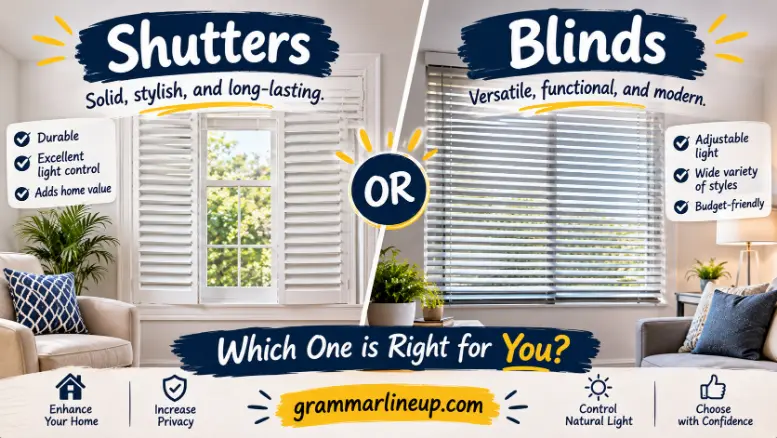
Choosing between shutters or blinds can seem like a small home decision, but the difference can affect light control, privacy, appearance, maintenance, and even how a room feels. Both options can be practical and stylish, yet they work in noticeably different ways.
Shutters are typically solid window coverings with adjustable slats, while blinds usually feature horizontal or vertical slats made from materials such as wood, faux wood, aluminium, or fabric. That basic difference can influence everything from durability to flexibility.
So, which should you choose? The answer depends on your windows, budget, decorating style, and how much control you want over light and privacy. In this guide, we’ll compare shutters and blinds in simple terms, explain their key differences, and help you understand which option may suit your space best.
Shutters and blinds are both window coverings, but they differ in construction and operation. Shutters have a fixed frame with adjustable louvers, while blinds usually have movable slats or fabric sections that can be raised, lowered, tilted, or adjusted. The better choice depends on your priorities, such as privacy, light control, durability, appearance, cleaning, and budget.
Shutters or Blinds: What Is the Difference?
The main difference between shutters and blinds is how they are constructed and how they operate.
Shutters are generally built as a more substantial window covering, often with a frame attached around or within the window opening. Their adjustable louvers can be tilted to control light and privacy. Plantation shutters, for instance, commonly have wider louvers and a solid, built-in appearance.
Blinds typically consist of horizontal or vertical slats, fabric sections, or other flexible components that can be adjusted to control light and privacy. Venetian blinds, roller blinds, Roman blinds, and vertical blinds are common examples.
In simple terms:
- Shutters: More permanent-looking and structured.
- Blinds: Usually more flexible and available in a wider variety of operating styles.
- Both: Can provide privacy, light control, and decorative value.
- Neither: Is automatically the right choice for every window.
The important question is not simply which looks better. It is which type fits the room, window, budget, maintenance needs, and level of light and privacy control you want.
Quick Comparison: Shutters vs Blinds
| Feature | Shutters | Blinds |
|---|---|---|
| Construction | Rigid panels and louvers | Slats, fabric, or flexible sections |
| Appearance | Built-in and substantial | Generally lighter and more varied |
| Light control | Strong | Strong, depending on type |
| Privacy | Strong | Strong |
| Durability | Often very durable | Varies by material and design |
| Cleaning | Usually straightforward | Depends on material and slat design |
| Installation | Can be more involved | Often simpler |
| Style choices | More defined | Very broad |
| Operation | Usually louvers/panels | Tilt, raise, lower, roll, or slide |
| Budget | Often higher | Wide range of prices |
These are broad characteristics rather than universal rules. Materials, construction quality, window size, installation, and the specific product can significantly change the result.
What Are Window Shutters?
Window shutters are rigid window coverings made with panels and adjustable louvers.
One familiar style is the plantation shutter, which generally has wider horizontal louvers and a clean, architectural appearance. Other shutter designs can have different louver sizes, materials, and configurations.
Shutters can be mounted inside or around a window opening, depending on the design and installation requirements.
Their main appeal is their combination of privacy, light adjustment, structure, and visual permanence.
When the louvers are tilted, you can reduce direct sunlight while still allowing some daylight into the room. Closing the louvers can provide greater privacy.
Some shutter systems also allow the panels themselves to open, giving access to the window.
What Are Window Blinds?
Blinds are window coverings that use slats, fabric, or similar materials to regulate light and privacy.
There are many different kinds, including:
- Venetian blinds: Horizontal slats that tilt and usually raise or lower.
- Vertical blinds: Vertical slats that can move sideways and rotate.
- Roller blinds: Fabric or similar material that rolls up and down.
- Roman blinds: Fabric that folds into sections as it is raised.
- Mini blinds: Blinds with relatively narrow horizontal slats.
- Wood or faux-wood blinds: Slatted blinds designed to provide a more substantial appearance.
Because “blinds” describes a broad category, two blind products can behave and look very differently.
That makes blinds particularly versatile when you are trying to match a specific window, decorating style, or budget.
Shutters or Blinds for Light Control
Both can provide effective light control, but the experience is different.
Shutters allow you to adjust the angle of the louvers. This can let you direct or reduce incoming light while maintaining some visibility through the window.
Blinds offer similar control in many designs. Venetian-style blinds, for example, allow the slats to tilt, while roller blinds primarily control light by raising or lowering the fabric.
The best option depends on the type of light control you want.
If you like the ability to fine-tune the direction and amount of light, adjustable-louver shutters or slatted blinds can both work well.
If you want a simple solution that can quickly make a room darker, a suitable roller blind may be more convenient.
Shutters or Blinds for Privacy
Privacy is another area where both choices can work well.
With shutters, the louvers can be tilted so that people outside have less visibility into the room while daylight can still enter.
Many slatted blinds offer a similar function.
However, privacy also depends on the window’s position, the direction of the louvers or slats, the surrounding buildings, and the material.
For example, a bedroom facing a busy street may require different privacy control from a living-room window overlooking a private garden.
The important point is that the type of window covering alone does not determine privacy. Correct sizing, installation, positioning, and adjustment matter too.
Shutters or Blinds for Durability
Durability depends heavily on material and construction quality.
A well-made shutter can be a substantial, long-term window treatment. Its rigid frame and panels can give it a more permanent character than many lightweight blinds.
Blinds vary much more widely. A basic lightweight blind and a high-quality wood or faux-wood blind should not be treated as equivalent products.
Consider:
- Material quality
- Hardware
- Hinges and operating mechanisms
- Exposure to sunlight
- Moisture levels
- Frequency of use
- Installation quality
- Cleaning and maintenance
A durable product is not necessarily the product that costs the most. Construction and suitability for the room are important.
Shutters or Blinds for Cleaning
Cleaning needs vary by material and design.
Shutters often have relatively accessible louvers that can be dusted or wiped. Their rigid construction can also make them straightforward to clean.
Blinds may require more attention because individual slats can collect dust. Fabric blinds may require a different cleaning approach from metal, vinyl, wood, or faux-wood blinds.
For either option, follow the manufacturer’s cleaning instructions. Certain finishes or materials can be damaged by excessive moisture or unsuitable cleaning products.
If easy routine cleaning is a major priority, look closely at the actual material and construction rather than choosing solely based on whether something is called a shutter or blind.
Shutters or Blinds for Style
Style is subjective, but the two categories often create different visual impressions.
Shutters tend to give windows a structured, built-in appearance. They can work particularly well with interiors where architectural simplicity is important.
Blinds offer more variety. You can find different colors, textures, materials, slat widths, and operating styles.
That makes blinds useful when you want to coordinate window coverings with a specific decorating scheme.
Neither category has a universal style advantage. A modern home, traditional room, rental property, bedroom, kitchen, or office can each call for a different solution.
Shutters or Blinds for Bedrooms
Bedrooms commonly need privacy and effective control over incoming light.
Shutters can provide both through adjustable louvers and a more substantial window covering.
Blinds can also work very well, particularly when paired with a design intended to reduce incoming daylight.
For a bedroom, consider:
- How much morning light enters the room
- Whether outside privacy is important
- Whether the window is frequently opened
- How easy the covering is to operate
- Whether the material suits the room’s moisture and temperature conditions
If darkness is particularly important, focus on the actual light-blocking characteristics of the chosen product rather than assuming that every shutter or blind performs the same way.
Shutters or Blinds for Living Rooms
Living rooms often need a balance between natural light, privacy, appearance, and convenience.
Shutters can provide a strong architectural look and allow you to adjust the louvers throughout the day.
Blinds provide more design flexibility and can be combined with curtains or other window treatments.
Large windows may also require special consideration. The weight, span, operating mechanism, and mounting method can affect which products are practical.
For a living room, it is useful to think about how the window looks when the covering is open, partially closed, and fully closed.
Shutters or Blinds for Bathrooms and Kitchens
Moisture changes the equation.
Bathrooms and kitchens can expose window coverings to humidity, steam, splashes, grease, and temperature changes.
The material therefore matters considerably.
A moisture-suitable blind or shutter may be more appropriate than a product that is vulnerable to water or humidity.
For these rooms, check the manufacturer’s recommendations before choosing a material. A product that performs well in a dry bedroom may not be suitable for a humid bathroom.
Do Shutters or Blinds Help With Insulation?
Window coverings can influence how a room feels, but their insulating performance varies considerably.
The result depends on factors such as:
- Window construction
- Glass type
- Gaps around the covering
- Material
- Product design
- Installation
- Climate
- How the covering is used
A window covering should not be treated as a replacement for properly insulated glazing or other building measures.
If energy efficiency is your main concern, examine the complete window system rather than choosing between shutters and blinds based on the product name alone.
Common Misunderstandings About Shutters and Blinds
“Shutters and blinds are basically the same.”
They serve a similar general purpose, but they are constructed differently.
Shutters are usually more rigid and architectural, while blinds cover a much broader range of flexible or slatted window treatments.
“Blinds are always cheaper.”
Not necessarily.
“Blinds” includes inexpensive and premium products, while shutter prices also vary according to material, size, configuration, and installation.
“Shutters always block more light.”
Not automatically.
Light control depends on the specific product, louver or slat design, installation, and gaps around the window covering.
“Any blind works in a bathroom.”
Material suitability matters. Humidity and moisture can affect some products, so manufacturer guidance is important.
“The most expensive option is automatically the best.”
Cost does not guarantee suitability. The best choice depends on what you need the window covering to do.
When Should You Choose Shutters?
Shutters may make sense if you value:
- A substantial, built-in appearance
- Adjustable louvers
- Long-term use
- A consistent architectural look
- Strong privacy control
- A window covering that feels like part of the room’s design
They can be particularly appealing when you want the window treatment to become a noticeable part of the interior rather than simply functioning as a temporary covering.
When Should You Choose Blinds?
Blinds may make sense if you value:
- A wide range of designs
- Different operating mechanisms
- Flexible material choices
- A broad range of price points
- Simple solutions for different types of windows
- Easy matching with existing décor
Because blinds encompass so many styles, they can be a practical choice when you want to compare several different designs before committing.
Shutters or Blinds: How to Decide
Instead of asking which one is universally better, start with the job the window covering needs to perform.
Ask yourself:
- How much privacy do I need?
- How much daylight do I want?
- Do I need precise light direction?
- Is the room humid?
- How often will the covering be operated?
- Do I prefer a built-in appearance?
- How much maintenance am I comfortable with?
- What is my realistic budget?
- Does the window have an unusual shape or size?
- Will the covering be installed inside or outside the window recess?
These questions usually narrow the options much faster than choosing based on appearance alone.
FAQs:
Are shutters better than blinds?
There is no universal answer. Shutters and blinds have different construction, operating styles, materials, and price ranges. The appropriate choice depends on the window, room, privacy needs, light control, appearance, maintenance, and budget.
Do shutters last longer than blinds?
A well-made shutter can be highly durable, but durability varies by material, construction, installation, and use. Some high-quality blinds can also provide long service. Comparing the specific products is more meaningful than comparing the categories alone.
Are shutters more expensive than blinds?
Shutters can cost more than some types of blinds, particularly when they involve substantial frames, custom sizing, or professional installation. However, blind prices also range widely, so there is no universal price difference.
Which is easier to clean, shutters or blinds?
Both can be relatively easy to maintain. Shutters often have accessible rigid louvers, while blinds may have many individual slats or fabric surfaces. The material and design determine the actual cleaning requirements.
Are blinds or shutters better for privacy?
Both can provide strong privacy when correctly sized and adjusted. Slatted blinds and shutter louvers allow you to control visibility, while the final result depends on the window’s position, product design, and installation.
Can shutters and blinds be used together?
Yes. Different window treatments can be combined when their designs and mounting arrangements are compatible. For example, a homeowner may use a rigid window treatment with another covering to achieve a particular combination of privacy, light control, or decoration.
Conclusion:
Shutters or blinds is not simply a choice between two names for the same product.
Shutters are generally more rigid, substantial, and architectural, with adjustable louvers that provide privacy and light control. Blinds cover a much broader family of window treatments, offering many materials, designs, mechanisms, and price points.
Choose based on the specific window and the job it needs to do.
If you want a structured, built-in appearance and adjustable louvers, shutters may suit your priorities. If you want broader design flexibility and more types of operating systems, blinds may give you more options.
The smartest comparison is ultimately between the specific shutter and blind products you are considering not between the category names alone.
