
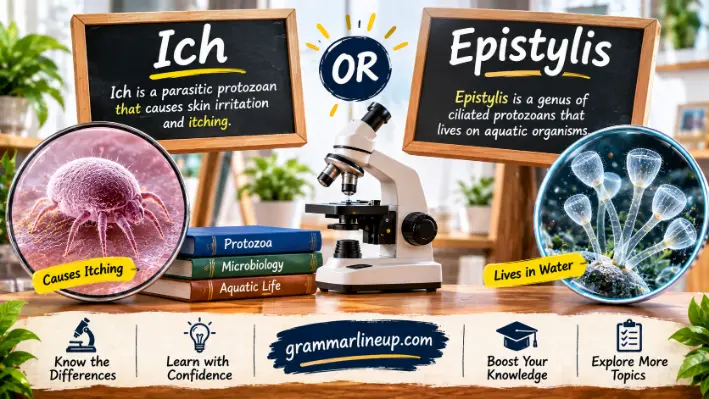
If you’re trying to understand ich or epistylis, you’re probably dealing with two conditions that can look surprisingly similar, especially when viewing spots or growths on a fish. At a glance, both may appear as small white or pale patches, which can make it difficult to know what you’re actually seeing. However, they are not the same thing, and telling them apart matters when deciding what the situation may involve.
Ich, commonly called white spot disease, is associated with a parasitic infection. Epistylis, on the other hand, is a colony-forming organism that can grow on fish, often when water conditions or the fish’s health create favorable circumstances. Their appearance can overlap, but their underlying causes and typical patterns can differ.
In this guide, we’ll compare ich and epistylis in clear, straightforward language. You’ll learn how they differ in appearance, possible causes, common signs, and the clues that can help you distinguish one from the other. The goal is to make this confusing comparison easier to understand without relying on guesswork.
Ich and Epistylis can both cause white spots on aquarium fish, but they are different conditions. Ich is caused by the parasite Ichthyophthirius multifiliis, while Epistylis is a stalked ciliate that commonly grows on damaged tissue. Their appearance can overlap, so symptoms alone may not always provide a reliable diagnosis.
Ich or Epistylis: Meaning, Differences & Identification
The terms ich and Epistylis are often confused because both can be associated with white spots or pale growths on freshwater fish.
They are not the same disease.
Ich, commonly called white spot disease, is caused by the protozoan parasite Ichthyophthirius multifiliis. The organism attaches to the fish and feeds within the outer tissues before eventually leaving the host as part of its life cycle.
Epistylis refers to a group of stalked, colony-forming ciliates. These organisms can attach to surfaces in aquatic environments, including fish. Their presence on fish is often associated with damaged tissue, poor environmental conditions, or an underlying problem rather than being equivalent to ich.
This distinction matters because a treatment that is appropriate for ich should not automatically be assumed to be appropriate for Epistylis.
Quick Answer
| Feature | Ich | Epistylis |
|---|---|---|
| What it is | Parasitic infection | Stalked ciliate growth |
| Common organism | Ichthyophthirius multifiliis | Epistylis species |
| Typical appearance | Small white spots | White or grayish tufts/growths |
| Life cycle | Has distinct free-living and fish-associated stages | Commonly grows on surfaces and attached material |
| Main concern | Parasite infection | Often associated with damaged tissue or environmental problems |
| Treatment approach | Requires treatment targeting ich | Requires addressing the underlying conditions as well as the organism |
The biggest takeaway is simple: white spots do not automatically mean ich.
What Is Ich?
Ich is the common name for infection with Ichthyophthirius multifiliis, a ciliated protozoan parasite that affects freshwater fish.
It is one of the best-known parasitic diseases in aquarium fish.
The parasite has several stages in its life cycle. One stage is visible as a spot on the fish, while other stages occur away from the fish. This life cycle is important because treatments may affect some stages more effectively than others.
Common signs can include:
- Small white spots resembling grains of salt
- Scratching or rubbing against aquarium objects
- Increased breathing or respiratory distress in serious cases
- Clamped fins
- Reduced activity
- Loss of appetite
- Increased mucus production
- General stress
The exact presentation can vary depending on the fish species, severity, and location of the infection.
A particularly important point is that ich is a parasite, not a bacterial infection.
What Is Epistylis?
Epistylis is a genus of stalked ciliates rather than the parasite responsible for ich.
Epistylis organisms can live attached to surfaces in aquatic environments. Under certain conditions, they may become conspicuous on fish, especially where tissue has already been damaged.
This can create a visual problem for aquarium keepers: Epistylis may resemble the white spots associated with ich.
However, the two organisms have different biology.
Epistylis may appear as:
- White or grayish patches
- Tuft-like or fuzzy growths
- Irregular growth rather than neat, individual spots
- Growth concentrated around damaged or irritated areas
Environmental conditions can be highly relevant when Epistylis is suspected. Poor water quality, organic waste, overcrowding, or an underlying injury or infection may contribute to the conditions in which these organisms become noticeable.
That means simply trying to eliminate the visible growth may not address the underlying problem.
How Can You Tell Ich and Epistylis Apart?
Appearance can provide clues, but visual identification is not always definitive.
Ich often looks like individual grains of salt
Classic ich is frequently described as producing numerous small white spots.
The spots may appear across the:
- Body
- Fins
- Gills
Fish may also become noticeably irritated and scratch themselves against surfaces.
Epistylis can look more irregular
Epistylis-associated growth may appear more like a tuft, patch, or fuzzy protrusion than evenly distributed salt-like dots.
It can also be particularly noticeable on areas that are already damaged.
Location can provide a clue
Where the growth appears can help distinguish the possibilities.
For example, an irregular growth concentrated around an injury may raise different questions from numerous small spots spread across the fins and body.
But location alone should not be treated as a diagnosis.
A microscope can provide much better evidence
When a fish disease is difficult to identify visually, microscopic examination can be far more informative than relying on photographs or appearance alone.
This is especially important because different parasites, ciliates, fungal growths, bacterial problems, and tissue changes can sometimes look surprisingly similar.
Why the Confusion Matters
The confusion between ich and Epistylis is more than a vocabulary issue.
The two conditions involve different organisms and different biological relationships with the fish.
If an aquarist assumes every white mark is ich, they may focus entirely on an anti-ich treatment while overlooking water quality, tissue damage, or another underlying disease process.
Conversely, assuming every fuzzy white growth is Epistylis can also lead to a mistaken diagnosis.
A better approach is to ask:
- What exactly does the growth look like?
- Where is it located?
- Are the spots individual or clustered?
- Is the fish scratching?
- Are the gills affected?
- Has the fish recently been injured?
- What are the aquarium’s water-quality parameters?
- Are other fish showing similar signs?
- Did symptoms appear suddenly or gradually?
- Can the organism be examined microscopically?
This approach focuses on the cause, rather than simply treating the most recognizable visual symptom.
Common Symptoms That Can Overlap
Some signs are not specific enough to distinguish the two conditions on their own.
White marks
Both conditions can be associated with conspicuous pale or white material on fish.
The important distinction is what is producing the appearance, not merely its color.
Skin irritation
Fish affected by different external problems may rub against rocks, decorations, or aquarium walls.
This behavior can indicate irritation but does not identify the exact cause.
Reduced activity
A stressed or sick fish may become less active regardless of whether the underlying problem is parasitic, bacterial, environmental, or otherwise.
Loss of appetite
Changes in feeding behavior are another general sign of illness.
For this reason, symptoms should be considered together rather than treated as isolated diagnostic tests.
Treatment Considerations
Treatment should depend on the suspected cause.
If ich is suspected
Ich treatment generally targets the parasite and its life cycle.
Because Ichthyophthirius multifiliis has stages that occur away from the fish, treatment may need to be continued according to the instructions for the specific product and the biology of the parasite.
Aquarium keepers should also consider:
- Water quality
- Temperature requirements of the fish
- Filtration
- Stress
- Tank hygiene
- Whether other fish have been exposed
Medication should always be used according to the product label and with attention to species-specific sensitivity.
If Epistylis is suspected
The approach can be different.
Rather than treating the visible growth as though it were automatically ich, the aquarist should investigate why the fish is developing the conditions associated with Epistylis.
Important considerations can include:
- Ammonia and nitrite
- Nitrate accumulation
- Organic waste
- Overcrowding
- Recent injury
- Existing infection
- General husbandry
- Stress
Improving environmental conditions can therefore be an important part of addressing the problem.
When the diagnosis is uncertain, professional veterinary or aquatic-animal guidance is preferable to repeatedly switching medications.
Why Water Quality Matters
Water quality is central to aquarium health regardless of the specific diagnosis.
Poor environmental conditions can stress fish and contribute to susceptibility to disease or secondary problems.
Useful parameters to monitor can include:
- Ammonia
- Nitrite
- Nitrate
- pH
- Temperature
- Dissolved oxygen, where relevant
The ideal range depends on the fish species and aquarium system, so there is no single “perfect” value that applies to every aquarium.
A test kit can provide information that visual inspection cannot.
For example, a fish covered in unusual growths may have an underlying environmental problem that is invisible from the outside.
Common Misunderstandings
“Every white spot is ich.”
Not necessarily.
Ich is a major cause of white spots, but white or pale material can have several causes.
“Epistylis is just another name for ich.”
It isn’t.
Ich is associated with Ichthyophthirius multifiliis. Epistylis refers to a different group of ciliates.
“If medicine does not work, I should simply use more.”
Increasing or combining medications without understanding the diagnosis can create additional problems.
Some fish are sensitive to particular chemicals, and medications can affect biological filtration or interact with other treatments.
“A photograph always gives the diagnosis.”
Photos can be useful, but they may not distinguish between visually similar organisms.
Microscopic examination can be necessary when an accurate identification matters.
“The visible organism is always the original problem.”
Not necessarily.
An organism growing on damaged tissue may be a secondary finding rather than the initial cause of the fish’s illness.
How to Reduce the Risk of Aquarium Disease
Good aquarium management cannot guarantee that fish will never become sick, but it can reduce avoidable stress and environmental problems.
Maintain stable water conditions
Regular testing and appropriate maintenance help identify problems before they become severe.
Avoid overcrowding
Too many fish can increase waste production, competition, stress, and disease pressure.
Quarantine new fish when appropriate
Separating new arrivals can reduce the chance of introducing infectious organisms into an established aquarium.
Feed appropriately
Overfeeding can contribute to excess organic waste and deteriorating water quality.
Remove dead or decaying material
Prompt maintenance can help keep the aquarium environment cleaner.
Watch fish behavior
Changes in swimming, feeding, breathing, or interaction can provide early warning signs.
Similar Terms You May Encounter
Understanding related terminology can make aquarium disease discussions much easier.
- Ich — Common name for infection caused by Ichthyophthirius multifiliis.
- White spot disease — Another common name for ich.
- Epistylis — A genus of stalked ciliates that can occur in aquatic environments and may become conspicuous on fish.
- Ciliate — A type of single-celled organism characterized by cilia.
- Parasite — An organism that lives in or on a host and obtains resources from that relationship.
- Secondary infection — An infection that develops after another condition has damaged or weakened tissue.
These terms should not be treated as interchangeable.
FAQs:
Is Epistylis the same as ich?
No. Ich is caused by Ichthyophthirius multifiliis, while Epistylis refers to a different group of stalked ciliates. They can sometimes create similar-looking white growths on fish.
Does Epistylis look like white spots?
It can appear as white or grayish material on fish, but its appearance may be more irregular, tuft-like, or fuzzy than the classic small spots associated with ich.
Can you identify ich or Epistylis by appearance alone?
Sometimes appearance provides useful clues, but it is not always enough for a reliable diagnosis. Microscopic examination can help distinguish organisms that look similar.
What should I check if my fish develops white growths?
Check water quality, including ammonia, nitrite, nitrate, pH, and temperature as appropriate for the species. Also look for injuries, behavioral changes, respiratory problems, and signs affecting other fish.
Should I treat every white spot as ich?
No. A white mark can have multiple causes. Before choosing medication, consider the appearance, distribution, fish behavior, aquarium conditions, and available diagnostic evidence.
Why can Epistylis appear on an injured fish?
Epistylis organisms can attach to surfaces in aquatic environments, and conspicuous growth on damaged tissue may occur under favorable conditions. The underlying injury or environmental problem should therefore also be investigated.
Conclusion:
Ich and Epistylis are different organisms that can sometimes produce confusingly similar appearances on aquarium fish.
Ich is the parasitic disease caused by Ichthyophthirius multifiliis. Epistylis refers to stalked ciliates that can become visible on fish, particularly in association with damaged tissue and unfavorable conditions.
The most useful distinction is not simply “white spot versus white spot.” Look at the shape, distribution, behavior of the fish, environmental conditions, and progression of the problem.
When the diagnosis is uncertain or the fish is seriously ill, microscopic examination or advice from an aquatic veterinarian can provide a much more reliable answer than guessing from appearance alone.
