
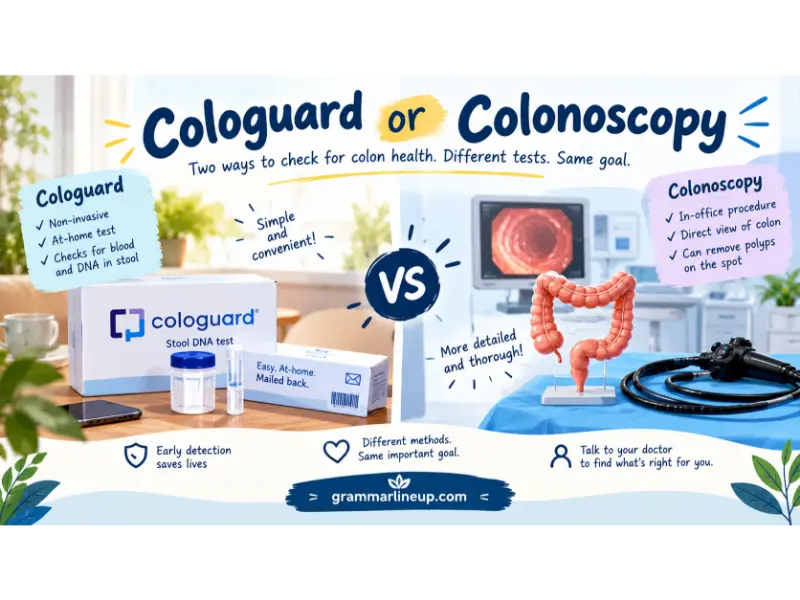
When it comes to colorectal cancer screening, Cologuard and colonoscopy are two options that often come up. While both can play a role in screening, they work in very different ways. Cologuard is a stool based test that looks for certain signs linked to colorectal cancer, while a colonoscopy allows a healthcare professional to examine the colon directly.
Choosing between Cologuard or colonoscopy can depend on factors such as your age, health history, screening needs, and personal preferences. Each option has benefits, limitations, and different follow up requirements.
Understanding these differences can make the conversation with your healthcare provider much easier.
In this guide, we will compare Cologuard and colonoscopy in clear, straightforward language. You will learn how each test works, what the process involves, how their results differ, and why a healthcare professional may recommend one over the other.
The goal is to help you understand your screening options without making the subject more confusing than it needs to be.
Featured Snippet Answer
Cologuard is a stool-based colorectal cancer screening test, while a colonoscopy directly examines the colon and can remove many polyps during the procedure. For average-risk adults, both are recognized screening options, but they differ in preparation, frequency, follow-up, and what happens after an abnormal result.
Cologuard or Colonoscopy: Quick Answer
👍Cologuard and colonoscopy are both used for colorectal cancer screening, but they serve different purposes.
Cologuard is a noninvasive stool-based test. It analyzes a whole stool sample for certain DNA markers associated with colorectal neoplasia and for hidden blood.
Colonoscopy is a procedure in which a clinician uses a flexible instrument to examine the rectum and entire colon. Polyps and some other abnormal growths can often be removed during the same procedure.
For average-risk adults, U.S. guidance includes both stool-based screening strategies and colonoscopy among recommended options.
One major distinction is what happens after an abnormal result. A positive Cologuard result generally needs follow-up with a colonoscopy. In other words, choosing a stool test does not necessarily eliminate the possibility of eventually having a colonoscopy.
What Is Cologuard?
Cologuard is a branded stool-based colorectal cancer screening test. It combines testing for certain altered DNA markers in stool with testing for occult, or hidden, blood.
The sample is collected at home using the manufacturer’s collection kit and then sent to a laboratory.
The test is intended for adults age 45 and older who are considered at average risk for colorectal cancer. It is not intended to replace diagnostic or surveillance colonoscopy for people at higher risk or for people who need colonoscopy for another medical reason.
That distinction matters because screening and diagnosis are not always the same thing.
Screening looks for signs of disease in people who may not have symptoms. A diagnostic evaluation is used when symptoms, an abnormal screening result, or another concern requires further investigation.
What Is a Colonoscopy?
A colonoscopy allows a healthcare professional to examine the lining of the entire colon and rectum using a flexible, lighted instrument.
Before the procedure, the colon usually needs to be thoroughly cleaned. This involves bowel preparation, which is one of the biggest practical differences between colonoscopy and an at-home stool test.
During a colonoscopy, the clinician can look for abnormal tissue and remove many polyps during the same procedure.
This gives colonoscopy an important role not only in detecting abnormalities but also in removing many precancerous polyps before they can potentially develop into cancer.
A colonoscopy can also be used as a follow-up procedure after certain abnormal stool-based screening results.
Cologuard vs. Colonoscopy at a Glance
| Feature | Cologuard | Colonoscopy |
|---|---|---|
| Type | Stool-based screening test | Direct examination of the colon |
| Where it starts | At home | Medical facility |
| Sample or procedure | Whole stool sample | Flexible scope examination |
| Bowel preparation | No colonoscopy-style bowel prep | Usually required |
| Can directly view the colon? | No | Yes |
| Can remove many polyps during the test? | No | Yes |
| Typical screening interval for average-risk adults | Every 3 years | Every 10 years |
| What if the screening result is positive? | Follow-up colonoscopy is needed | Abnormal findings can often be evaluated or treated during the procedure |
The intervals above are general U.S. screening intervals for average-risk adults. Individual recommendations can differ based on personal and family history, previous findings, symptoms, and other risk factors.
How Cologuard and Colonoscopy Differ
Preparation
Preparation is one of the most noticeable differences.
With Cologuard, the collection process takes place at home. You collect the required stool sample and send it to the laboratory according to the kit’s instructions.
Colonoscopy generally requires bowel preparation beforehand. The goal is to clear the colon so the clinician can see its lining properly.
For many people, the preparation is one of the biggest factors they consider when discussing screening options.
What the Test Can Detect
Cologuard looks for specific stool-based signals associated with colorectal cancer and certain precancerous lesions.
Colonoscopy allows the clinician to directly inspect the colon for polyps, tumors, and other abnormalities.
Because the tests work differently, their results should not be interpreted as though they are simply two versions of the same examination.
What Happens After an Abnormal Result
A positive Cologuard result does not by itself mean that someone has colorectal cancer.
It means that follow-up evaluation is needed. According to the test’s indications, a positive result should be followed by colonoscopy.
This is an important point for anyone comparing the two options: a stool-based screening test can be a first step, but an abnormal result can lead to the very procedure someone hoped to avoid.
How Often Are They Done?
For average-risk adults using these particular screening strategies, the CDC lists:
- FIT-DNA testing: every 3 years
- Colonoscopy: every 10 years
These are not universal schedules for every person.
People with increased colorectal cancer risk may need different testing, earlier screening, or more frequent surveillance. Factors can include a personal or family history of colorectal cancer or certain polyps, inflammatory bowel disease, or inherited cancer syndromes.
Your previous screening results can also change what happens next.
Which One Is More Convenient?
Convenience depends on what you personally consider difficult.
Cologuard removes the need for a colonoscopy appointment and is collected at home. That can make the initial screening process more convenient for some people.
Colonoscopy requires more preparation and a medical appointment, but it provides a direct examination and allows many polyps to be removed during the procedure.
There is also an important difference in what happens if Cologuard is positive. A positive stool test requires follow-up colonoscopy, so the initial convenience does not necessarily mean that a colonoscopy will never be needed.
Is Cologuard a Replacement for Colonoscopy?
No—not in every situation.
Cologuard is a screening option for certain average-risk adults. It is not a replacement for diagnostic or surveillance colonoscopy when colonoscopy is medically indicated.
It is also not intended for certain higher-risk groups.
For example, Cologuard’s current risk information says it is not intended for people with certain personal histories of adenomas, inflammatory bowel disease, hereditary syndromes, or certain family histories of colorectal cancer.
That is why a person should not choose between the tests based only on convenience.
The appropriate screening method depends partly on whether you are considered average risk and whether there is another reason you may need direct examination of the colon.
What About Age and Colorectal Cancer Screening?
In the United States, the CDC reports that most people should begin colorectal cancer screening at age 45.
The USPSTF recommends screening adults ages 45 to 75. For adults ages 76 to 85, the decision is individualized based on factors such as overall health, previous screening history, and preferences.
These recommendations apply to screening populations and do not mean that everyone under 45 or over 75 has exactly the same medical needs.
People with certain risk factors may need to begin screening earlier or follow a different schedule.
When Cologuard May Come Up in a Screening Discussion
Cologuard may be discussed when an average-risk adult is considering a stool-based screening option.
It may appeal to someone who prefers an at-home test and wants to avoid an initial invasive procedure.
However, convenience should be considered alongside limitations.
A stool test does not provide the same direct visual examination as colonoscopy. It also cannot remove a polyp during collection and testing.
And a positive result generally means another procedure is needed.
When Colonoscopy May Be Recommended
Colonoscopy may be particularly relevant when direct examination of the colon is medically appropriate.
It is also commonly used as the follow-up examination after an abnormal stool-based screening test.
Because colonoscopy can identify abnormalities and remove many polyps during the procedure, it can play both a detection and intervention role.
It can also be used for diagnostic or surveillance purposes, which is different from routine screening in an average-risk person without symptoms.
Symptoms Change the Question
If you have symptoms such as blood in or on the stool, persistent changes in bowel habits, ongoing abdominal pain or cramping, unexplained weight loss, or anemia, the question may no longer be simply “Cologuard or colonoscopy?”
Screening tests are intended for people without symptoms. Symptoms may require a healthcare professional to determine whether diagnostic testing is appropriate.
Don’t use a home screening test as a substitute for medical evaluation of concerning symptoms.
Common Misunderstandings
“A positive Cologuard result means I have cancer.”
Not necessarily.
A positive result indicates that follow-up is needed because the test detected findings that can be associated with colorectal cancer or advanced precancerous lesions. Colonoscopy is generally needed to determine what is actually present.
“If Cologuard is negative, I never need a colonoscopy.”
Not necessarily.
A negative screening result does not guarantee that a person will never need colonoscopy. Future screening, symptoms, risk factors, or other medical findings can change the appropriate testing plan.
“Colonoscopy is only for people who have symptoms.”
No.
Colonoscopy can be used for routine colorectal cancer screening as well as diagnostic and surveillance purposes.
“Cologuard and colonoscopy look for exactly the same thing.”
They are designed differently.
Cologuard analyzes stool for specific markers, while colonoscopy allows direct examination of the colon.
“Everyone should follow the same screening schedule.”
No.
Screening intervals and methods can vary depending on risk, age, previous findings, symptoms, and medical history.
Cologuard or Colonoscopy: Questions to Ask Your Doctor
If you’re deciding between screening options, consider asking:
- Am I considered average risk for colorectal cancer?
- When should I begin screening?
- Which screening options are appropriate for me?
- How often would I need this test?
- What preparation is required?
- What happens if the result is positive?
- Do my family or personal medical histories change the recommendation?
- Do any of my symptoms require diagnostic testing instead of routine screening?
- What will my insurance cover?
These questions can help turn a general comparison into a decision based on your actual circumstances.
FAQs:
Is Cologuard better than a colonoscopy?
There is no single answer that applies to everyone. Cologuard and colonoscopy are different screening approaches with different preparation requirements, procedures, intervals, and follow-up pathways. The appropriate option depends on individual risk and medical circumstances.
How often do you need Cologuard?
For average-risk adults using the FIT-DNA screening strategy, the CDC lists testing every three years. Your healthcare professional may recommend a different approach depending on your risk factors or medical history.
How often should an average-risk adult have a colonoscopy?
The CDC lists colonoscopy every 10 years for people without increased colorectal cancer risk. Individual recommendations may differ.
What happens if Cologuard is positive?
A positive Cologuard result should be followed by a colonoscopy. A positive result does not automatically mean that colorectal cancer is present.
Can Cologuard find polyps?
Cologuard is designed to detect certain markers associated with colorectal neoplasia, including markers associated with advanced precancerous lesions. Unlike colonoscopy, it does not directly examine the colon or remove polyps.
Can you use Cologuard if you have a higher risk of colorectal cancer?
Not necessarily. Cologuard is indicated for average-risk adults and is not intended to replace diagnostic or surveillance colonoscopy in higher-risk individuals. People with certain personal or family histories and medical conditions may need a different screening strategy.
Final Takeaway:
Cologuard or colonoscopy isn’t simply a choice between an easy test and a difficult one. They are different screening tools with different strengths, limitations, preparation requirements, and follow-up pathways.
Cologuard is a stool-based option that can be completed at home, while colonoscopy directly examines the colon and can allow many polyps to be removed during the procedure.
For average-risk adults, both are recognized colorectal cancer screening options in U.S. guidance. But if a Cologuard result is positive, follow-up colonoscopy is generally required. And if you have symptoms or higher-risk medical or family history, your healthcare professional may recommend a diagnostic or surveillance approach rather than routine stool screening.
The most useful question isn’t simply “Which test is better?” It’s “Which screening approach is appropriate for my risk level and medical situation?”
