
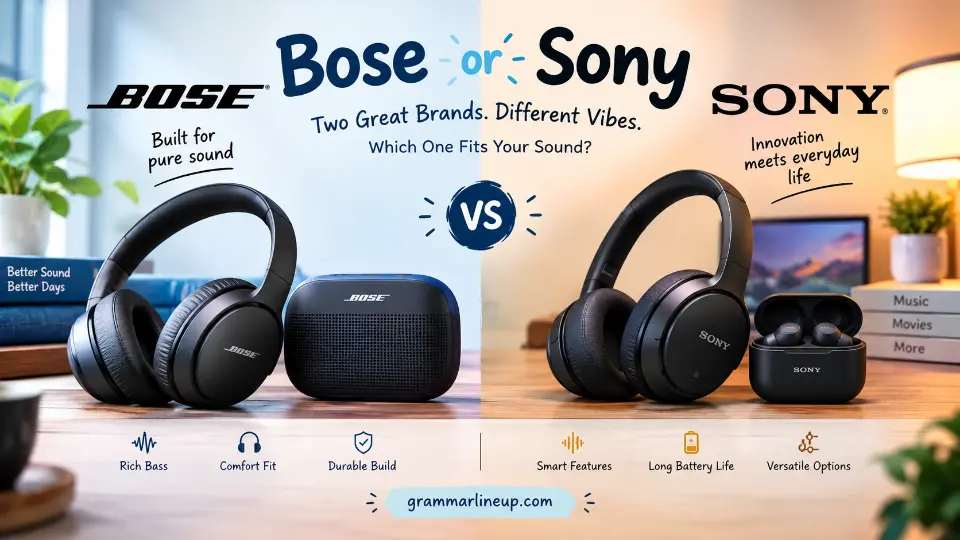
Choosing between Bose and Sony can be tricky because both brands offer headphones and earbuds with impressive sound quality, noise cancellation, and comfortable designs.
However, the best choice depends on what matters most to you. Some listeners prefer Bose for its noise cancellation and comfort, while others lean toward Sony for its sound customization, features, and variety of options.
Whether you need headphones for travelling, working, studying, exercising, or enjoying music at home, comparing these brands can help you make a smarter decision. Price, battery life, sound preferences, and everyday usability are all worth considering before you buy.
In this guide, we will compare Bose and Sony across their key features, strengths, and potential drawbacks. By the end, you will have a clearer idea of which brand suits your needs, listening habits, and budget best.
Bose or Sony depends on what matters most to you. Sony’s current WH-1000XM6 emphasizes noise isolation, microphone performance, controls, codecs, and customization. Bose’s QuietComfort Ultra Headphones (2nd Gen) emphasize comfort, spacious ear cups, and a different approach to sound and listening modes. For either brand, compare the exact model rather than the brand name alone.
Bose or Sony: Quick Answer
If you are comparing premium wireless headphones, Bose and Sony are both established choices, but they approach the listening experience differently.
The Sony WH-1000XM6 offers features including multipoint connectivity, ambient sound mode, LDAC support, and passive wired operation. Sony lists the headphones at approximately 8.96 ounces and provides a frequency response extending to 40 kHz with LDAC under its specified conditions.
Bose’s QuietComfort Ultra Headphones (2nd Gen) offer features such as multiple listening modes, ActiveSense, Bose Immersive Audio, CustomTune, Bluetooth multipoint, and a stated battery life of up to 30 hours.
The important point is that “Bose or Sony” is really a model-by-model question. A Bose flagship may differ significantly from a lower-priced Bose model, just as the Sony WH-1000XM6 is a different proposition from Sony’s ULT WEAR range.
Bose vs Sony: The Main Differences
| Category | Bose | Sony |
|---|---|---|
| Noise cancellation | Excellent ANC across its premium range | Excellent ANC, with strong performance from current flagship models |
| Comfort | Often emphasizes plush comfort and spacious ear cups | Comfortable, but fit varies by listener |
| Sound | Generally warm and customizable depending on model | Warm sound with strong customization options |
| Microphones | Good, but performance varies by model | Current flagship models perform strongly for calls |
| EQ/customization | Available through Bose app on supported models | Extensive customization through Sony’s app |
| Connectivity | Bluetooth multipoint on supported models | Multipoint plus broad codec support on current models |
| Battery | Varies considerably by model | Varies by model |
| Immersive/spatial features | Bose Immersive Audio on supported models | Sony offers several spatial and processing features |
| Controls | Physical controls on some Bose models | Touch and physical controls vary by model |
| Best comparison approach | Compare the exact Bose model | Compare the exact Sony model |
Independent testing of the current flagship models describes the differences as relatively close in several areas, with Sony showing advantages in noise isolation and customization while Bose provides notable comfort and fit benefits.
Which Is Better for Noise Cancellation?
Noise cancellation, or ANC (active noise cancellation), is one of the biggest reasons people search for Bose or Sony headphones.
Both brands have strong ANC technology. In testing of the Sony WH-1000XM6 against the Bose QuietComfort Ultra Headphones, Sony achieved slightly stronger overall noise isolation, although the difference was relatively small in practical use.
That distinction matters because ANC performance is not identical across every model.
For example, the comparison between the Sony WH-1000XM6 and Bose QuietComfort Ultra Headphones (2nd Gen) describes Sony as having a bit stronger noise isolation while noting that the difference is close.
If your priority is reducing airplane engines, office noise, commuting sounds, or other background noise, compare the specific ANC model rather than assuming every Bose or Sony product performs the same way.
Which Is More Comfortable?
Comfort can be more important than specifications if you plan to wear headphones for several hours.
Bose has historically placed a strong emphasis on the physical comfort of its QuietComfort line. Current testing of the QuietComfort Ultra Headphones (2nd Gen) also identifies deeper ear cups and a more comfortable fit as notable Bose strengths.
Sony’s WH-1000XM6 is also designed for long listening sessions, but individual fit can vary based on head shape, ear size, glasses, and personal preference.
This is why comfort is difficult to judge from a specification sheet.
If your ears need more room inside the cups, Bose may deserve particular attention. If you prefer Sony’s fit and control system, the XM6 can still be a strong option.
Comfort is personal, so try to consider ear-cup depth, clamp force, weight, glasses compatibility, and how long you normally wear headphones.
Bose or Sony for Sound Quality?
Neither brand has a single sound signature across its entire product lineup.
Modern Bose and Sony headphones generally allow some degree of sound customization, but their default tuning can differ from model to model.
Testing of the Sony WH-1000XM6 and Bose QuietComfort Ultra Headphones (2nd Gen) describes both as having warm overall presentations, while the Sony has more pronounced bass emphasis in the tested configuration.
That means the question is not simply:
“Does Bose sound better than Sony?”
A better question is:
“Which model’s sound profile fits the music I listen to?”
If you enjoy bass-heavy music, vocals, podcasts, classical recordings, rock, electronic music, or acoustic tracks, your preference may change depending on the headphone’s tuning and EQ settings.
For that reason, sound quality should be judged using the exact models being compared rather than the company names alone.
Which Has the Better Microphone?
Microphone quality matters if you use headphones for work calls, video meetings, gaming chat, or phone conversations.
Current testing gives Sony’s WH-1000XM6 an advantage in microphone performance compared with the Bose QuietComfort Ultra models. RTINGS also reports that the XM6 performs better for calls in its comparison with Bose’s QuietComfort Headphones (2nd Gen).
However, microphone performance can change dramatically depending on background noise, wind, the recording environment, and the exact model.
If calls are one of your main reasons for buying headphones, microphone testing should be part of your comparison rather than relying only on music-focused reviews.
Battery Life and Charging
Battery life is another area where the exact model matters.
Bose lists up to 30 hours of battery life for its QuietComfort Ultra Headphones (2nd Gen).
Sony’s WH-1000XM6 also supports long wireless listening and offers passive operation through a wired connection, according to Sony’s specifications.
But battery ratings should not be compared without checking the testing conditions. Features such as noise cancellation, spatial audio, codec selection, and listening volume can influence real-world battery performance.
If you travel frequently, compare:
- Rated battery life
- Battery life with ANC enabled
- Quick-charge performance
- Wired operation
- USB-C audio support
- Whether the headphones can operate passively when the battery is depleted
These details can matter more than a small difference in advertised hours.
Connectivity and Smart Features
Sony and Bose both offer companion apps and advanced wireless features, but their implementations differ.
The Sony WH-1000XM6 supports Bluetooth multipoint, ambient sound functionality, LDAC, and passive wired operation. Sony also lists DSEE Extreme processing among its features.
Bose’s QuietComfort Ultra Headphones (2nd Gen) support Bluetooth multipoint, Bose Immersive Audio, CustomTune, multiple listening modes, and the Bose app.
This creates an important distinction:
Sony tends to provide extensive control and customization, while Bose focuses heavily on its listening modes, comfort, and immersive-audio experience.
Neither approach is automatically right for every listener.
Bose or Sony for Travel?
For frequent travelers, three factors usually deserve the most attention:
- Noise cancellation
- Comfort over long periods
- Battery life
Both brands have premium models designed for travel and noise reduction.
Sony’s current WH-1000XM6 has demonstrated extremely strong noise isolation in independent testing. Bose’s QuietComfort family is also built around noise cancellation and comfort, making the physical fit an important part of the decision.
For long flights, comfort can become just as important as ANC. A technically excellent headphone is less useful if its fit becomes uncomfortable after several hours.
Consider the complete travel experience rather than focusing on ANC alone.
Bose or Sony for Work and Calls?
If your headphones are mainly for remote work, online meetings, and phone calls, prioritize:
- Microphone quality
- Multipoint connectivity
- Comfort
- Background-noise handling
- Easy controls
- Battery life
Sony’s WH-1000XM6 has strong microphone performance in independent testing and supports multipoint connections.
Bose also provides multipoint on supported models and emphasizes comfort, which can be useful during long workdays.
For office use, however, the best choice can depend heavily on whether you value call performance, physical comfort, or the way each headphone handles voices and ambient sound.
Common Mistakes When Comparing Bose and Sony
Comparing Brands Instead of Models
This is the biggest mistake.
“Bose” and “Sony” are brand names, not individual headphones. A flagship Bose headphone should not automatically be compared with an entry-level Sony model.
Always write down the exact model names before comparing specifications.
Looking Only at ANC
Strong noise cancellation is useful, but it is not the entire headphone experience.
Comfort, microphone quality, sound tuning, controls, battery life, connectivity, and app features can all influence satisfaction.
Assuming More Features Mean Better Sound
A headphone can have more codecs, modes, or software features without necessarily matching your preferred sound profile.
Features should support your use case rather than become the only reason you choose a product.
Ignoring Fit
Two people can have completely different experiences with the same headphones.
Ear shape, glasses, head size, hair, and preferred clamping pressure can all affect comfort and even perceived sound.
How to Choose Between Bose and Sony
Instead of asking which brand is universally better, start with your main use.
| Your Priority | What to Examine |
|---|---|
| Air travel | ANC + comfort + battery |
| Office work | Microphone + multipoint + comfort |
| Music | Sound profile + EQ + codecs |
| Long listening | Ear-cup space + clamp + weight |
| Phone calls | Microphone + background-noise handling |
| Bass-heavy music | Default tuning + EQ |
| Customization | App controls + equalizer |
| Immersive audio | Spatial/immersive features |
| Wired listening | Wired/passive and USB-C capabilities |
| Everyday use | Comfort + ANC + battery + controls |
This approach produces a more useful answer than simply labeling one brand the overall winner.
Bose vs Sony: What About Earbuds?
The Bose-versus-Sony question also appears frequently when people are shopping for wireless earbuds.
This comparison becomes even more model-specific because the brands offer different designs, ear tips, microphones, ANC systems, and fit approaches.
For example, independent testing of the Bose QuietComfort Ultra Earbuds (2nd Gen) and Sony WF-1000XM6 describes both as premium true-wireless products with strong ANC and warm default sound profiles, while differences between them are relatively nuanced.
Therefore, if your search is actually about Bose earbuds vs Sony earbuds, identify the two exact models before making a decision.
Are Bose Headphones Better Than Sony Headphones?
There is no single answer that applies to every Bose and Sony headphone.
Current independent comparisons show that Sony’s flagship WH-1000XM6 has strengths in noise isolation, microphone performance, and customization, while Bose’s QuietComfort Ultra Headphones (2nd Gen) offer notable comfort and spacious ear cups.
The practical choice therefore depends on which characteristics matter most to you.
Are Sony Headphones Better Than Bose Headphones?
Sony’s current flagship is highly competitive, particularly if you care about noise isolation, calls, controls, codecs, and customization.
Sony’s official specifications confirm features such as multipoint connectivity, ambient sound mode, LDAC, and passive wired operation on the WH-1000XM6.
But Bose remains compelling for listeners who prioritize comfort and the physical fit of the headphones. Independent testing specifically identifies Bose’s deeper ear cups and comfort as advantages.
So the meaningful comparison is not simply Sony versus Bose. It is Sony model versus Bose model for a particular listener and use case.
FAQs:
Is Bose or Sony better for noise cancellation?
Both brands offer excellent noise-cancelling headphones. Current testing of the Sony WH-1000XM6 and Bose QuietComfort Ultra models shows Sony with a small advantage in noise isolation, although the difference is relatively close in practical use.
Is Bose or Sony more comfortable?
Comfort depends on the person, but Bose’s current QuietComfort Ultra Headphones (2nd Gen) receive particular praise in independent testing for their ear-cup space and comfort. Fit, glasses, head shape, and ear size can still change the experience.
Which is better for phone calls, Bose or Sony?
For the current flagship over-ear comparison, Sony’s WH-1000XM6 has stronger microphone performance in independent testing.
Does Sony have better sound than Bose?
Not universally. Sound depends on the exact model, tuning, EQ settings, music, and listener preference. Current flagship testing describes both brands’ compared models as warm-sounding, with differences in bass emphasis and other aspects of reproduction.
Which should I buy for travel?
Look at the exact models and compare ANC, comfort, battery life, microphone performance, and controls. Both Bose and Sony have premium options designed for travel, so the brand name alone does not determine the better fit.
Should I compare Bose and Sony by brand or model?
Compare model to model. Brand-level comparisons can be misleading because both companies sell products at different prices and with different designs, features, and performance characteristics.
Conclusion:
The search “Bose or Sony” sounds like a simple brand-versus-brand question, but headphones are too different for a universal answer to be useful.
The smarter approach is to identify what you actually need quiet travel, comfortable long sessions, clear calls, strong bass, customizable sound, long battery life, or advanced wireless features and then compare the Bose and Sony models that match those priorities.
That makes the decision clearer, more accurate, and much less dependent on brand reputation alone.
