
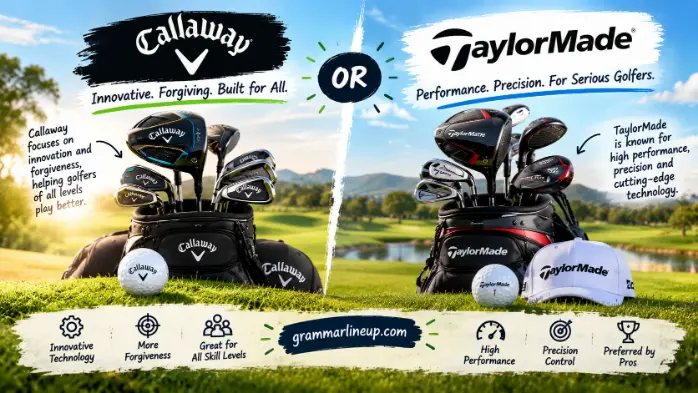
Choosing between Callaway or TaylorMade can feel surprisingly tricky, especially when both brands have strong reputations in golf. They offer a wide range of clubs, balls, bags, and other equipment, but their products can differ in design, technology, feel, and price. That can make a simple question “Which one should I choose?” harder than it first appears.
The good news is that you do not need to pick a brand based on reputation alone. The better choice depends on what you want from your equipment, your playing style, your experience level, and the features that matter most to you.
A beginner may have different priorities from an experienced golfer, while someone looking for maximum forgiveness may value different qualities than a player focused on control and feel.
In this guide, we’ll compare Callaway and TaylorMade in clear, practical terms. We’ll look at their key differences, equipment options, technology, performance considerations, and who each brand may suit. By the end, you’ll have a clearer way to decide which one matches your golfing needs.
Callaway and TaylorMade are two major golf-equipment brands offering drivers, fairway woods, hybrids, irons, wedges, putters, and golf balls. Neither is universally better. The better choice depends on your swing, desired launch and spin, forgiveness, club type, budget, and fitting. Comparing specific models is more useful than choosing a brand alone.
Callaway or TaylorMade: Quick Answer
If you are searching “Callaway or TaylorMade,” you are usually trying to decide which brand of golf clubs makes more sense for your game.
The important point is that this is not really a simple brand-versus-brand question.
Both companies make equipment for different types of golfers, from players who want maximum forgiveness to experienced golfers looking for lower spin, workability, or a particular feel.
As of 2026, Callaway’s current lineup includes the Quantum family of drivers alongside Apex, Elyte, Paradym Ai Smoke, and other club families. TaylorMade’s current lineup includes the Qi4D driver family, Qi MAX and P·Series irons, plus a broad range of fairway woods, rescues, wedges, and putters.
So instead of asking, “Which company is better?” a more useful question is:
Which specific club matches your swing and what you want the club to do?
That distinction matters because a golfer who needs help launching the ball may need a very different driver from someone who already produces excessive height and spin.
Callaway vs TaylorMade at a Glance
| Factor | Callaway | TaylorMade |
|---|---|---|
| Drivers | Quantum family and other current families | Qi4D family and other current families |
| Irons | Quantum, Apex, Elyte and other families | Qi MAX, P·Series and other families |
| Forgiveness options | Yes, including Quantum Max and Max D | Yes, including Qi4D Max |
| Lower-spin options | Quantum Triple Diamond | Qi4D LS |
| Draw-biased options | Quantum Max D | Model-dependent options |
| Lightweight options | Quantum Max Fast | Qi4D Max Lite |
| Custom fitting | Available | Available |
| Club selectors | Available | Available |
| Golf balls | Chrome Tour, Chrome Soft and others | TP5/TP5x and others |
| Best approach | Match model to golfer | Match model to golfer |
This table is deliberately not a ranking. The brands organize their current equipment differently, and model specifications change over time.
For example, Callaway describes the Quantum Max as a total-performance driver designed around speed, consistency, forgiveness, and control, while its Quantum Max D is designed around easy launch, maximum forgiveness, and draw bias.
TaylorMade similarly offers different Qi4D driver configurations for different launch, spin, forgiveness, and adjustability needs.
What Is Callaway?
Callaway is a major golf-equipment company founded by Ely Callaway in 1982. One of the company’s historically significant products was the original Big Bertha driver, introduced in 1991. Callaway later acquired Odyssey Golf in 1997, expanding its presence in the putter market.
Today, Callaway sells a broad range of golf equipment, including:
- Drivers
- Fairway woods
- Hybrids
- Irons
- Wedges
- Putters
- Golf balls
- Complete sets
- Golf accessories
Its current website also provides selector tools for drivers, fairway woods, irons/hybrids, wedges, putters, and golf balls.
The current Quantum driver family illustrates how much choice exists within one brand. Callaway lists Quantum Max, Quantum Max D, Quantum Max Fast, Quantum Triple Diamond, and Quantum Triple Diamond Max, with different intended performance characteristics.
That means saying “I want Callaway” does not tell you which type of club you actually need.
What Is TaylorMade?
TaylorMade Golf was founded by Gary Adams in 1979. The company began with a stainless-steel metalwood and became associated with the development and popularization of metalwoods as an alternative to traditional wooden woods.
TaylorMade now produces:
- Drivers
- Fairway woods
- Rescues and hybrids
- Irons
- Wedges
- Putters
- Golf balls
- Complete sets
- Accessories
Its current club catalog includes the Qi4D family and P·Series irons, among other products.
TaylorMade also puts substantial emphasis on custom fitting. Its current fitting program includes in-person fitting, online fitting tools, driver and iron selectors, and equipment customization.
Callaway or TaylorMade for Drivers?
This is probably the most common version of the question.
Drivers have a huge influence on distance, launch, spin, dispersion, and confidence from the tee. But the right driver depends heavily on the individual golfer.
Callaway Quantum
Callaway’s 2026 Quantum lineup provides several distinct driver profiles.
The Quantum Max is described by Callaway as a total-performance model aimed at golfers wanting speed, consistent tee shots, forgiveness, and control.
👍Quantum Max D adds draw bias and is designed for golfers who need forgiveness and easier launch.
The Quantum Max Fast targets golfers who can benefit from a lighter configuration and higher launch.
At the other end, the Quantum Triple Diamond is positioned toward better players seeking lower spin, workability, and controlled flight.
TaylorMade Qi4D
TaylorMade’s 2026 Qi4D family follows a similarly varied approach.
The Qi4D driver uses adjustable weighting and a loft sleeve, while TaylorMade lists different models with different launch, spin, forgiveness, and weight characteristics.
😁The Qi4D Max is positioned toward higher forgiveness, while the Qi4D LS targets golfers looking for very low spin and a lower-launching profile. The Qi4D Max Lite is intended for golfers who benefit from lighter equipment and higher launch.
What this means
You cannot reliably choose between Callaway and TaylorMade by simply looking at advertised distance.
A driver that produces excellent results for one golfer can produce worse results for another because of differences in:
- Clubhead speed
- Strike location
- Attack angle
- Launch angle
- Spin rate
- Shaft weight
- Shaft profile
- Loft
- Face delivery
- Typical miss
The best comparison is therefore Callaway model vs TaylorMade model, not simply Callaway vs TaylorMade.
Callaway or TaylorMade for Irons?
Iron selection is even more personal because golfers have different needs for distance, launch, forgiveness, turf interaction, feel, and trajectory.
Callaway’s current range includes models such as Quantum, Apex, and Elyte, while TaylorMade’s current iron catalog includes Qi MAX and several P·Series models.
The categories also overlap.
A newer golfer might prioritize:
- Forgiveness
- Higher launch
- More help on mishits
- Consistent carry
- Easy-to-hit long irons or hybrids
A skilled golfer may instead prioritize:
- Distance control
- Workability
- Turf interaction
- Compact head shape
- Consistent strike
- Feel and feedback
That is why the name on the sole is only one part of the decision.
Which Is More Forgiving?
There is no universal brand-level answer.
Forgiveness is a property of a particular club design, not something every club from one manufacturer automatically has more of.
For example, Callaway specifically identifies the Quantum Max D as a maximum-forgiveness, easy-launch option and describes the Quantum Max as offering forgiveness and consistent tee shots.
TaylorMade’s current Qi4D comparison data likewise distinguishes its models by forgiveness. The company lists the Qi4D Max at the highest forgiveness level in its driver comparison, while the Qi4D LS is designed more toward low spin and speed.
So if forgiveness is your priority, compare the forgiving model from each brand rather than comparing two randomly selected drivers.
Which Is Better for Beginners?
For a beginner, the brand itself should usually be lower on the priority list than the club’s characteristics.
A newer golfer often benefits from equipment that is:
- Forgiving
- Easy to launch
- Properly fitted
- Comfortable to swing
- Appropriate for their speed
- Consistent enough to build confidence
Both manufacturers offer equipment across different player categories.
Callaway explicitly categorizes its club-selection tools by skill level, including beginner, intermediate, and advanced players.
TaylorMade also states that golfers of all skill levels can benefit from custom fitting and provides fitting options designed to match clubs to an individual’s swing.
For a beginner, a properly fitted forgiving club from either company can make more sense than choosing a more demanding model simply because it has a premium reputation.
Callaway or TaylorMade for Experienced Golfers?
More experienced golfers often have a clearer understanding of their ball flight.
For example, you may know that you:
- Generate too much driver spin
- Launch the ball too low
- Miss predominantly to the right
- Need less offset
- Prefer a compact iron
- Need more predictable distance gaps
- Want to shape shots
- Prefer a particular shaft profile
That information is much more useful than a general brand preference.
Callaway’s Quantum Triple Diamond, for instance, is explicitly aimed at better players seeking lower spin, workability, and controlled flight.
TaylorMade’s Qi4D LS similarly occupies the lower-spin end of the current Qi4D driver range.
For a skilled golfer, the fitting numbers can therefore be more meaningful than the brand logo.
Does Club Fitting Matter More Than the Brand?
In many cases, yes.
A fitting can reveal that the club you assumed was right for you does not actually produce your best combination of launch, spin, carry, dispersion, and feel.
TaylorMade describes fitting as a process that can account for specifications such as head type, loft, shaft, and grip. Its fitting technology can also analyze launch, spin, distance, and other performance measurements.
Callaway also offers custom fitting and selector tools, including fitting options for drivers, fairway woods, irons/hybrids, wedges, putters, and golf balls.
This leads to a practical rule:
If you are spending serious money on new clubs, test the equipment rather than choosing from the logo alone.
If possible, hit comparable models with the same or similar shaft specifications and compare the results.
What Should You Compare During a Fitting?
Don’t focus only on the longest shot.
Look at the overall pattern.
Driver
Pay attention to:
- Ball speed
- Launch angle
- Spin rate
- Carry distance
- Total distance
- Dispersion
- Strike consistency
- Direction of your typical miss
Irons
Look at:
- Carry distance
- Distance consistency
- Launch
- Spin
- Descent angle
- Dispersion
- Turf interaction
- Feel
- Gapping between clubs
A driver that produces one spectacular distance number but sprays shots across a wide area may be less useful than a club producing slightly less distance with a much tighter pattern.
Likewise, an iron that goes exceptionally far may not be helpful if your carry distances become difficult to control.
Common Misunderstandings About Callaway vs TaylorMade
“One brand is always better.”
Golf equipment does not work that way.
Manufacturers build different models for different swing characteristics. A brand can have a club that fits you extremely well and another that does not.
“The newest club must be the right club.”
New technology can be useful, but newer does not automatically mean better for every golfer.
Your current club may already fit your swing well.
“More distance means better performance.”
Not necessarily.
Distance is only one part of performance. Accuracy, launch, spin, dispersion, consistency, and stopping power can also matter.
“A Tour-style club is better because professionals use it.”
Tour players have highly specific swing characteristics and equipment requirements.
A club designed for a highly skilled player can be unnecessarily demanding for another golfer.
“Callaway and TaylorMade clubs cannot be mixed.”
They can.
There is no general requirement that your driver, irons, wedges, and putter all come from one manufacturer.
A mixed golf bag can make complete sense if different clubs fit different needs.
Can You Mix Callaway and TaylorMade Clubs?
Absolutely.
You could, for example, use:
- A Callaway driver
- TaylorMade fairway wood
- Callaway irons
- TaylorMade wedges
- An Odyssey putter
There is no performance rule requiring every club to carry the same logo.
In fact, once you stop thinking in terms of brand loyalty and start thinking in terms of club performance, the decision can become much easier.
The important considerations are whether the individual clubs work together in terms of distance gaps, shaft characteristics, lofts, and your overall setup.
How to Choose Between Callaway and TaylorMade
Use this checklist before buying.
Start With Your Miss
Ask yourself what normally goes wrong.
Do you:
- Slice?
- Hook?
- Hit the ball too high?
- Hit it too low?
- Strike the heel?
- Strike the toe?
- Struggle with long irons?
- Have inconsistent distances?
Your typical miss can help identify the type of club characteristics worth testing.
Know Your Launch and Spin
If you have launch-monitor data, use it.
For drivers especially, launch and spin can help determine whether you should investigate a higher-launching, lower-spinning, more forgiving, or more workable head.
Compare Similar Models
Don’t compare a highly forgiving Callaway driver with a low-spin TaylorMade Tour-oriented model and conclude that the brands perform differently.
That is not an apples-to-apples test.
Compare models serving similar purposes.
Test the Shaft Too
The shaft is not an afterthought.
Two drivers with similar heads can behave very differently with different shaft weights, flexes, profiles, and lengths.
Consider the Price
Prices can vary significantly by model, configuration, promotions, and whether you are buying current or older equipment.
For example, Callaway’s current Quantum Max is listed at $649.99 on its U.S. site, while the Quantum Triple Diamond is listed at $699.99.
TaylorMade’s current Qi4D listings also vary by model and configuration.
Because prices change, check the manufacturer’s current listing before making a purchase.
FAQs:
Is Callaway or TaylorMade better?
Neither brand is universally better for every golfer. Both offer multiple club families designed around different combinations of forgiveness, launch, spin, speed, feel, and workability. Compare specific models and fitting results rather than the brand name alone.
Is Callaway or TaylorMade better for beginners?
Both offer equipment suitable for newer golfers. A beginner should generally prioritize forgiveness, appropriate loft, suitable shaft characteristics, and a comfortable setup rather than choosing a brand solely because it is popular.
Is Callaway or TaylorMade better for drivers?
Both companies currently offer drivers across multiple performance categories. Callaway’s Quantum family includes models ranging from forgiving and draw-biased designs to lower-spin options, while TaylorMade’s Qi4D family similarly spans different launch, spin, and forgiveness profiles.
Can I use Callaway irons with TaylorMade woods?
Yes. Golfers can mix equipment from different manufacturers. The main concern is whether the individual clubs fit your swing and produce sensible distance gaps and performance throughout the set.
Should I get fitted for Callaway or TaylorMade clubs?
If you are buying new clubs, a fitting can be useful regardless of which brand you choose. Both companies provide fitting resources and tools intended to match equipment specifications to individual golfers.
Is the newest Callaway or TaylorMade club automatically better?
No. Newer equipment may introduce technological changes, but the best club for an individual golfer depends on fit and performance. An older model that fits your swing can still be a sensible choice.
Conclusion:
The Callaway or TaylorMade debate sounds like a simple brand competition, but golf equipment is much more individual than that.
Callaway and TaylorMade both offer extensive current ranges covering different swing speeds, launch conditions, forgiveness levels, player types, and preferences. Callaway’s Quantum family and TaylorMade’s Qi4D family demonstrate this variety particularly clearly.
If you’re choosing between them, start with your swing and your goals, then compare suitable models.
Think about your typical miss, launch, spin, distance, dispersion, feel, shaft, and budget. If you can test the clubs or get fitted, those results will tell you far more than a simple “Callaway vs TaylorMade” label.
The smartest question isn’t “Which brand wins?”
It’s “Which club gives my swing the results I actually need?”
