
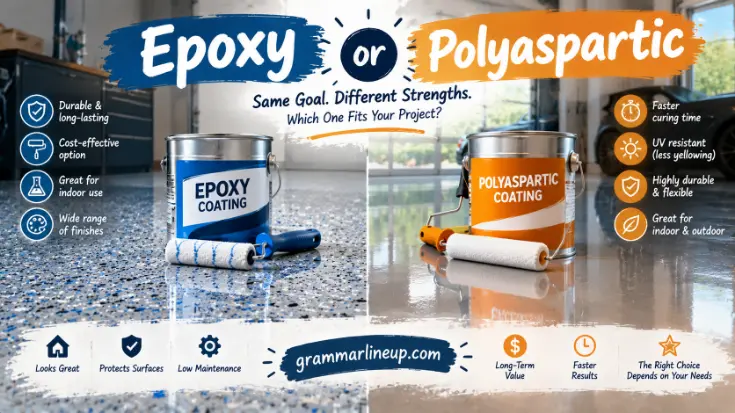
Choosing the right floor coating can feel a little confusing when two popular options, epoxy or polyaspartic, keep coming up. Both can create a durable, attractive surface for garages, workshops, basements, commercial spaces, and other areas, but they are not exactly the same. Their differences in application, curing time, appearance, maintenance, and performance can matter depending on where the coating will be used.
Epoxy has been a familiar choice for years and is known for forming a strong, hard surface with plenty of design options. Polyaspartic coatings, meanwhile, are often chosen for their fast curing time and resistance to UV exposure and certain types of wear. That does not automatically make one suitable for every situation.
So, epoxy or polyaspartic? The better choice depends on your priorities, the condition of the existing floor, the environment, and how the space will be used. In this guide, we’ll compare the two in clear, practical terms so you can understand their key differences without getting buried in technical jargon.
Epoxy or polyaspartic? Epoxy is commonly valued for its strong adhesion, build, and chemical-resistant flooring performance, while polyaspartic is known for faster curing and strong UV stability. For a garage or exposed floor, polyaspartic can reduce downtime and resist UV-related color changes. A properly designed system may use epoxy as a base with polyaspartic as the topcoat.
Quick Answer:
The simplest way to understand the difference is this:
- Epoxy: often used for the base or build portion of a resinous flooring system.
- Polyaspartic: often selected for fast curing, UV stability, and durable topcoat performance.
- Epoxy + polyaspartic: a common system approach when the strengths of both materials are useful.
Neither material automatically wins in every situation.
For example, Sherwin-Williams describes polyaspartic systems as fast-curing and UV stable, while its resinous flooring information treats epoxy and polyaspartic as separate coating chemistries with different performance characteristics.
The specific formulation also matters. “Epoxy” and “polyaspartic” describe broad coating chemistries, not one universal product. Cure time, thickness, chemical resistance, application temperature, appearance, and service requirements can vary considerably between products.
What Is Epoxy Flooring?
Epoxy flooring is a resin-based flooring system created by combining epoxy resin with a curing component. Once mixed and properly cured, the material forms a hard coating that can protect concrete and provide a seamless decorative or functional surface.
Epoxy systems are available in different formulations and can be used for applications ranging from garages and workshops to commercial and industrial floors.
One important advantage is that epoxy can provide substantial film build. Depending on the product and system design, it may be used as a primer, base coat, high-build layer, or other component of a flooring assembly.
Epoxy is also frequently combined with decorative aggregates such as vinyl flakes or quartz.
The final performance depends heavily on the complete system and installation rather than chemistry alone.
What Is Polyaspartic Flooring?
Polyaspartic is a type of coating technology commonly used for concrete floors and other protective coating applications.
One of its best-known characteristics is fast curing. For example, Sherwin-Williams lists a polyaspartic product that can allow foot traffic after six hours under specified conditions. Rust-Oleum’s FinishKote 70 and 80 products advertise vehicle traffic in 24 hours under their stated application requirements.
Polyaspartic coatings are also commonly selected for their UV stability. This makes them particularly useful where sunlight exposure is a concern.
They can be used as clear or pigmented coatings and may serve as topcoats over decorative broadcast systems.
However, fast curing creates an important trade-off: installers have less time to work with some formulations. Sherwin-Williams notes that polyaspartic products with short pot lives must be installed quickly and consistently.
Epoxy vs Polyaspartic: Key Differences
| Feature | Epoxy | Polyaspartic |
|---|---|---|
| Cure speed | Generally slower, product-dependent | Generally fast |
| UV stability | Product/system dependent | Commonly a major advantage |
| Chemical resistance | Strong in many formulations | Strong in many formulations |
| Abrasion resistance | Strong in appropriate systems | Strong in appropriate systems |
| Application window | Often more forgiving than very fast systems | Can require faster installation |
| Decorative options | Wide range | Wide range |
| Outdoor/light exposure | Formulation dependent | Often well suited because of UV stability |
| Return to service | Product dependent | Often faster |
| Typical role | Primer, base coat, build coat, or complete system | Topcoat or fast-cure flooring layer |
These are broad comparisons, not guarantees for every product. Always check the technical data sheet for the exact coating being considered.
Cure Time: Epoxy or Polyaspartic?
Cure time is one of the clearest practical differences.
A polyaspartic coating may allow a floor to return to service relatively quickly. For instance, Sherwin-Williams lists six-hour foot traffic for its Accelera 4850 product under specified conditions. Rust-Oleum lists 24-hour vehicle traffic for several FinishKote polyaspartic products.
Epoxy can also be formulated for relatively fast curing. Rust-Oleum, for example, lists a 100% solids fast-cure epoxy with 16–24 hours for foot traffic and 24–48 hours for full use under specified conditions.
So the useful question isn’t simply:
“Which one cures faster?”
It is:
“How quickly does the exact system need to be ready for the type of traffic I have?”
Temperature, humidity, coating thickness, product formulation, and substrate conditions can all affect actual curing.
UV Resistance and Sunlight
UV exposure is an important consideration when a floor receives substantial sunlight.
Polyaspartic systems are commonly designed with UV stability in mind. Sherwin-Williams describes its polyaspartic systems as UV stable, while Rust-Oleum describes its FinishKote products as UV stable for interior and exterior applications.
That does not mean every polyaspartic product behaves identically, nor does it mean every epoxy product is unsuitable for sunlight.
Instead, the formulation and complete coating system should be checked for the expected exposure.
This is particularly relevant for garages with open doors, sunrooms, commercial entrances, exterior concrete, and other areas exposed to natural light.
Durability and Abrasion Resistance
Both epoxy and polyaspartic systems can provide substantial protection against wear.
But “durability” is not one single measurement.
A floor may need to resist:
- Foot traffic
- Vehicle tires
- Abrasion
- Scratches
- Impact
- Chemicals
- Heat
- Moisture
- UV exposure
- Repeated cleaning
Polyaspartic products are frequently marketed for abrasion and chemical resistance. Rust-Oleum, for example, describes FinishKote 70 and 80 as having chemical and abrasion resistance.
Epoxy systems can also offer strong chemical and mechanical performance. Sherwin-Williams lists chemical resistance and abrasion resistance among the performance characteristics available in resinous flooring systems.
The better comparison is therefore between specific flooring systems, not just the words “epoxy” and “polyaspartic.”
Which Is Better for a Garage Floor?
For a residential garage, both can make sense.
A polyaspartic system may be attractive when:
- You want the floor back in service quickly.
- The garage receives significant sunlight.
- UV stability matters.
- You want a durable decorative topcoat.
- Installation speed is important.
Epoxy may be attractive when:
- You want a substantial base or build coat.
- The system is designed around strong adhesion and film build.
- You have enough downtime for the specified curing schedule.
- You want a particular decorative or performance system.
But there is another option that is easy to overlook:
Use them together.
A professionally designed garage-floor system can use epoxy underneath and a UV-stable polyaspartic layer above it. Sherwin-Williams documents this type of multi-coat approach, including epoxy primer/base coats followed by decorative flakes and a clear polyaspartic coating.
Can You Use Epoxy and Polyaspartic Together?
Yes. In many flooring systems, they are complementary rather than competing materials.
A typical system might contain:
- Prepared concrete
- Primer
- Epoxy base coat
- Decorative flake or aggregate
- Polyaspartic topcoat
The exact layers vary by product and application.
The benefit of this approach is that each material can perform a particular role. The epoxy can provide the desired base/build characteristics, while the polyaspartic topcoat can provide UV stability and rapid curing.
Sherwin-Williams specifically documents systems incorporating an epoxy primer and base coat with a clear polyaspartic UV-stable coating.
Application Matters More Than the Label
One of the biggest mistakes in comparing floor coatings is focusing only on chemistry.
A high-quality coating can still perform poorly if the concrete is not properly prepared.
The substrate generally needs to be clean and properly profiled so the coating can bond as intended. Contamination such as oil, grease, dirt, or other substances can interfere with coating performance.
Application conditions matter too.
Polyaspartic products can have relatively short working times. Sherwin-Williams notes that some polyaspartic products must be installed quickly and consistently because of their short pot life.
That can make professional application particularly important for larger floors.
Cost: Epoxy or Polyaspartic?
There is no universal price difference that applies to every project.
The total cost depends on factors such as:
- Concrete preparation
- Floor size
- Number of coats
- Product formulation
- Decorative flakes or aggregates
- Repairs required
- Labor
- Moisture mitigation
- Desired thickness
- Warranty requirements
- Return-to-service requirements
A cheaper coating that fails because the concrete was poorly prepared is not necessarily a cheaper flooring solution in the long run.
When comparing quotes, ask what is actually included.
A useful quote should identify the preparation method, number and type of coats, approximate coverage, curing requirements, and the specific products or system being installed.
Common Misunderstandings
“Polyaspartic is always better than epoxy.”
Not necessarily.
Polyaspartic has important advantages, especially fast curing and UV stability, but epoxy remains useful in many flooring systems.
The appropriate choice depends on the floor’s requirements.
“Epoxy cannot be used in a garage.”
That is too broad.
Epoxy is widely used in garage and other concrete-floor applications. The important questions involve the specific formulation, preparation, environment, and complete system.
“Polyaspartic is just a faster epoxy.”
No.
They are different coating chemistries. Their curing behavior and performance characteristics are not identical.
“The coating alone determines how long the floor lasts.”
Not necessarily.
Concrete preparation, moisture conditions, installation quality, coating thickness, traffic, chemicals, temperature, and maintenance can all influence performance.
“Every polyaspartic product cures in the same amount of time.”
Definitely not.
Manufacturer specifications vary. Even the same product can have different drying or curing behavior depending on temperature, humidity, thickness, and other conditions.
How to Choose Between Epoxy and Polyaspartic
Instead of starting with the coating name, start with your floor.
Ask these questions:
Does the floor receive direct sunlight?
If yes, UV stability deserves close attention.
How quickly must the floor be usable?
If downtime is a major concern, fast-curing polyaspartic systems may be attractive.
Will vehicles or heavy equipment use the floor?
Look specifically at the manufacturer’s abrasion, impact, chemical, and traffic ratings.
Will chemicals be spilled?
Check the exact chemical-resistance data rather than relying on general claims.
Is appearance important?
Both technologies can be used in decorative flooring systems, including solid colors and broadcast flake designs.
Who will install it?
A coating with a short working time may require more precise installation.
What does the technical data sheet say?
This is one of the most useful questions because product names alone don’t tell you enough.
Epoxy or Polyaspartic for Different Situations
| Situation | Important consideration |
|---|---|
| Residential garage | Durability, UV exposure, appearance, downtime |
| Workshop | Abrasion, chemicals, impact, maintenance |
| Commercial floor | Traffic, cure schedule, maintenance |
| Sun-exposed area | UV stability |
| Fast renovation | Cure and return-to-service time |
| Decorative flake floor | Complete multi-coat system |
| Heavy-duty environment | Specific chemical, abrasion, and impact ratings |
This table is intentionally not a “winner” list. The requirements of the space determine which characteristics matter most.
FAQs:
Is epoxy or polyaspartic better for a garage?
Both can be suitable for garage floors. Polyaspartic is often attractive when fast return to service and UV stability are important, while epoxy can provide a strong base or build layer. Some professional systems combine epoxy and polyaspartic rather than choosing only one.
Is polyaspartic more durable than epoxy?
There is no universal answer. Durability depends on the specific formulation and complete flooring system, as well as preparation, installation, traffic, chemicals, and environmental conditions. Compare technical data for the actual products rather than relying on the chemistry name alone.
Does polyaspartic cure faster than epoxy?
Often, yes, although the exact difference depends on the products being compared. Some polyaspartic products are designed for very fast return to service, while fast-cure epoxy products also exist.
Does polyaspartic resist sunlight better?
Polyaspartic coatings are commonly formulated for strong UV stability. This is one of their notable advantages in applications exposed to sunlight. The exact product specification should still be checked before installation.
Can polyaspartic go over epoxy?
It can be used as part of a compatible multi-coat system, including systems where epoxy forms the base and polyaspartic provides the topcoat. Compatibility, surface preparation, recoat windows, and manufacturer instructions must be followed.
Which coating lasts longer?
There is no reliable single lifespan that applies to every epoxy or polyaspartic floor. Service life depends on the particular system, substrate preparation, installation, environment, traffic, and maintenance. Be cautious of universal lifespan claims that do not identify the actual product and conditions.
Conclusion:
When comparing epoxy or polyaspartic, don’t think of the decision as simply choosing between “good” and “better.”
Epoxy is a versatile flooring chemistry that can provide strong build, adhesion, and chemical-resistant performance in properly designed systems. Polyaspartic is particularly notable for fast curing and UV stability.
For some floors, the most practical design is actually a combination: epoxy for the base layers and polyaspartic for the protective topcoat.
The smartest comparison is therefore between complete flooring systems, not just two chemistry names.
Before buying, check the exact product’s technical data sheet, required surface preparation, application conditions, cure schedule, chemical resistance, UV performance, and intended traffic.
