
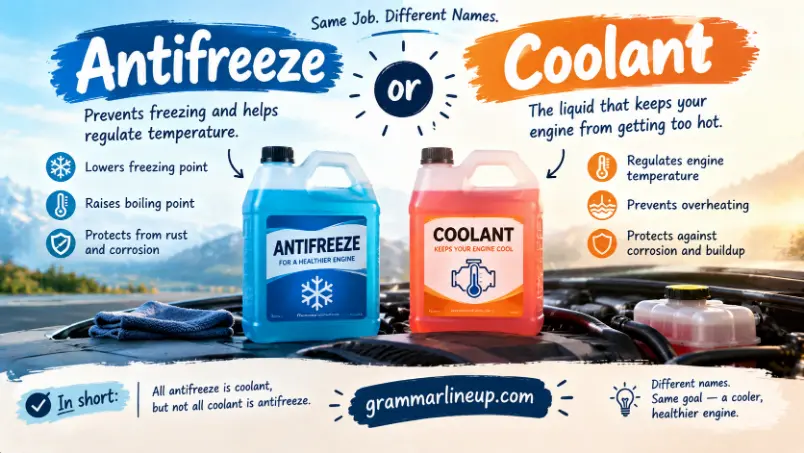
If you’ve ever stood in an auto parts store wondering whether you need antifreeze or coolant, you’re certainly not alone. The two terms are often used interchangeably, which can make a simple car maintenance task feel more confusing than it needs to be. So, are antifreeze and coolant actually the same thing?
The short answer is: not exactly, but they are closely related. Antifreeze is a concentrated liquid designed to help protect an engine’s cooling system from freezing and overheating. Coolant, on the other hand, is generally the mixture that circulates through the engine to regulate temperature. In many vehicles, coolant is made by mixing antifreeze with water at the recommended ratio.
Understanding the difference matters because your engine depends on the right coolant mixture to stay within a safe operating temperature. Using the wrong product, an incorrect mixture, or a fluid that does not meet your vehicle manufacturer’s specifications can cause cooling-system problems.
In this guide, we’ll break down antifreeze or coolant, explain how each term is used, and show you what to look for when choosing the right fluid for your vehicle.
Featured Snippet Answer
Antifreeze and coolant are closely related but not always identical. Antifreeze is a concentrated fluid, commonly based on ethylene glycol or propylene glycol, that helps prevent freezing and raises boiling protection. Coolant is the fluid used in an engine’s cooling system, often made by mixing antifreeze concentrate with water and corrosion-protection additives. Many products are sold as “antifreeze + coolant.”
Antifreeze or Coolant: What’s the Difference?
The simplest way to understand the distinction is to think about what the word describes.
Antifreeze describes a fluid or chemical mixture whose important job includes protecting against freezing.
Coolant describes the fluid circulating through an engine’s cooling system to help control engine temperature and protect cooling-system components.
In automotive products, the distinction can become blurry because manufacturers commonly sell a single product that performs both roles.
For example, Ford’s current product catalog includes ready-mix antifreeze/coolant made from an ethylene-glycol-based formula. Its specified 50/50 mixture provides both freeze and boiling protection.
The U.S. Department of Energy has also used “antifreeze” and “radiator coolant” as closely related terms in its terminology materials.
So if someone casually says, “I need coolant,” they may be talking about the same automotive product another person calls antifreeze.
Quick Answer: Are Antifreeze and Coolant the Same?
Not exactly, but they are closely connected.
Here’s the practical distinction:
| Term | What it generally means |
|---|---|
| Antifreeze | Concentrated fluid designed in part to prevent freezing and provide temperature protection |
| Coolant | Fluid circulating through the engine cooling system |
| Antifreeze + coolant | Automotive product designed to perform both functions |
| Ready-to-use coolant | Usually already mixed with water |
| Antifreeze concentrate | Usually needs to be mixed according to the manufacturer’s instructions |
The key point is that you should not assume every bottle labeled “antifreeze” can be poured directly into the cooling system.
Some products are concentrates. Others are already diluted.
Always read the product label and, more importantly, follow the vehicle manufacturer’s specification.
What Does Antifreeze Do?
Antifreeze helps the cooling system operate across a wider temperature range than plain water alone.
A common automotive antifreeze base is ethylene glycol. Propylene glycol is another material used in antifreeze and related cooling applications.
Antifreeze can help with:
- Lowering the freezing point of the cooling mixture
- Increasing boiling protection
- Protecting cooling-system components from corrosion when properly formulated
- Supporting heat transfer when correctly mixed
- Maintaining appropriate cooling-system performance in changing temperatures
However, antifreeze is not simply a product you add without checking the required mixture.
The concentration matters.
For instance, Ford specifies some of its ready-mix antifreeze/coolant products as a 50/50 mixture of antifreeze and treated water, with stated freeze and boiling protection.
What Does Coolant Do?
Engine coolant circulates through passages in and around the engine and carries heat away from areas that become hot during operation.
It is part of the vehicle’s overall thermal-management system.
A properly specified coolant can help:
- Control engine temperature
- Transfer heat
- Provide freeze protection
- Provide boiling protection
- Protect cooling-system metals and components
- Reduce corrosion and deposits when the formulation is appropriate
Modern coolant is therefore doing much more than simply “keeping the engine cool.”
The formulation also matters. Prestone, for example, describes its antifreeze/coolant products as providing temperature management alongside protection against corrosion and deposits.
Why Do Bottles Say “Antifreeze + Coolant”?
This wording reflects how automotive cooling products are actually used.
A bottle may contain a formulated fluid that is intended to function as engine coolant while also providing the properties associated with antifreeze.
That is why you will commonly see labels such as:
Antifreeze + Coolant
rather than simply Antifreeze or Coolant.
This labeling also helps avoid the misleading idea that antifreeze is useful only during winter.
A properly formulated coolant mixture provides protection against both freezing and excessive heat, depending on the formulation and concentration.
Concentrate vs. Ready-to-Use Coolant
This is one of the most important distinctions when buying coolant.
Antifreeze Concentrate
Concentrated antifreeze generally needs to be diluted with the appropriate water before it goes into the cooling system.
The exact mixture should follow the product instructions and the vehicle manufacturer’s requirements.
Ready-to-Use Coolant
Ready-to-use coolant has already been diluted to the intended concentration.
Ford, for example, lists ready-mix antifreeze/coolant products that are already formulated as a 50/50 mixture and specifically says certain ready-mix products should not be diluted further.
Why This Matters
Adding water to an already-prepared ready-to-use product can change its intended concentration.
Likewise, putting concentrated antifreeze into a system without the required dilution can produce a mixture that does not match the manufacturer’s specification.
Always check whether the bottle says “concentrate,” “ready to use,” or “50/50.”
Does Coolant Prevent Freezing?
Yes, when it is correctly formulated.
Despite the name coolant, the fluid is not intended only for hot weather.
A suitable antifreeze/coolant mixture lowers the freezing point of the fluid and also provides protection against high operating temperatures.
For example, Ford’s documentation states that certain 50/50 antifreeze/coolant mixtures provide freeze protection to approximately −37°C and boiling protection to 129°C. Those figures apply to the specified product and mixture, not to every coolant.
This is why using the correct mixture is important.
Can You Use Water Instead of Coolant?
Plain water can absorb and transfer heat effectively, but water alone is not generally an appropriate long-term replacement for the specified engine coolant.
A vehicle’s cooling system may require more than heat transfer. The specified coolant can provide freezing and boiling protection as well as protection against corrosion and deposits.
The correct fluid also depends on the vehicle and cooling-system design.
For maintenance, follow the vehicle owner’s manual and the coolant manufacturer’s instructions rather than choosing a fluid based only on color or price.
Does Coolant Color Tell You What to Buy?
Not reliably.
This is one of the most common misunderstandings.
Coolants may come in different colors, but color alone does not provide enough information to determine whether a particular product is appropriate for a specific vehicle.
Different formulations and vehicle specifications exist. Prestone’s current product range, for example, includes different formulations marketed for different vehicle groups and technologies.
So instead of asking only:
“What color coolant does my car use?”
check:
- The owner’s manual
- The manufacturer’s coolant specification
- The product label
- Required coolant technology
- Whether the product is concentrate or ready-to-use
Specification matters more than color.
Can You Mix Different Coolants?
Do not assume that two coolants are compatible simply because they look similar.
Different products can use different additive technologies and specifications.
Some products are specifically marketed as compatible with certain coolant technologies or vehicle groups, while others have narrower compatibility requirements.
If you are unsure what is already in the cooling system, check the owner’s manual or consult the vehicle manufacturer or a qualified technician.
For a complete coolant change, the correct procedure may involve draining and, where required, flushing the existing coolant before refilling with the specified product.
When Should You Use Antifreeze or Coolant?
The answer depends on what you are trying to do.
Topping Up the Cooling System
Use the coolant specified for your vehicle and check whether you need:
- Concentrate
- Ready-to-use coolant
- A particular coolant specification
- A particular mixture ratio
Do not choose solely by the word antifreeze on the front of the bottle.
Replacing Old Coolant
If the coolant needs replacement, follow the vehicle manufacturer’s maintenance guidance.
Dirty or degraded coolant can contribute to corrosion and reduced cooling-system performance. Prestone recommends following the manufacturer’s maintenance schedule and describes drain-and-fill or flush-and-fill procedures depending on the situation.
Emergency Situations
If the coolant level is dangerously low or the engine is overheating, adding random coolant is not the only concern.
A low coolant level can indicate a leak or another cooling-system problem.
If the temperature gauge is in the danger zone, stop safely and allow the engine to cool. Never remove a pressurized radiator cap from a hot engine.
Common Misunderstandings About Antifreeze and Coolant
“Antifreeze is only for winter.”
Not quite.
Antifreeze is also part of many year-round engine coolant formulations. Proper coolant provides protection across both low and high temperatures.
“All coolant is basically the same.”
No.
Coolant formulations can differ in chemistry, additive packages, specifications, and intended applications.
“The color tells me which coolant to buy.”
Color is not a sufficient compatibility guide.
“50/50 means I should add more water.”
Usually no.
If the bottle is already labeled 50/50 ready-to-use, it has already been mixed to that stated ratio.
“More antifreeze must always mean better protection.”
Not necessarily.
The correct concentration is determined by the product and vehicle requirements. More concentrated does not automatically mean better cooling-system performance.
Antifreeze vs. Coolant at a Glance
| Question | Antifreeze | Coolant |
|---|---|---|
| Prevents freezing? | Yes, when properly formulated | Yes, when properly formulated |
| Helps manage engine temperature? | As part of a coolant mixture | Yes |
| May require dilution? | Concentrate may | Depends on product |
| Available as 50/50 mix? | Yes | Yes |
| Contains corrosion protection? | Formulated products often do | Formulated products often do |
| Can you choose by color alone? | No | No |
| Should you follow vehicle specifications? | Yes | Yes |
The overlap is why the terms often appear together on automotive products.
Antifreeze or Coolant: Which Word Should You Use?
Both terms are natural, but they emphasize slightly different ideas.
Use antifreeze when talking about the concentrated chemical or its freeze-protection role.
Use coolant when talking about the fluid circulating through an engine’s cooling system.
In everyday automotive conversation, either word may refer to the same product.
For example:
“I need to check my coolant level.”
This is a natural way to talk about the fluid in the vehicle.
You might also hear:
“I need to buy antifreeze.”
In an automotive context, the speaker may mean an antifreeze/coolant product.
So the terminology is not as neatly separated in everyday speech as the technical definitions might suggest.
What Is the Best Coolant for Your Car?
There is no single coolant that is automatically correct for every vehicle.
The appropriate choice depends on the vehicle manufacturer’s requirements and the cooling-system specification.
Some manufacturers specify particular coolant technologies. Some aftermarket products are designed for particular makes, models, years, or coolant technologies.
Before buying, check:
- Your owner’s manual
- The manufacturer’s coolant specification
- The product’s compatibility information
- Whether the product is concentrate or premixed
- The required water-to-antifreeze ratio
This is more reliable than choosing a bottle because its label says universal, because its color looks familiar, or because someone recommends it for a different vehicle.
Safety: Handle Antifreeze Carefully
Automotive antifreeze should be treated as a chemical product, not as an ordinary household liquid.
Ethylene glycol, which is widely used in automotive antifreeze, is toxic if swallowed. The U.S. Department of Energy’s fuel-cell maintenance guidance specifically warns about the toxicity of ethylene glycol.
Keep coolant away from children and pets, avoid skin and eye contact, and follow the product’s safety instructions.
Used coolant should also be disposed of according to applicable local requirements rather than poured onto the ground or into drains. Product guidance from Prestone likewise directs users to dispose of used antifreeze/coolant according to applicable regulations.
FAQs:
Is antifreeze the same as coolant?
Not always technically, but the terms overlap heavily in automotive use. Antifreeze is commonly the concentrated glycol-based component, while coolant is the finished fluid circulating through the cooling system. Many products combine both functions and are labeled antifreeze + coolant.
Can I put antifreeze directly into my car?
Only if the product and vehicle instructions call for it. Some antifreeze products are concentrates that need dilution, while others are ready-to-use mixtures. Check the bottle and your owner’s manual before adding anything.
Is 50/50 coolant already mixed?
Yes. A product labeled 50/50 ready-to-use is generally already mixed with the specified proportion of antifreeze and water. It should not automatically be diluted further.
Does coolant color matter?
Color can help identify some products, but it should not be your main method for determining compatibility. Use the vehicle manufacturer’s specification and the product’s compatibility information instead.
Can I mix two different coolants?
Do not assume that different coolant formulations are compatible. Check the manufacturer’s specifications before mixing them. If compatibility is uncertain, professional advice or a proper coolant replacement may be appropriate.
Why is my coolant level low?
A low level can result from normal service needs, an external leak, or another cooling-system issue. If the level repeatedly drops, the cause should be investigated rather than simply adding coolant again and again.
Conclusion:
Antifreeze and coolant are closely related, but they are not always technically identical terms. Antifreeze commonly refers to the concentrated fluid that provides freeze and temperature protection, while coolant refers to the fluid circulating through the engine’s cooling system.
In modern automotive products, the two functions are frequently combined into one product labeled antifreeze + coolant.
The most important thing is not whether the bottle says antifreeze or coolant. It is whether the fluid matches your vehicle’s required specification and concentration.
When in doubt, check the owner’s manual before topping up.
