
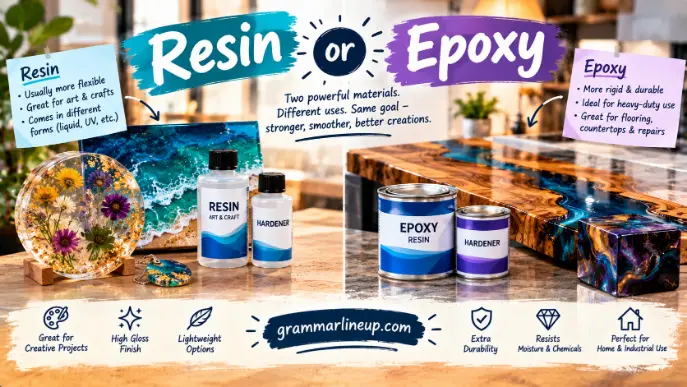
When you’re choosing between resin or epoxy, it’s easy to assume they are simply two names for the same material. After all, you’ll often see both words used for crafts, coatings, repairs, furniture, and DIY projects. But there is an important distinction: resin is a broad term, while epoxy refers to a specific type of resin system.
That small difference can matter when you’re deciding what to buy or how to use a product. Some resins are designed for casting, while others work better as coatings, adhesives, or protective finishes. Epoxy is especially popular because it can create a strong, durable surface when the right products are mixed and cured correctly.
So, which should you choose resin or epoxy? The answer depends on what you’re making, the finish you want, how much strength you need, and how the material will be used. A decorative project may have very different requirements from a tabletop, repair job, or protective coating.
In this guide, we’ll break down the difference between resin and epoxy in simple terms. You’ll learn what each term means, where they overlap, and how to choose the right option without getting lost in technical jargon.
Featured Snippet Answer:
Resin is a broad term for materials that can form solid polymers, while epoxy is a specific type of resin system based on reactive epoxide groups. In everyday product language, “resin” may refer to several different formulations, whereas epoxy usually means an epoxy resin combined with a hardener. The right choice depends on the project, properties, and curing requirements.
Quick Answer
The simplest distinction is:
| Term | What it means | Typical use |
|---|---|---|
| Resin | A broad category of materials/formulations that can cure or polymerize into solid materials | Crafts, coatings, composites, plastics, adhesives |
| Epoxy | A specific resin chemistry containing reactive epoxide groups | Coatings, adhesives, casting, composites, repairs |
| Epoxy resin | An uncured or partly formulated epoxy component/system | Casting, coating, bonding, laminating |
| Cured epoxy | The solid cross-linked material formed after curing | Finished surfaces, bonds, protective coatings |
The important point is that “resin” does not identify one single chemical material.
There are many resin families, including epoxy, polyester, polyurethane, phenolic, and others. Their properties and curing mechanisms can differ substantially.
Epoxy is therefore a type of resin, not a separate category that sits beside resin.
What Does “Resin” Mean?
In everyday conversation, resin can mean several things.
In materials science and manufacturing, the word can refer broadly to a polymer-forming material or a polymer system used to make a solid material. Depending on the formulation, resin may be natural or synthetic and may cure, polymerize, or otherwise form a finished material.
Natural resins have existed for centuries, while modern synthetic resins are important in plastics, coatings, adhesives, composites, and other manufactured products.
The word alone does not tell you exactly what the material is.
For instance, a product labeled simply “resin” could be an epoxy-based system, polyester resin, polyurethane resin, or another formulation.
That is why product labels matter more than the word resin by itself.
Resin is a category, not necessarily one formula
Think of resin like the word vehicle.
A vehicle could be a car, truck, motorcycle, or bus. The category tells you something, but not everything.
Similarly, resin describes a broad class of materials, while the specific chemistry tells you how the material behaves.
What Is Epoxy?
Epoxy refers to a family of resin systems associated with reactive epoxide groups.
Epoxy resins are also called polyepoxides. They can react with curing agents such as certain amines, acids, anhydrides, phenols, alcohols, and thiols. This reaction creates cross-links and produces a thermosetting polymer.
A common epoxy system has two main components:
- Epoxy resin
- Hardener or curing agent
They are mixed in a specified ratio. The chemical reaction then changes the mixture from a workable liquid into a solid material.
This is why many consumer epoxy products come in two separate containers.
The exact formulation varies by product, so the manufacturer’s mixing ratio and instructions should always take priority.
Why People Confuse Resin and Epoxy
The confusion mostly comes from everyday product language.
A craft product might be marketed simply as “resin.” In many cases, the product may actually be an epoxy resin system designed for casting.
Someone may then say:
“I need resin, not epoxy.”
Chemically, that statement can be misleading because the particular “resin” being discussed may itself be epoxy.
On the other hand, not every resin is epoxy.
So both of these statements can be true:
- Epoxy is a resin.
- Not all resin is epoxy.
That is the central distinction to remember.
Resin vs. Epoxy: Key Differences
Although epoxy belongs to the resin family, the terms can still have different practical meanings.
Chemical identity
Resin is a broad term.
Epoxy identifies a particular chemical family characterized by reactive epoxide groups.
This makes “epoxy” more specific than “resin.”
Curing process
Different resin systems cure in different ways.
Epoxy commonly cures through a chemical reaction between an epoxy component and a curing agent. The reaction forms a cross-linked structure.
Other resin systems can use different catalysts, initiators, heat, radiation, moisture, or other mechanisms.
Performance
You cannot determine performance simply from the word resin.
Properties such as hardness, flexibility, chemical resistance, temperature resistance, adhesion, transparency, and cure time depend on the specific formulation.
Epoxy systems are widely used where strong adhesion, protective coatings, and durable composite structures are required.
Typical applications
Epoxy is commonly found in:
- Adhesives
- Protective coatings
- Electrical applications
- Composite materials
- Structural bonding
- Some casting products
- Repair systems
Other resin families have their own applications and advantages.
Common Types of Resin
If you see the word resin, check what type it actually is.
Epoxy resin
Epoxy resin is widely used for adhesives, coatings, composites, casting applications, and other projects where a cured, cross-linked material is desirable.
Many epoxy systems consist of a resin component and a curing agent.
Polyester resin
Polyester resin is a different resin family. It has different chemistry and curing behavior from epoxy.
It is widely associated with fiberglass and composite applications.
Polyurethane resin
Polyurethane resin systems can be formulated for different properties, including flexibility, toughness, abrasion resistance, or casting performance.
The exact characteristics depend heavily on the formulation.
Natural resin
Some naturally occurring materials are also called resins. Their chemistry and behavior can be very different from modern synthetic epoxy systems.
This is another reason why the word resin alone is not precise enough for technical comparisons.
How Epoxy Resin Cures
One of the most useful things to understand is that epoxy does not simply “dry” in the same way water evaporates from paint.
When an epoxy resin and its curing agent are mixed, they undergo a chemical reaction.
The mixture typically progresses through several stages:
Liquid → gel → solid
During the liquid stage, the material can be mixed and applied.
As the reaction continues, it begins to gel and becomes less workable.
Eventually, it reaches a solid, cured state.
WEST SYSTEM describes epoxy curing as a progression from liquid through gel to solid, with working time and cure time affected by factors such as the hardener and temperature.
The final material is a cross-linked thermoset. Once sufficiently cured, a thermoset does not simply melt and return to its original liquid state when heated.
Resin or Epoxy for Crafts and DIY Projects
This is where the terminology becomes especially confusing.
Many craft products are advertised as “resin.”
If you are making:
- Jewelry
- Coasters
- Decorative pieces
- Small molds
- Art pieces
- Wood-and-resin projects
- Embedded designs
the product may be an epoxy casting resin.
That means you are not necessarily choosing between “resin” and “epoxy.” You may actually be choosing among different resin formulations, one of which happens to be epoxy.
What to check on the label
Instead of asking only whether a product is “resin,” look for:
- Resin type
- Mixing ratio
- Recommended casting thickness
- Cure time
- Working time
- Maximum temperature
- UV resistance
- Intended application
- Safety instructions
- Manufacturer’s technical data
These details tell you much more about whether a product suits your project.
Resin or Epoxy for Wood
For wood projects, the choice depends on what you want the material to do.
Epoxy is often used for:
- Bonding wood
- Filling gaps
- Sealing surfaces
- Creating protective coatings
- Combining wood with decorative castings
- Certain composite applications
But “epoxy” is not automatically the right answer for every wood project.
A thin coating, structural repair, deep casting, and adhesive joint can require very different formulations.
For example, a product designed for a thin tabletop coating may not be appropriate for a deep pour.
Always match the formulation to the application rather than choosing based only on the word “epoxy.”
Resin or Epoxy for Coating
Epoxy is frequently used as a coating because cured epoxy systems can provide a hard, protective surface.
Applications can include certain:
- Floors
- Work surfaces
- Industrial coatings
- Wood surfaces
- Equipment
- Composite structures
However, coating performance depends on the specific epoxy formulation and the environment.
Factors such as UV exposure, temperature, moisture, chemical exposure, surface preparation, and expected mechanical wear can affect suitability.
A decorative casting resin should not automatically be assumed to perform like an industrial coating.
Resin or Epoxy for Adhesives
Epoxy is also widely used as an adhesive.
The reason is that epoxy systems can create strong bonds and cure into durable cross-linked materials. Epoxy adhesives are used for household repairs as well as demanding industrial applications.
But different epoxy adhesives are designed for different jobs.
Some are optimized for:
- Fast repairs
- Structural bonding
- Flexible joints
- High-temperature environments
- Specific substrates
So if bonding is your goal, look for an epoxy adhesive formulated for the materials you’re joining, rather than choosing a generic casting resin.
When Should You Choose Epoxy?
Epoxy may be appropriate when you need a material designed for applications such as:
- Strong bonding
- Protective coatings
- Composite reinforcement
- Certain casting applications
- Durable surface finishes
- Chemical-resistant applications
- Electrical or insulating uses
Epoxy systems are particularly versatile because their formulations can be adjusted for different properties and applications.
Still, “epoxy” does not automatically mean strongest, hardest, clearest, or best.
The formulation matters.
When “Resin” Is Too Vague
If someone tells you:
“Use resin.”
that advice may not be specific enough.
A better question is:
What type of resin, and what is the intended application?
For example:
For casting:
Ask whether it is a casting resin and what maximum thickness is recommended.
😊For bonding:
Ask whether it is formulated as an adhesive.
For coating:
Check whether it is designed for the intended surface and exposure conditions.
For composites:
Check compatibility with the reinforcement material and required mechanical properties.
This small distinction can prevent a lot of wasted material.
Common Misunderstandings About Resin and Epoxy
“Resin and epoxy are completely different.”
Not exactly.
Epoxy is a type of resin system.
“Every resin product is epoxy.”
No.
“Resin” is a broad term that can refer to multiple chemical families.
“All epoxy works the same way.”
No.
Epoxy formulations can differ significantly in viscosity, cure speed, flexibility, hardness, temperature performance, chemical resistance, and intended use.
“Curing means the water has evaporated.”
Not necessarily.
Epoxy curing involves a chemical reaction that creates a cross-linked material.
“If something says resin, it can be used for any resin project.”
No.
A resin designed for one application may perform poorly or be unsuitable for another.
Resin or Epoxy: Which Word Should You Use?
If you’re simply talking about the general material category, resin can be appropriate.
If you specifically mean a material based on epoxy chemistry, epoxy or epoxy resin is more precise.
Compare these sentences:
“I bought resin for my project.”
This tells us very little about the actual chemistry.
“I bought a two-part epoxy resin for the coating.”
This is much more informative.
The second sentence identifies both the resin family and the general product format.
A Simple Way to Remember the Difference
Use this rule:
Resin = broad category
Epoxy = specific resin family
Or think of it this way:
All epoxy resin belongs to the resin family, but not all resin is epoxy.
That one sentence resolves most everyday confusion around the phrase “resin or epoxy.”
FAQs:
Is epoxy a type of resin?
Yes. Epoxy is a specific family of resin systems associated with reactive epoxide groups. Epoxy resins can be cured into cross-linked thermosetting materials.
Is resin stronger than epoxy?
There is no general answer because resin is a broad category. Different resin types and formulations have different mechanical properties. You need to compare specific products rather than resin versus epoxy as general categories.
Is epoxy resin the same as resin?
Sometimes people use the terms interchangeably in casual conversation, particularly in crafts. Technically, however, epoxy resin is one particular type of resin.
Which is better for crafts, resin or epoxy?
If by “resin” you mean a general craft resin, check its chemistry first. Many craft products marketed as resin are epoxy-based. Choose according to the project’s required cure, thickness, appearance, hardness, UV performance, and intended use.
Can epoxy be used as glue?
Yes. Epoxy is widely used in adhesive applications, including household repairs and structural bonding.
Does epoxy resin need a hardener?
Many two-component epoxy systems require a separate curing agent or hardener. The exact formulation varies, so follow the product manufacturer’s specified mixing ratio and instructions.
Conclusion:
Resin and epoxy are not two completely separate materials.
Resin is the broader term, while epoxy identifies a particular family of resin systems.
The phrase “epoxy resin” is therefore perfectly logical: it identifies a specific kind of resin.
If you’re choosing a product, don’t stop at the label resin or epoxy. Look at the actual formulation and intended application. A casting resin, coating resin, adhesive epoxy, and industrial composite system can all behave very differently.
The best choice depends on what you need the finished material to do not simply on which word appears on the container.
