
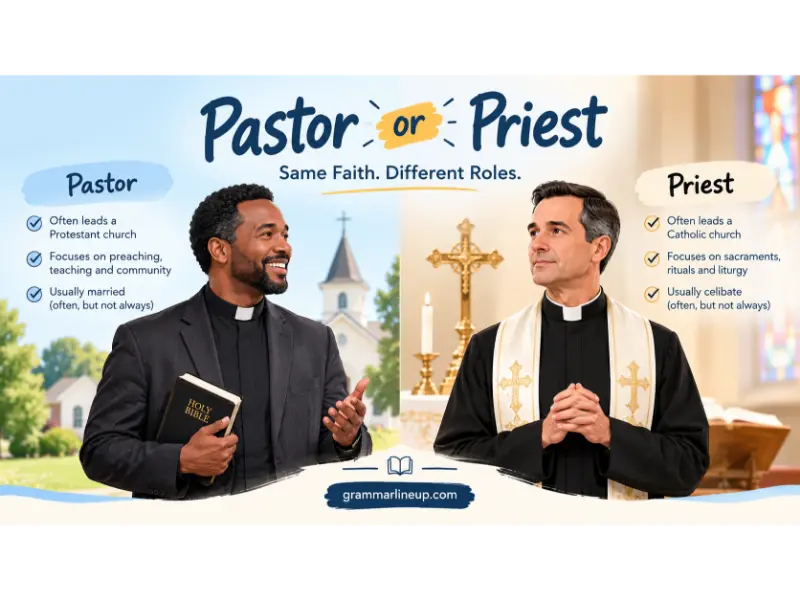
If you’ve ever wondered whether to say pastor or priest, you’re not alone. The two words are often used when talking about Christian religious leaders, but they do not always mean the same thing. Their meanings can change depending on the Christian tradition, denomination, and role being described.
A pastor is generally a Christian leader who guides a congregation, leads worship, teaches from the Bible, and provides spiritual support to members of the church. The word is commonly associated with Protestant churches, although its use can vary between denominations.
A priest, on the other hand, is a religious leader in traditions such as Roman Catholic, Eastern Orthodox, and Anglican Christianity. Priests may lead worship services, administer sacraments, offer pastoral care, and perform other duties according to the practices of their church.
So, is one word simply another way to say the other? Not quite. While pastors and priests can share responsibilities, their titles, training, authority, and religious functions may differ.
Understanding these distinctions can make conversations about Christian traditions much easier—and help you choose the right word when you’re writing or speaking.
In this guide, we’ll explore the difference between pastor and priest in simple terms, including their roles, responsibilities, and where each title is commonly used.
Featured Snippet Answer
A pastor is generally a Christian minister who provides spiritual leadership and pastoral care to a congregation. A priest is an ordained Christian minister whose role, especially in Catholic, Orthodox, and some Anglican traditions, includes specific sacramental duties. In some traditions, a priest may also serve as a pastor.
Pastor or Priest: Quick Answer
The simplest way to understand pastor or priest is to think about role and tradition.
| Term | General meaning | Common usage |
|---|---|---|
| Pastor | A spiritual leader who shepherds and cares for a Christian congregation | Common in Protestant and Evangelical churches |
| Priest | An ordained Christian minister with priestly responsibilities, particularly sacramental ones | Common in Catholic, Orthodox, Anglican, and related traditions |
| Pastor and priest | Roles that can overlap | A Catholic priest, for example, may also be the pastor of a parish |
The important point is that these terms describe different aspects of Christian ministry. Pastor emphasizes caring for and leading a community, while priest identifies a particular form of ordained ministry in traditions that use priestly orders.
The distinction is not universal. Christian denominations organize ministry differently, so using one word as a universal substitute for the other can create confusion. Official Catholic terminology, for instance, specifically describes a pastor as a priest responsible for a parish.
What Does “Pastor” Mean?
A pastor is a Christian religious leader who has responsibility for the spiritual care and leadership of a congregation.
The word has a literal background connected with shepherding. Its linguistic history traces pastor to Latin pastor, meaning “shepherd,” from a verb associated with feeding or tending. The Christian sense developed from the image of a spiritual shepherd caring for a community.
That meaning helps explain why pastors are often associated with:
- Preaching and teaching
- Spiritual guidance
- Counseling and pastoral care
- Leading worship
- Visiting members of the congregation
- Supporting people during difficult periods
- Organizing or overseeing church ministries
- Providing leadership to a local church
In many Protestant churches, pastor is the normal title for the person leading a local congregation.
For example:
“I spoke with my pastor after Sunday service.”
Here, pastor identifies the person’s role as a spiritual leader within that congregation.
The exact responsibilities vary from one denomination or church to another.
What Does “Priest” Mean?
A priest is an ordained Christian minister whose responsibilities depend on the tradition in which the priest serves.
The word priest developed through Old English and Germanic forms ultimately connected with the Late Latin presbyter, meaning “elder,” which comes from Greek presbyteros.
In Catholic and Orthodox Christianity, priesthood is part of a structured ordained ministry. Catholic teaching, for example, distinguishes the ministerial priesthood from the common priesthood of all believers and places priestly ministry within the sacramental life of the Church.
Depending on the tradition, a priest may:
- Celebrate or preside at the Eucharist or Divine Liturgy
- Administer certain sacraments
- Preach and teach
- Provide pastoral care
- Hear confessions in traditions where this is part of priestly ministry
- Lead a parish or local Christian community
- Perform weddings, baptisms, funerals, and other religious services according to church rules
So, priest generally tells you something about a person’s ordained status and ministry, while pastor often tells you about a person’s responsibility for a particular congregation.
Pastor vs. Priest: What Is the Difference?
The biggest difference is that pastor and priest are not simply two universal names for the same job.
A pastor is commonly understood through the idea of shepherding a congregation. A priest is understood through a particular tradition of ordained priestly ministry.
Consider three broad situations:
Protestant pastor
Many Protestant churches use pastor as the normal title for their congregational leader. The person may preach sermons, teach, lead worship, counsel members, and oversee church activities.
Catholic priest
In the Catholic Church, a priest may also be a pastor. The United States Conference of Catholic Bishops defines a pastor as a priest responsible for a Catholic parish, including ministerial service, teaching, sacramental responsibilities, and care of the congregation.
Orthodox priest
Orthodox Christianity also has ordained priests and a pastoral office. Catholic-Orthodox dialogue documents describe bishops and priests as exercising pastoral office and identify their roles in the sacramental and pastoral life of the Church.
This means that saying “pastor and priest are completely different people” would be inaccurate. Sometimes the same person can legitimately be both.
Can a Priest Be a Pastor?
Yes.
This is one of the most important details when comparing the two terms.
In the Catholic Church, for example, a pastor is a priest who has responsibility for a parish. The title describes his particular assignment rather than replacing the underlying priestly role.
A useful way to think about it is:
Priest = ordained ministry
Pastor = pastoral leadership or responsibility for a congregation/parish
The exact relationship varies among denominations, but this distinction makes many apparently confusing uses easier to understand.
Can a Pastor Be Called a Priest?
Not necessarily.
It depends on the church.
In a Protestant denomination that does not use the term priest for its ordained ministers, calling the pastor a priest may not reflect that church’s normal terminology or theology.
For instance, a person may be the pastor of a Baptist or Evangelical congregation without being described as a priest.
On the other hand, some Christian traditions use both concepts, so a person serving as a pastor may also be a priest.
The safest approach is to use the title the person’s own church uses.
How the Terms Are Used in Different Christian Traditions
Christianity includes many denominations and traditions, so there is no single rule that applies everywhere.
| Christian tradition | Common term | How the terms can relate |
|---|---|---|
| Catholic | Priest, pastor | A priest can be appointed as a parish pastor |
| Orthodox | Priest, presbyter | Priests have pastoral and sacramental responsibilities |
| Anglican | Priest, rector, vicar, pastor | Terminology varies by church and jurisdiction |
| Lutheran | Pastor, minister | “Priest” is generally not the everyday title in many Lutheran contexts |
| Baptist | Pastor, minister | Pastor is commonly used for congregational leadership |
| Evangelical | Pastor, minister | Pastor is widely used, though practices differ |
| Presbyterian | Pastor, minister | Pastor/minister terminology is common |
These categories are broad rather than absolute. Individual denominations and local churches can use titles differently.
Catholic and Lutheran dialogue, for example, explicitly discusses the ministry serving a congregation or parish in terms including pastor, priest, or presbyter, showing why a one-size-fits-all definition can be misleading.
Why People Confuse Pastor and Priest
The confusion is understandable because both roles can involve many of the same visible activities.
A pastor and a priest may both:
- Lead worship
- Give sermons or homilies
- Teach Christianity
- Visit sick or senior members
- Offer spiritual guidance
- Conduct funerals
- Participate in weddings
- Baptize believers or children, depending on the tradition
- Lead a local Christian community
The difference often lies less in what an observer sees and more in how the church defines the minister’s authority, ordination, and responsibilities.
That is why simply comparing a list of daily tasks does not completely explain the distinction.
Pastor or Priest: Which Word Should You Use?
If you’re writing or speaking about a specific religious leader, the best choice is usually the title recognized by that person’s church.
Use “pastor” when:
- The church normally calls its leader a pastor.
- You are discussing pastoral leadership.
- You are referring to a Protestant or Evangelical congregational leader who uses that title.
- The context specifically concerns care of a congregation.
Natural sentence:
“Her pastor delivered the Sunday sermon.”
Use “priest” when:
- The person’s tradition officially identifies them as a priest.
- You are discussing Catholic or Orthodox priesthood.
- The context involves priestly ordination or sacramental ministry.
- The person is publicly known by the title “priest.”
Natural sentence:
“The priest celebrated Mass on Sunday.”
Use both when the context calls for it
Sometimes the most precise description includes both roles:
“The priest serves as pastor of the local parish.”
That sentence communicates both the person’s ordained status and their pastoral assignment.
Real Conversation Examples
Talking about a Protestant church
Alex: “Who should I talk to about joining the church?”
Maria: “You could speak with the pastor.”
Here, pastor naturally identifies the congregation’s spiritual leader.
Talking about a Catholic church
Alex: “Who is responsible for this parish?”
Maria: “The pastor is the priest assigned to lead the parish.”
This reflects the Catholic use of pastor as a role held by a priest.
Talking about priestly ministry
Alex: “What does a priest do?”
Maria: “That depends on the Christian tradition, but priests in Catholic and Orthodox churches have ordained and sacramental responsibilities.”
Choosing a respectful title
Alex: “Should I call him Pastor or Father?”
Maria: “Use the title his church and community normally use.”
This is generally the most respectful approach because religious titles are tied to a person’s tradition and role.
Meaning by Context
The phrase “pastor or priest” can mean slightly different things depending on why someone is asking.
If you’re asking about a church leader
The question may simply be asking which title is appropriate.
In that situation, identify the person’s denomination or church first.
If you’re comparing Christianity’s denominations
The question is probably about differences in church structure and ordained ministry.
Here, it is useful to explain that Christian traditions do not all organize clergy in the same way.
If you’re writing an article or formal document
Accuracy matters more than choosing the supposedly “better” term.
Use the terminology preferred by the relevant denomination, church, or person.
If you’re speaking casually
You may hear people use pastor, minister, priest, clergy, or church leader somewhat loosely. That does not mean the terms have identical technical meanings.
Common Misunderstandings
“Pastor and priest always mean the same thing.”
Not always. Their meanings overlap in some Christian traditions but differ in others.
“A pastor can never be a priest.”
That is incorrect. In Catholic usage, for example, a parish pastor is a priest.
“Every Christian church has priests.”
No. Different Christian traditions use different forms of ordained ministry and different terminology.
“A priest only performs religious ceremonies.”
That is too narrow. Priests may also preach, teach, provide pastoral care, lead communities, and perform administrative or organizational duties.
“Pastor only means the person who gives sermons.”
A pastor’s role can extend well beyond preaching. Pastoral care, spiritual guidance, community leadership, and administration may all be part of the role.
Similar Terms: Minister, Clergy, Reverend, and Father
Several other words can make the terminology even more confusing.
Minister is a broad term for someone who performs Christian ministry. Its exact meaning varies between denominations.
Clergy refers collectively to ordained or officially recognized religious leaders, depending on the tradition.
Reverend is generally used as a form of address or title for certain Christian ministers rather than describing one specific denomination or ministry structure.
Father is commonly used as a form of address for priests in Catholic and some other traditions.
These terms should not automatically be treated as synonyms. A church’s own terminology is the best guide.
Origin and Evolution of the Words
The histories of pastor and priest help explain why their modern meanings developed differently.
Pastor
Pastor comes directly from Latin pastor, meaning “shepherd.” Its figurative religious meaning developed around the concept of a spiritual shepherd caring for a community. The word entered English with meanings associated with both shepherding and Christian spiritual leadership.
This is also why words such as pastoral are connected with religious care and leadership.
Priest
Priest has a different linguistic path. English priest comes through Old English preost and related Germanic forms from Late Latin presbyter, ultimately connected to Greek presbyteros, meaning “elder.”
So although both words developed into Christian terminology, their linguistic histories are not the same.
FAQs:
Is a pastor the same as a priest?
Not always. Some Christian traditions use the terms for distinct roles, while others allow them to overlap. In Catholic usage, a pastor is a priest responsible for a parish.
Is a Catholic priest a pastor?
A Catholic priest can be a pastor when he is appointed to lead a parish. Not every Catholic priest necessarily has the specific assignment of parish pastor.
Do Protestants have priests?
It depends on the Protestant denomination. Many Protestant churches use terms such as pastor or minister rather than priest, while Anglican and some other traditions retain priestly terminology.
Should I say “Pastor” or “Father”?
Use the title that the person’s own Christian tradition and community normally use. For a Catholic priest, “Father” is commonly used; Protestant congregational leaders are often called “Pastor.”
Can a woman be called a pastor?
This depends on the denomination’s rules and practices regarding pastoral or ordained ministry. Christian traditions differ significantly on this question, so the appropriate title depends on the particular church.
What is the difference between a pastor and a minister?
A minister is a broader term that can refer to someone serving in Christian ministry, while pastor usually emphasizes responsibility for caring for and leading a congregation. The exact distinction varies by denomination.
Conclusion:
The difference between pastor or priest is mainly about Christian tradition, role, and terminology.
A pastor generally refers to a spiritual leader responsible for caring for and guiding a Christian congregation. A priest generally refers to an ordained minister in traditions that recognize priesthood as a distinct form of ministry.
The terms can overlap. A Catholic priest, for example, may also serve as the pastor of a parish.
So, if you’re unsure which word to use, don’t rely on a universal rule. Look at the person’s denomination and the title their church actually uses. That gives you the clearest and most respectful wording.
