
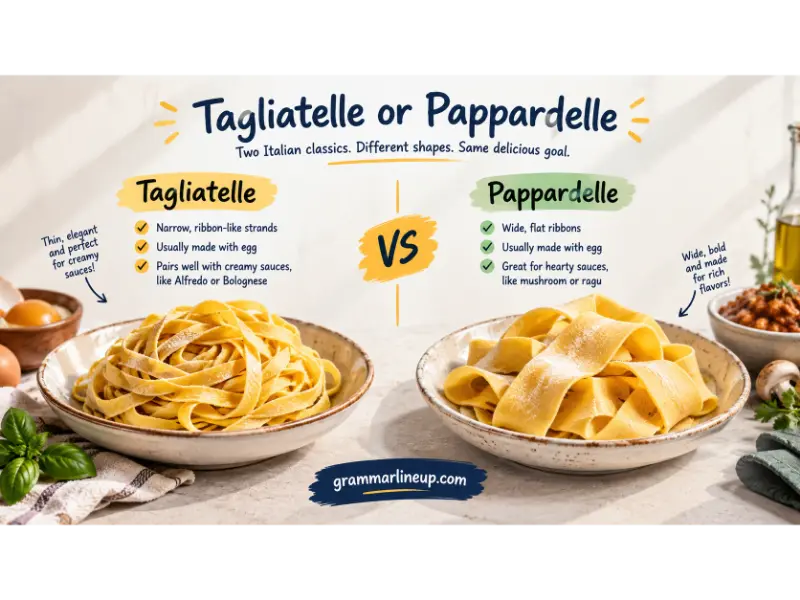
Tagliatelle or pappardelle which one should make its way onto your plate? At first glance, these two Italian pastas can look remarkably similar. Both are long, flat noodles with a satisfying bite and enough surface area to hold a generous amount of sauce. It is easy to see why they are sometimes confused, especially when you are standing in the pasta aisle or choosing a dish from an Italian menu.
The difference, however, is mainly in their width, texture, and traditional uses. Tagliatelle is typically narrower and has a delicate balance between tenderness and chewiness. Pappardelle is noticeably wider, giving it a broader, more substantial feel that pairs especially well with rich, hearty sauces.
So, is one better than the other? Not necessarily. The better choice depends on the sauce, recipe, and kind of pasta experience you want.
In this guide, we will break down the key differences between tagliatelle and pappardelle in simple terms. You will learn how they compare in shape, texture, cooking, and classic pairings, making it easier to choose the right pasta without overthinking dinner.
Featured Snippet Answer
Tagliatelle and pappardelle are both long, flat Italian ribbon pastas, but pappardelle is much wider. Tagliatelle is traditionally associated with Bologna and Emilia-Romagna and is commonly paired with ragù. Pappardelle is associated with Tuscany and is often served with hearty meat, mushroom, or game-based sauces.
Quick Answer: Tagliatelle vs. Pappardelle
The simplest distinction is width.
| Feature | Tagliatelle | Pappardelle |
|---|---|---|
| Shape | Long, flat ribbon | Long, broad, flat ribbon |
| Traditional association | Emilia-Romagna, especially Bologna | Tuscany |
| Width | Bolognese tagliatelle is officially specified at 8 mm cooked | Generally much wider; dimensions vary |
| Classic pairing | Ragù, especially Bolognese-style ragù | Game, meat, mushroom, and other hearty sauces |
| Texture with sauce | Balanced ribbon that carries sauce without being overly broad | Large surface area suited to substantial sauces |
| Typical impression | Refined, medium-width ribbon | Broad, rustic ribbon |
The 8 mm measurement for Bolognese tagliatelle comes from a specification deposited in Bologna in 1972 by the Accademia Italiana della Cucina and the Confraternita del Tortellino. Pappardelle does not have the same universally fixed measurement; its width can vary by region and recipe.
What Is Tagliatelle?
Tagliatelle is a long, flat ribbon pasta traditionally associated with Emilia-Romagna, particularly Bologna.
The name is connected to the Italian verb tagliare, meaning “to cut.” The basic idea is straightforward: pasta dough is rolled into a thin sheet and then cut into long ribbons. The Accademia Italiana della Cucina describes tagliatelle as an egg pasta typical of Emilia that also appears throughout central and northern Italian cooking.
Bolognese tagliatelle has a particularly interesting culinary specification. In 1972, an official reference for its dimensions was deposited at the Bologna Chamber of Commerce. The traditional cooked width was established at 8 millimeters, corresponding to a specific fraction of the height of Bologna’s Torre degli Asinelli.
That measurement refers specifically to the Bolognese tradition, rather than meaning every commercially sold or homemade tagliatelle worldwide must have exactly that width.
What does tagliatelle taste like?
The pasta itself has a mild wheat-and-egg character when made traditionally with egg dough. Its broad but relatively narrow ribbon gives sauces plenty of surface to cling to.
That’s one reason tagliatelle works so naturally with ragù. The shape provides enough surface area for the sauce while remaining considerably narrower than pappardelle.
Common tagliatelle pairings
Tagliatelle can be served with:
- Bolognese-style ragù
- Meat sauces
- Mushroom sauces
- Truffle-based sauces
- Butter and cheese
- Some tomato-based sauces
- Seafood preparations
It isn’t limited to one sauce. The classic association with ragù is simply one of its strongest culinary identities.
What Is Pappardelle?
Pappardelle is another long, flat ribbon pasta, but its defining visual feature is its much greater width.
It is traditionally associated with Tuscany, particularly central Italian cooking. The Accademia Italiana della Cucina’s publication contrasts Tuscan pappardelle with the narrower tagliatelle tradition and notes its association with hearty sauces such as ragù made with game.
Unlike Bolognese tagliatelle, pappardelle does not have one universally accepted width. Sources discussing Italian culinary tradition commonly describe it as substantially wider, with regional and family variations. The Associazione Italiana Food Blogger, for instance, notes widths varying roughly from 2 to 4 centimeters depending on region or family recipe.
Commercial versions can also differ. For example, Barilla lists an egg pappardelle at approximately 13 mm wide, demonstrating why package measurements shouldn’t automatically be treated as a universal definition.
What does pappardelle taste like?
Pappardelle doesn’t necessarily have a completely different flavor from tagliatelle. The major difference is shape and texture, especially when combined with sauce.
Because the ribbon is wider, each bite can carry a generous amount of sauce. That’s particularly useful with chunky, slow-cooked preparations containing meat, mushrooms, or other substantial ingredients.
Common pappardelle pairings
Pappardelle is frequently associated with:
- Wild boar ragù
- Rabbit sauces
- Other game-based ragùs
- Mushroom sauces
- Slow-cooked meat sauces
- Rich tomato-and-meat sauces
- Creamy mushroom preparations
Barilla likewise describes pappardelle as a Tuscan pasta suited to hearty ragùs and creamy sauces.
The Main Difference Between Tagliatelle and Pappardelle
If you remember only one thing, remember this:
Pappardelle is wider than tagliatelle.
Both belong to the family of flat ribbon pastas, and both can be made with egg dough. Their traditional regional identities are also different.
Tagliatelle → Emilia-Romagna → Bologna → narrower ribbon → ragù
Pappardelle → Tuscany → broader ribbon → hearty sauces
That doesn’t mean you can never swap them. Pasta cooking is full of regional variations, and modern recipes regularly use shapes in flexible ways.
The important practical difference is how much surface area the pasta provides for the sauce.
Why Does Pasta Width Matter?
Pasta width isn’t merely decorative.
A wider ribbon can provide more physical surface for sauce and substantial ingredients. That’s particularly noticeable when a sauce contains larger pieces of meat, mushrooms, or other ingredients.
Imagine a slow-cooked wild boar sauce. Its hearty texture naturally suits a broad ribbon that can hold generous amounts of the sauce.
By contrast, a finely textured ragù can work beautifully with tagliatelle because the narrower ribbons offer a good balance between pasta and sauce.
This is why traditional pasta-and-sauce combinations make culinary sense even though they’re not absolute rules.
Tagliatelle or Pappardelle for Bolognese?
For a traditional Bolognese-style presentation, tagliatelle is the more closely associated choice.
The connection between Bologna, tagliatelle, and ragù is deeply established in Italian culinary tradition. The official 1972 Bolognese specification further reinforces tagliatelle’s identity within the city’s food culture.
Pappardelle can still be used with meat sauce, of course. But if your goal is to follow the classic Bolognese tradition as closely as possible, tagliatelle is the relevant pasta shape.
Tagliatelle or Pappardelle for Hearty Meat Sauce?
For a particularly chunky or rustic meat sauce, pappardelle is often a natural fit.
Its broad ribbon gives the dish a substantial bite and works especially well with sauces traditionally associated with Tuscan cooking, including preparations involving wild boar, rabbit, and other game.
That said, sauce preference matters more than rigid rules. If you already have tagliatelle in your kitchen, there is no culinary emergency requiring a trip to the store.
Can You Substitute Pappardelle for Tagliatelle?
Yes, in many recipes.
The substitution will usually change the texture and sauce-to-pasta experience, rather than completely changing the dish.
If a recipe calls for tagliatelle and you use pappardelle:
- Expect a broader bite.
- More sauce may sit across each ribbon.
- Chunky ingredients may feel more prominent.
- Cooking time can vary depending on whether the pasta is fresh or dried and on the manufacturer’s instructions.
Going in the other direction from pappardelle to tagliatelle will give you narrower ribbons and a somewhat lighter pasta presence.
The substitution is generally more straightforward when the sauce is smooth or moderately textured. Extremely chunky sauces may feel more natural with the wider ribbon.
Common Misunderstandings
“They are completely different kinds of pasta.”
Not really. They are closely related ribbon-pasta shapes. The most obvious difference is their width and traditional regional identity.
“Pappardelle is always egg pasta.”
Not necessarily. Traditional fresh pappardelle is often associated with egg pasta, but versions and recipes can vary. Commercial products may also use different dough formulations. Barilla, for example, sells both egg-based pappardelle and other pasta products under its own specifications.
“Every tagliatelle must be exactly 8 mm wide.”
The 8 mm figure is specifically tied to the Bolognese specification deposited in 1972. It shouldn’t be treated as a universal manufacturing rule for every pasta labeled tagliatelle.
“Pappardelle and tagliatelle taste completely different.”
The shape usually makes a greater difference than the basic flavor of the pasta itself. The dough, whether egg-based or not, and the sauce also influence the final dish.
“You can only use each pasta with one sauce.”
Italian culinary traditions provide classic pairings, but they aren’t universal laws. Both shapes can be used with a range of sauces.
Tagliatelle vs. Pappardelle: Which One Should You Use?
Instead of asking which pasta is universally preferable, match the shape to the dish you’re making.
Choose tagliatelle when:
- You want a classic Bolognese association.
- You’re serving a finely textured ragù.
- You prefer a medium-width ribbon.
- You’re making a dish inspired by Emilia-Romagna.
Choose pappardelle when:
- You want a very broad ribbon.
- You’re serving a rustic or chunky sauce.
- You’re making a Tuscan-inspired dish.
- You’re pairing pasta with game, mushrooms, or slow-cooked meat.
If you’re simply deciding what to buy at the supermarket, either can be an excellent choice. The sauce you’re planning is usually the most useful deciding factor.
How to Pronounce Tagliatelle and Pappardelle
Italian pasta names can look intimidating if you’re unfamiliar with Italian spelling.
Tagliatelle contains the Italian gli sound, which doesn’t correspond neatly to an English “g-l” pronunciation.
Pappardelle has four syllables in standard Italian pronunciation, with the stress falling on the third syllable.
If you’re ordering at an Italian restaurant, don’t worry about achieving a perfect accent. Clear pronunciation and confidence will get you much further than trying to perform an elaborate Italian impression.
Origin & Evolution
Both pasta shapes have long histories within Italian culinary culture, but their exact historical development is more complicated than a single invention story.
Tagliatelle is strongly connected to Emilia-Romagna, and historical Italian culinary writing documents related ribbon-pasta terminology well before the modern standardized Bolognese specification. The Accademia Italiana della Cucina also notes considerable variation in names and forms across Italian regions.
Pappardelle is especially associated with Tuscany. The word is commonly connected with the Tuscan verb pappare, relating to eating with appetite or pleasure. Barilla also gives this Tuscan-dialect explanation for the name.
A colorful story sometimes told about tagliatelle connects its invention with Lucrezia Borgia’s wedding and a chef supposedly inspired by her hair. That story is generally treated as a later legend rather than a firmly documented historical origin, so it is better not to present it as established fact.
FAQs:
Is pappardelle thicker than tagliatelle?
Pappardelle is primarily wider, not necessarily thicker. The two are distinguished most clearly by ribbon width. Thickness can vary depending on the recipe, producer, and whether the pasta is fresh or dried.
Is tagliatelle the same as fettuccine?
They are closely related flat ribbon pastas, but traditional Italian naming is regional. Bolognese tagliatelle has its own established dimensions, while fettuccine is particularly associated with Roman and central Italian cooking. Treating the names as perfectly interchangeable can overlook those regional distinctions.
Which is wider, tagliatelle or pappardelle?
Pappardelle is wider. Bolognese tagliatelle has a traditional cooked width of 8 mm, while pappardelle is commonly made considerably broader, although its width varies among recipes and producers.
Is pappardelle good with Bolognese sauce?
Yes. Pappardelle can be served with meat ragù, although tagliatelle has the stronger traditional association with Bolognese ragù and Bologna itself.
What sauce is traditionally served with pappardelle?
Pappardelle is especially associated with hearty Tuscan sauces, including ragùs made with wild boar, rabbit, and other game, as well as mushroom-based preparations.
Can I use pappardelle instead of tagliatelle?
Yes, in many recipes. The finished dish will have a broader, more substantial pasta texture, and the wider ribbons may carry more sauce per bite.
Final Takeaway:
Tagliatelle and pappardelle are close relatives, not competing pasta species. Tagliatelle is the narrower ribbon traditionally associated with Bologna and Emilia-Romagna, while pappardelle is substantially wider and strongly associated with Tuscany.
For classic Bolognese-style ragù, tagliatelle fits the traditional pairing. For rustic Tuscan sauces, particularly hearty meat, game, or mushroom preparations, pappardelle’s broad shape makes natural culinary sense.
The easiest rule to remember is simple: tagliatelle is narrower; pappardelle is wider. Once you know that, choosing between them becomes considerably less complicated and dinner can get back to being the important part.
