
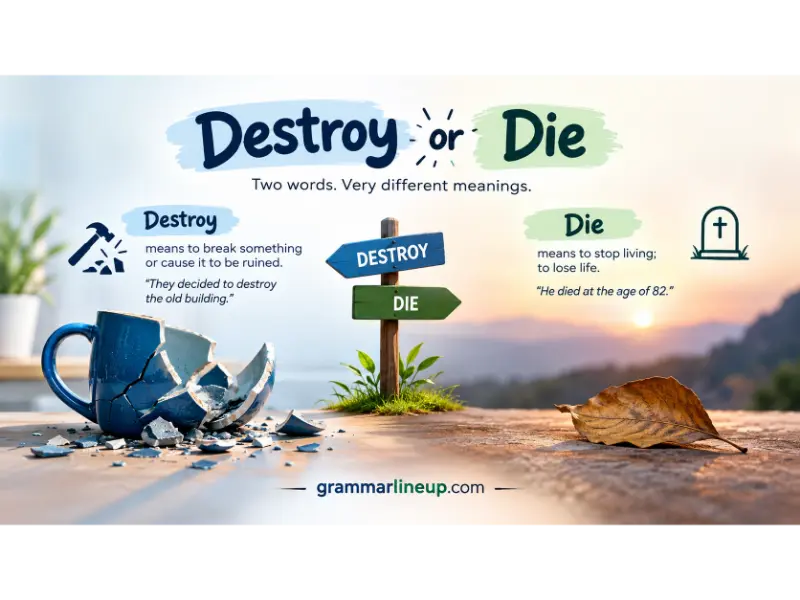
Choosing between destroy or die can be confusing because the two words describe very different actions, even though both can appear in serious or dramatic sentences.
Destroy usually means to damage something so badly that it no longer exists or works, while die means to stop living. The difference seems simple at first, but context can make these words surprisingly easy to mix up.
For example, you might say, “The fire could destroy the building,” but you would say, “The plant may die without water.” One word describes what happens to an object or thing, while the other describes the end of life.
In this guide, we’ll look at the meanings, grammar, common uses, and everyday examples of destroy and die. You’ll also see how their forms change in different sentences and learn a few easy tips to remember which word fits. By the end, choosing between them should feel much more natural.
Quick Answer
“Destroy or die” means facing a situation where the speaker presents two extreme possibilities: completely overcome or destroy something, or suffer defeat, failure, or destruction. In casual conversation, it is usually figurative rather than a literal statement about death. The phrase can communicate determination, urgency, aggression, or an all-or-nothing attitude.
What Does “Destroy or Die” Mean?
The phrase “destroy or die” combines two very strong verbs.
Destroy generally means to damage something so severely that it no longer exists, works, or can be used. It can also be used figuratively for ruining someone’s confidence, reputation, plans, or chances. Oxford also records an informal sense of destroy meaning to defeat someone completely.
Die normally means to stop living, but English frequently uses death-related language figuratively. In a phrase like “destroy or die,” the word can therefore suggest complete failure, defeat, or the loss of an opportunity rather than literal death.
Put together, “destroy or die” creates an extreme either-or message:
Overcome the challenge completely, or suffer the consequences.
For example, someone facing a major competition might say:
“It’s destroy or die tonight.”
They may simply mean, “We have to give this everything we’ve got.”
That does not automatically mean the person is talking about actual violence or death. Context determines how seriously the phrase should be interpreted.
Is “Destroy or Die” Slang?
Not in the same clear sense as established internet slang such as LOL, BRB, or IDK.
There is no strong evidence that “destroy or die” has one standardized slang definition used consistently across texting and social media. Search results show the wording being used as a title, a brand phrase, and in other specialized contexts rather than pointing to one universally accepted slang meaning.
So if someone sends you:
“Destroy or die 🔥”
the safest interpretation is based on the surrounding conversation. They could be expressing:
- intense determination
- competitive energy
- an all-or-nothing mindset
- dramatic humor
- a desire to completely defeat a challenge
- a literal meaning in a genuinely dangerous context
This is one reason short phrases can be tricky in online communication.
Meaning by Context
The same words can sound very different depending on where they appear.
| Context | Likely meaning |
|---|---|
| Gaming | Completely defeat the opponent or lose |
| Sports | Give maximum effort and fight to win |
| Work or competition | Succeed decisively or face failure |
| Motivation | Never give up; overcome the obstacle |
| Humor | Dramatic way of saying “go all out” |
| Fiction | May describe an actual life-or-death conflict |
| Violent situation | Could have a literal meaning and should not be treated casually |
In gaming
A player might say:
“Destroy or die. One more round.”
Here, the phrase is probably dramatic competitive language. “Die” may refer to losing the game or character rather than the speaker’s real-life safety.
In sports
A coach, athlete, or fan could use it to express extreme competitive intensity:
“Destroy or die we need this win.”
In this context, it usually means win decisively or accept defeat, rather than literally die.
In everyday motivation
Someone might use the phrase metaphorically:
“Destroy your doubts or die trying.”
The intended idea may be to overcome fear, hesitation, or self-doubt at any cost.
However, this wording is deliberately dramatic and can sound aggressive, so it is not appropriate for every audience.
Origin & Evolution
There is no reliably documented single origin for the exact phrase “destroy or die” as modern slang that would justify claiming one person, community, or date invented it.
The individual words are much older.
Oxford traces destroy through Middle English and Old French to Latin destruere, associated with undoing or taking apart what has been built.
The broader English language has also long used paired expressions built around survival, defeat, destruction, and death. Similar constructions can become slogans because their short structure makes them memorable.
A related example is “skate or die,” a phrase associated with skateboarding culture and discussed in modern writing about the skateboarding mindset.
That does not mean “destroy or die” directly came from “skate or die.” It simply shows why “X or die” constructions can work rhetorically: they compress a strong commitment into a short, memorable phrase.
A separate historical use of the exact wording appears in the 1971 book Destroy or Die: The True Story of Mylai by Martin Gershen. This is evidence that the wording has been used as a title, but it should not be treated as proof of a modern slang origin.
How to Use “Destroy or Die” in Texts and Chats
When used casually, the phrase works best when the surrounding context makes the figurative meaning obvious.
Casual conversation
“Final exam tomorrow. Destroy or die.”
Meaning: I need to do extremely well or I’m in serious trouble.
Gaming chat
“Last match. Destroy or die.”
Meaning: This is the decisive match, so we need to win.
Competitive situation
“We came this far. Destroy or die.”
Meaning: We are going all in and refusing to back down.
Social media caption
“New goal. Destroy or die.”
This can communicate an intense, dramatic, highly determined attitude.
Humorous use
“The deadline is in two hours. Destroy or die 😂”
Here, the emoji and context make it clear that the speaker is exaggerating for humor.
The phrase becomes easier to understand when the message gives readers a clear clue about what is being destroyed and what “die” represents.
Real Conversation Examples
Conversation 1: Gaming
Alex: “Ready for the final round?”
Jordan: “Yep. Destroy or die.”
Meaning: Jordan is saying they intend to give the final round everything they have.
Conversation 2: Studying
Mia: “How’s the exam prep going?”
Sam: “Honestly? Destroy or die tomorrow.”
Meaning: Sam is exaggerating to say the exam feels extremely important.
Conversation 3: Business competition
Alex: “The other company just launched a similar product.”
Jordan: “Then we need to step up.”
Alex: “Exactly. Destroy or die.”
Meaning: The phrase expresses intense competitive determination.
Conversation 4: Clearly dramatic
Mia: “You finished the presentation?”
Sam: “Not yet. I have three hours.”
Mia: “You got this.”
Sam: “Destroy or die 😂”
Meaning: Sam is jokingly describing the pressure of finishing the presentation.
When “Destroy or Die” Means Something Figurative
The phrase is often easier to understand as figurative language.
English speakers commonly use words associated with physical destruction or death to describe non-physical situations.
For instance:
- “That mistake destroyed my chances.”
- “The team destroyed its competition.”
- “I’m dying of embarrassment.”
- “This deadline is killing me.”
These statements do not necessarily describe literal physical events.
Likewise, “destroy or die” can frame failure as if it were destruction or death. The purpose is usually emphasis.
The phrase may therefore communicate:
“Win or lose.”
“Overcome the problem or fail.”
“Give everything you have.”
“There is no middle ground.”
The exact interpretation depends on the situation.
When to Use It
“Destroy or die” can work in informal settings where dramatic language is expected.
It may fit:
- gaming conversations
- sports banter
- fictional dialogue
- motivational captions
- joking conversations between friends
- highly competitive situations
- creative writing
It is especially effective when you intentionally want an intense or exaggerated tone.
For example:
“Final boss tonight. Destroy or die.”
That sounds like gaming or playful competition.
By contrast, using the same phrase in a serious professional email would probably sound unnecessarily aggressive.
When NOT to Use It
Avoid the phrase when the audience could reasonably interpret “die” literally or when the situation requires careful, neutral language.
For example, it is generally unsuitable for:
- professional business emails
- formal academic writing
- sensitive conversations about death
- messages to people who may not understand the intended exaggeration
- situations involving real threats or violence
Consider the difference:
Casual:
“Destroy or die! Let’s win this game.”
Professional:
“We need to perform at our best and meet the deadline.”
The second version communicates determination without the extreme wording.
If there is any possibility that someone might interpret the phrase as a genuine threat, choose clearer language.
Common Misunderstandings
It does not always mean literal death
In casual speech, “die” can be exaggeration. A gamer saying “destroy or die” is usually not announcing an actual life-or-death situation.
It is not a universal texting abbreviation
Unlike common abbreviations such as LOL or IMO, “destroy or die” is a full phrase rather than a standardized acronym or abbreviation.
It does not have one fixed slang definition
Different communities may use the phrase differently. A gaming community, a sports fan, and a writer may each give it a slightly different tone.
“Destroy” does not always mean physical destruction
English uses destroy metaphorically for things such as confidence, hopes, plans, reputations, and opponents. Oxford specifically records figurative and informal uses involving ruining someone’s life or defeating someone completely.
Tone matters
Without context, the phrase can sound aggressive. In a meme or gaming chat, it might be playful. In a real-world conflict, the same words could sound threatening.
Similar Slang & Alternatives
If you want the same general idea without such an extreme tone, several alternatives can work.
| Phrase | General idea | Tone |
|---|---|---|
| Go all out | Give maximum effort | Energetic |
| Give it everything | Try your hardest | Encouraging |
| Do or die | A situation feels extremely important | Dramatic |
| All or nothing | No middle ground | Neutral to intense |
| Win or lose | Accept either outcome | Neutral |
| Fight to the end | Keep trying until the finish | Strong |
| No backing down | Refuse to quit | Determined |
| Go big or go home | Take a bold approach | Playful |
“Do or die” is particularly close in structure, but it has its own established usage and can also be figurative.
If you want a less aggressive expression, “go all out” or “give it everything” is usually clearer.
Is “Destroy or Die” Positive or Negative?
It depends on the context.
The phrase can have a positive motivational intention when someone uses it to express determination:
“I’m going to destroy every obstacle in my way.”
But the wording itself is intense and aggressive.
It can also have a negative interpretation if it is directed at a person as a threat:
“Destroy or die.”
Without additional context, it is difficult to know which interpretation is intended.
That is why tone, relationship, setting, and surrounding messages matter more than the words alone.
FAQs:
What does “destroy or die” mean in texting?
In texting, it usually expresses an all-or-nothing attitude: completely overcome a challenge or face defeat. It is often figurative and dramatic rather than a literal statement about death.
Is “destroy or die” a slang phrase?
It can be used informally, but it is not a standardized texting slang term with one universally accepted definition. Its meaning depends heavily on context.
Is “destroy or die” a threat?
Not necessarily. In gaming, sports, memes, or casual conversation, it may simply be exaggerated language. However, in a real-world conflict, the same wording could sound threatening, so context is important.
What does “destroy” mean in slang?
Informally, destroy can mean to defeat someone completely or perform extremely well against them. Oxford lists an informal sense in which someone can “destroy” another person by defeating them completely.
What is a less aggressive alternative to “destroy or die”?
Try “go all out,” “give it everything,” “all or nothing,” or “fight to the end.” These expressions can communicate determination without directly invoking destruction or death.
Does “die” always mean literal death in English?
No. English frequently uses die and death-related expressions figuratively. The intended meaning can range from literal death to failure, embarrassment, exhaustion, or an exaggerated emotional reaction.
Conclusion:
The most important thing to remember about “destroy or die” is that context controls the meaning. The individual words are strong, but the complete phrase can range from playful competitive language to a genuinely serious statement.
If you encounter it in a text, caption, game, song, story, or conversation, look at the surrounding words before assuming it is literal. In most casual contexts, the phrase communicates extreme determination, competition, or an all-or-nothing mindset rather than an actual intention involving death.
